Sumiyoshi Taisha guide
Osaka: Osaka castle temple shrine walking tour
What makes Sumiyoshi Taisha different from other Osaka shrines?
Sumiyoshi Taisha, founded according to tradition in 211, is one of Japan's oldest shrines and uses Sumiyoshi-zukuri, an architectural style that predates Buddhist influence on Japanese shrine design. Entry to the grounds is free, and it's the head shrine of roughly 2,300 Sumiyoshi shrines nationwide.
While Kyoto and Nara absorb most of the region’s temple-and-shrine attention, Osaka has its own claim to religious history in Sumiyoshi Taisha — a shrine old enough, and architecturally distinct enough, that it predates the Buddhist-influenced building styles seen almost everywhere else in Japan. It draws over two million visitors during hatsumode (New Year’s shrine visits) alone, making it one of Kansai’s most-visited shrines by locals even as it stays relatively overlooked by international travelers focused on Kyoto.
| Where | Sumiyoshi ward, south of central Osaka |
| Admission | Free |
| Getting there | Nankai Sumiyoshi Taisha Station, or Hankai Tramway |
| Time needed | 45 minutes to an hour |
| Best time | Weekday mornings (avoid New Year’s) |
What Sumiyoshi Taisha actually is
Founded, according to shrine tradition, in the year 211, Sumiyoshi Taisha is among Japan’s oldest shrines and serves as the head shrine of a network of roughly 2,300 Sumiyoshi shrines across the country. Its four main sanctuaries (honden) are built in a style called Sumiyoshi-zukuri, characterized by a straight-lined gabled roof and an architectural layout that predates the curved rooflines and design conventions later introduced through Buddhist temple architecture — making it a genuinely distinct visual reference point for visitors who’ve spent a few days looking at Kyoto’s Buddhist-influenced temples.
The shrine is dedicated to three sea deities collectively known as the Sumiyoshi Okami, plus Empress Jingu, and functions as the patron shrine of sailors, sea travel, and — somewhat unusually — poetry, tied to its historical role in Japan’s classical literary tradition.
The Sorihashi drum bridge
The shrine’s most photographed feature is the Sorihashi, an arched vermilion drum bridge crossing a pond near the main entrance, steep enough that crossing it (particularly the wooden version, now largely a photo stop with a safer paved path alongside) feels closer to climbing than walking. The bridge’s reflection in the water below is a popular photo composition, especially with the vermilion color against green surroundings in spring and summer.
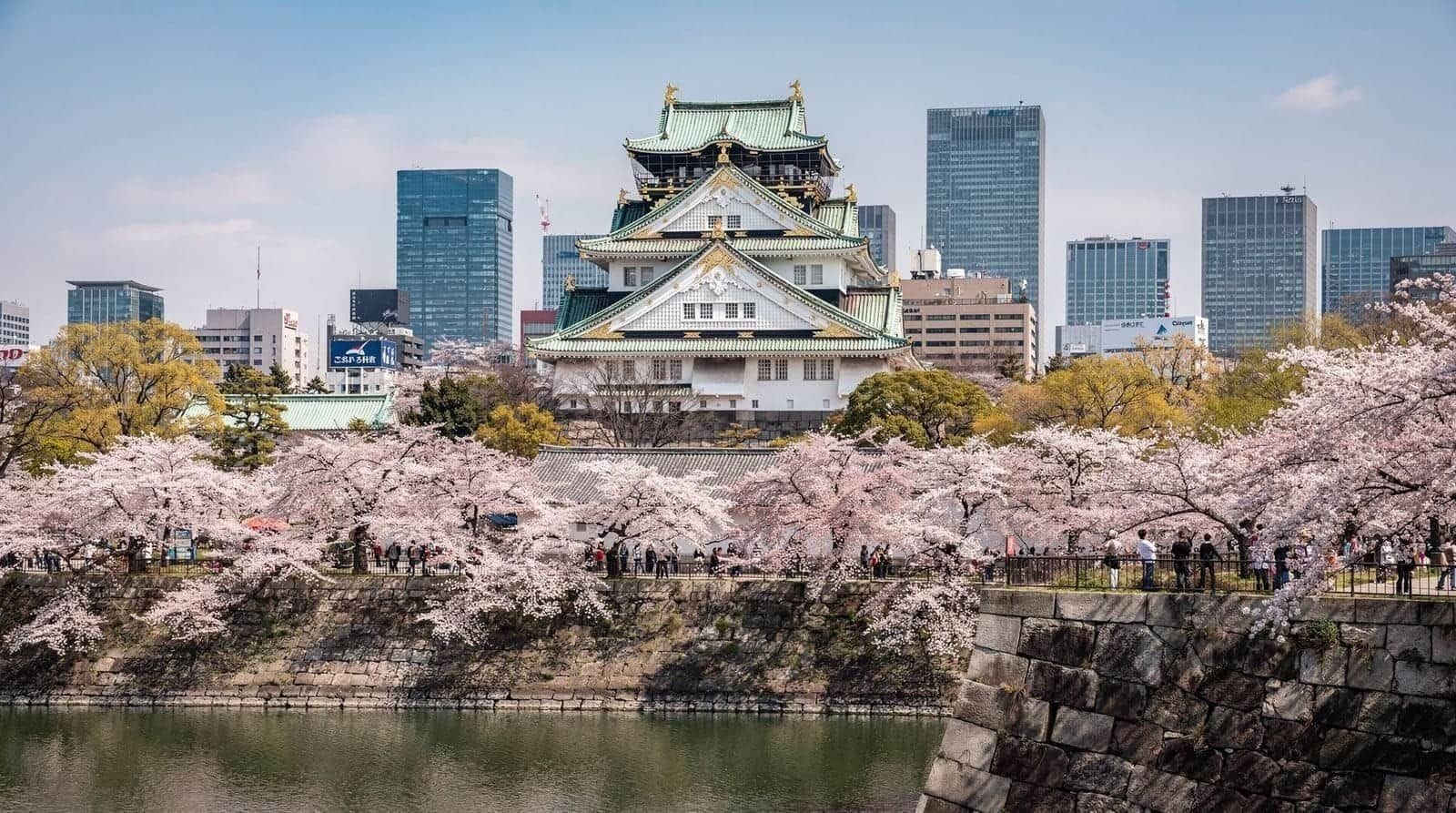
Osaka castle, temple, and shrine walking tour includes Sumiyoshi-style shrine architecture as part of a broader half-day walking route through Osaka’s historic sites.
Getting there
Sumiyoshi Taisha sits in Sumiyoshi ward, south of central Osaka, reached most directly via Nankai Sumiyoshi Taisha Station on the Nankai Main Line, a short walk from the shrine entrance. An alternative, slower but distinctive route is the Hankai Tramway (Hankai Line), Osaka’s last surviving streetcar line, which stops directly at Sumiyoshi-torii-mae — worth taking at least one direction for travelers who enjoy retro transit as part of the sightseeing itself rather than purely a means of getting somewhere.
Admission and visiting
Entry to the shrine grounds is free, with no ticket or gate fee for walking through the main approach, crossing the Sorihashi bridge, or viewing the four honden sanctuaries from outside. Most visits take 45 minutes to an hour at a relaxed pace, making Sumiyoshi Taisha a comfortable half-day add-on rather than a full-day commitment, and it pairs reasonably well with a broader look at Osaka’s temple and shrine sites beyond the city’s more famous castle and Dotonbori districts.
New Year’s crowds
Sumiyoshi Taisha is consistently ranked among the most-visited hatsumode (New Year’s first shrine visit) destinations in the Kansai region, drawing crowds well over two million across the first few days of January. Travelers visiting outside this window will find a far calmer, more contemplative shrine experience; those specifically curious about hatsumode culture and happening to be in Osaka in early January may find the crowds themselves part of the experience, though patience and crowd tolerance are required.
Comparing Sumiyoshi Taisha to Osaka’s other temples
Sumiyoshi Taisha’s Shinto shrine architecture contrasts directly with Shitenno-ji, Osaka’s oldest Buddhist temple, founded in 593 by Prince Shotoku and often cited as the oldest officially administered Buddhist temple in Japan — the two sites together give a useful before-and-after picture of how Buddhist influence reshaped Japanese religious architecture after its introduction from the continent.
Shitenno-ji private tour covers that architectural contrast directly, useful for travelers visiting both shrines in the same trip.
Isshinji, a short distance from Shitenno-ji, adds a stranger footnote to Osaka’s religious sites — a temple known for its Buddha statues made partly from the compressed cremated ashes of former worshippers, a practice unique to this particular temple rather than standard Buddhist custom.
Shitenno-ji and Isshin-ji bone Buddha combined tour pairs both temples into a single guided route for visitors curious about Osaka’s less-covered religious history.
The shrine’s connection to poetry and the sea
Sumiyoshi Taisha’s patronage of poetry stems from its historical role in Japan’s classical waka poetry tradition — the shrine and its pine-lined grounds appear repeatedly in the Man’yoshu and later imperial poetry anthologies as a symbol of safe travel and natural beauty, and the shrine’s association with sea travel made it a common stop for envoys and sailors departing for the Asian continent during the Nara and Heian periods, when Sumiyoshi’s coastline sat much closer to the shrine than it does today after centuries of land reclamation shifted Osaka Bay’s shoreline further out.
Sumiyoshi Matsuri and other festivals
Beyond hatsumode, Sumiyoshi Taisha holds its major annual festival, Sumiyoshi Matsuri, at the end of July (typically around July 30-August 1), featuring a large purification ritual and a mikoshi (portable shrine) procession that crosses the Yamato River — one of Osaka’s older and more traditional summer festivals, though it draws considerably fewer international visitors than the food-and-fireworks festivals more commonly associated with Osaka summer.
The shrine’s precinct and lesser-known features
Within the wider shrine precincts, a smaller sub-shrine called Ikukunitama-jinja and several minor auxiliary shrines dot the grounds, tied to specific local deities and often overlooked by visitors who head straight from the main torii to the Sorihashi bridge and back. A stone monument garden near the precinct edge, donated by various trade guilds and companies over centuries, gives a sense of the shrine’s continued relevance to Osaka’s business community, mirroring Fushimi Inari’s donation culture in Kyoto, albeit expressed through stone monuments rather than gates.
Practical visiting details
There’s no strict dress code beyond ordinary modest clothing, and photography is permitted throughout the public grounds except inside specific inner sanctuary buildings where signage indicates restrictions. Restrooms and a small shrine shop selling omamori (protective amulets, particularly popular here given the shrine’s maritime and safe-travel associations) and goshuin shrine stamps sit near the main entrance. The grounds are wheelchair-accessible along the main paved paths, though the arched Sorihashi bridge itself is steep enough that using the flatter side path rather than the bridge’s curved center is the practical option for visitors with mobility limitations.
Sumiyoshi-zukuri architecture in more detail
The Sumiyoshi-zukuri style used across all four honden is characterized by a straight, gabled roofline without the curved eaves found in later Buddhist-influenced shrine and temple architecture, a rectangular building footprint with the entrance on the gabled end rather than the long side (a layout called tsuma-iri), and an absence of the more elaborate decorative brackets that appear in later Japanese religious buildings. Along with Ise Grand Shrine’s Shinmei-zukuri and Izumo Taisha’s Taisha-zukuri, Sumiyoshi-zukuri is considered one of the three original, pre-Buddhist shrine architectural styles in Japan, making the four honden here a genuine architectural reference point rather than simply an old building.
The area around the shrine
Sumiyoshi ward, where the shrine sits, is a quieter, more residential part of Osaka than the tourist-heavy Namba or Umeda districts, and the immediate area around the shrine includes small local restaurants and shops catering more to neighborhood residents and shrine visitors than international tourists — a genuinely different atmosphere from central Osaka’s dense entertainment districts, worth experiencing for travelers curious about ordinary residential Osaka rather than only its most commercialized tourist zones.
Seasonal events beyond hatsumode and Sumiyoshi Matsuri
Beyond the two major annual events, Sumiyoshi Taisha holds a seasonal planting ritual in June (Otaue Shinji), in which participants in traditional dress plant rice seedlings in a small sacred paddy on the shrine grounds as a fertility and harvest ritual, accompanied by traditional music and dance — a smaller, more folk-ritual-oriented event than the shrine’s larger festivals, drawing mostly local participants and a modest number of curious visitors rather than large crowds.
Sumiyoshi Taisha’s relationship to Osaka’s port history
Osaka’s identity as a major port and trading city stretches back further than most visitors assume, and Sumiyoshi Taisha’s patronage of sea travel connects directly to this history — the shrine was historically a mandatory stop for official delegations and trade missions departing for the Asian continent during the Nara and Heian periods, when Osaka Bay (then much closer to the shrine before centuries of land reclamation pushed the coastline outward) served as Japan’s primary gateway westward.
Sailors and merchants continued visiting the shrine for safe-travel blessings well into the modern era, and vestiges of this maritime association remain visible in the shrine’s ongoing symbolism, even though the actual coastline has receded several kilometers from the original shrine grounds.
Comparing Sumiyoshi-zukuri to Ise and Izumo
Of Japan’s three original pre-Buddhist shrine architectural styles, Ise Grand Shrine’s Shinmei-zukuri is by far the most famous internationally, owing to Ise’s status as the spiritual home of the imperial family’s ancestral deity, while Izumo Taisha’s Taisha-zukuri and Sumiyoshi’s own Sumiyoshi-zukuri receive considerably less international attention despite comparable historical and architectural significance. Visitors who’ve previously seen Ise or Izumo will notice genuine structural similarities at Sumiyoshi Taisha — the raised floor construction, the straight roofline, the absence of later ornamental additions — a useful comparison point for anyone building a broader interest in Japan’s oldest shrine architecture across a longer trip.
Visiting Sumiyoshi Taisha outside New Year’s
For the vast majority of the calendar year outside the crowded first days of January, Sumiyoshi Taisha offers one of the calmest, least crowded major shrine experiences in the Kansai region, a genuine contrast to the sometimes overwhelming crowds at Kyoto’s most famous sights. Weekday mornings in particular tend to be close to empty beyond a handful of local worshippers going about ordinary devotional visits, making it a reasonable choice for travelers specifically seeking a contemplative, unhurried shrine experience without needing to arrive at dawn to avoid crowds, unlike almost every other major site covered across this site’s temple and shrine guides.
Sumiyoshi Taisha’s role in wedding and family ceremonies
Beyond tourism and hatsumode, Sumiyoshi Taisha remains a popular venue for traditional Shinto weddings and Shichi-Go-San, a rite-of-passage ceremony for children aged three, five, and seven celebrated each November, when families dress children in formal kimono and visit a shrine to pray for their health and growth. Visitors touring in mid-November may encounter families conducting this ceremony on the shrine grounds, offering a genuine, unstaged glimpse of ordinary Japanese religious and family life alongside the shrine’s historical architecture.
Sumiyoshi Taisha versus Fushimi Inari: two different Shinto experiences
Both shrines represent Shinto tradition, but the contrast is instructive for visitors trying to understand the religion’s range: Fushimi Inari’s thousands of donated torii gates express devotion through repeated, cumulative physical offering on a mountain pilgrimage route, while Sumiyoshi Taisha’s four unified honden buildings express an older, more architecturally restrained style of worship centered on a fixed built environment rather than an ever-expanding donated structure. Visiting both within the same trip, even though they sit in different cities, gives a genuinely broader sense of Shinto shrine architecture’s range than either site alone.
The shrine’s ongoing role in Osaka’s sumo tradition
Sumiyoshi Taisha has a lesser-known historical connection to sumo wrestling — the shrine grounds have hosted ceremonial sumo matches (Sumiyoshi Sumo Festival) tied to harvest and purification rituals since at least the Edo period, a tradition still occasionally observed today on specific ceremonial occasions, distinct from professional sumo tournaments held elsewhere in Osaka. This connection reflects sumo’s own origins as a Shinto ritual practice rather than purely a modern competitive sport, a detail that adds useful context for visitors who’ve also attended or plan to attend Osaka’s professional sumo tournament (held each March at Edion Arena Osaka) during the same trip.
Sumiyoshi Taisha’s influence on shrine architecture nationwide
As the head shrine of roughly 2,300 Sumiyoshi shrines distributed across Japan, this Osaka site holds an outsized architectural influence relative to its modest international visitor numbers — regional Sumiyoshi shrines, even those built centuries later and far from Osaka, generally follow design cues traceable back to this original complex’s Sumiyoshi-zukuri style, making a visit here genuinely useful context for travelers who may encounter smaller Sumiyoshi-affiliated shrines elsewhere in Japan during a longer trip and want to understand their architectural lineage.
A last practical tip
Weekday mornings offer the calmest visit outside the New Year period, and pairing the shrine with an early lunch at one of the small local restaurants near Sumiyoshi-torii-mae rounds out a genuinely relaxed half-day away from the busier parts of central Osaka.
Combining a Sumiyoshi Taisha visit with Osaka’s coastline
Given the shrine’s historical ties to sea travel and its original proximity to a coastline that has since receded through land reclamation, some visitors extend a Sumiyoshi Taisha trip toward Osaka’s modern bay area — Osaka Bay’s harbor district and aquarium sit a further transit connection away, offering a loose thematic pairing between the shrine’s maritime patronage and the city’s present-day waterfront, though the two areas require separate trips rather than a single combined walk given the distance and land reclamation between them.
Combining Sumiyoshi Taisha with nearby neighborhoods
Beyond the shrine itself, the surrounding Sumiyoshi district offers a genuine slice of ordinary residential Osaka life, with small local eateries, an old-fashioned shopping street near Sumiyoshi-torii-mae tram stop, and considerably fewer English menus or tourist-oriented services than central Osaka — a worthwhile contrast for travelers wanting to see how most Osaka residents actually live day to day, distinct from the curated tourist experience of Dotonbori or Umeda.
A closing note on visiting with realistic expectations
Sumiyoshi Taisha won’t deliver the singular visual spectacle of Fushimi Inari’s gate tunnels or Kinkaku-ji’s gold-and-water reflection, and visitors expecting an equivalent “wow” moment on the same scale may come away underwhelmed. Its value lies instead in genuine historical depth, architectural distinctiveness, and the simple fact of experiencing a significant Shinto site without competing for space with tour groups — a different, quieter kind of reward that suits travelers already comfortable adjusting their expectations away from Instagram-driven sightseeing checklists toward a more historically grounded, unhurried visit.
Comparing a visit by season
| Time | Crowds | What to expect |
|---|---|---|
| First days of January | Very heavy | Hatsumode crowds, over 2 million visitors citywide |
| Late July (Sumiyoshi Matsuri) | Moderate | Purification ritual, mikoshi procession |
| June (Otaue Shinji) | Low | Rice-planting ritual, small local crowd |
| Weekday mornings, rest of year | Very light | Near-empty, contemplative visit |
| Mid-November | Light-moderate | Possible Shichi-Go-San family ceremonies |
Photography tips at Sumiyoshi Taisha
The Sorihashi bridge photographs best from the pond-side angle rather than directly on the bridge itself, since the steep arch and its vermilion reflection in the water together make the more compelling composition — mid-morning light, before crowds build even on a busy day, generally gives the clearest, least crowded shot. The straight-lined honden roofs photograph well from an angled three-quarter view that shows both the gabled roofline and the tsuma-iri entrance layout, a more informative composition for anyone documenting the Sumiyoshi-zukuri style specifically rather than a generic shrine snapshot.
What to combine a visit with, realistically
Sumiyoshi Taisha’s 45-minute-to-an-hour visit length makes it a natural half-day pairing rather than a standalone destination — the Osaka temples and shrines overview covers several other under-visited religious sites in the city worth combining with Sumiyoshi Taisha into a single dedicated temple-and-shrine day, an approach that suits travelers who’ve already covered Osaka Castle and Dotonbori on previous days and want a quieter, less commercial side of the city.
A fuller look at Osaka and Kansai’s temples and shrines
Sumiyoshi Taisha is one piece of a broader, often underrated collection of religious sites in Osaka that get far less attention than Kyoto’s temple circuit, covered in fuller depth in the Osaka temples and shrines overview. Travelers comparing Sumiyoshi Taisha’s Shinto architecture to Kyoto’s shrines will find a useful reference point in the Fushimi Inari guide, and those curious how Osaka’s oldest sites stack up against Kyoto’s most famous temples can check the best temples in Kyoto guide.
For visitors basing themselves in Osaka and building a day around the castle area or Shinsekai and Tennoji, Sumiyoshi Taisha fits naturally as a half-day extension south of the city center, and those wanting a full temple-and-shrine-focused day might combine it with the central Kyoto sites on a separate day rather than trying to cover both cities’ religious sites at once.
Frequently asked questions about Osaka
Is Sumiyoshi Taisha worth visiting if I’ve already seen Fushimi Inari?
Yes, for a different reason — Fushimi Inari’s appeal is visual spectacle (thousands of gates), while Sumiyoshi Taisha’s appeal is architectural history and a genuinely calm, uncrowded shrine experience outside the New Year period.
How long should I budget for a Sumiyoshi Taisha visit?
45 minutes to an hour at a relaxed pace covers the main approach, the Sorihashi bridge, and the four honden sanctuaries — treat it as a half-day add-on alongside other Osaka sights rather than a standalone destination.
Top experiences
Bookable activities with verified prices and instant confirmation on GetYourGuide.