Kasuga Taisha guide
Nara: Nara Kasuga Taisha sacred deer shrine
Duration: 1.5 hours
What is Kasuga Taisha known for?
Kasuga Taisha is a Shinto shrine in Nara Park known for roughly 3,000 stone and bronze lanterns lining its forest approach and shrine buildings, donated over centuries by worshippers. The outer grounds are free; the inner sanctuary near the vermilion main hall costs ¥500 to enter.
Roughly 3,000 stone and bronze lanterns, donated by worshippers across more than a thousand years, line the forested approach and shrine buildings of Kasuga Taisha, making it one of the most visually distinctive Shinto shrines in the Kansai region — and one that gets noticeably less attention from first-time visitors than Todai-ji, its neighbor a short walk away in Nara Park.
| Where | Nara Park, 1.2km east of Todai-ji |
| Cost | Free grounds; ¥500 inner sanctuary |
| Time needed | 45 min-1 hour |
| Getting there | On foot from Todai-ji through Nara Park (15-20 min) |
| Best time | Early morning or dusk; Mantoro festivals (early Feb, mid-Aug) for lit lanterns |
What Kasuga Taisha actually is
Founded in 768 as the tutelary shrine of the powerful Fujiwara clan, Kasuga Taisha was built in the distinctive Kasuga-zukuri architectural style, characterized by its vermilion-lacquered wood and gabled roofline, and it remains the head shrine of a network of roughly 3,000 Kasuga shrines across Japan. According to shrine tradition, the deity Takemikazuchi arrived at the site riding a white deer — the origin of the sacred status Nara’s deer still hold today, and the reason feeding or approaching deer near this shrine carries slightly more cultural weight than doing so elsewhere in the park.
The lanterns
The roughly 2,000 stone lanterns lining the forest path and the roughly 1,000 bronze lanterns hanging from the shrine buildings themselves were donated by worshippers over centuries as offerings, and no two are quite identical — some bear moss and weathering from age, others look freshly maintained. Twice a year, during the Setsubun festival in early February and the Obon season in mid-August, the shrine holds Mantoro, a lantern-lighting ceremony in which every one of the roughly 3,000 lanterns is lit simultaneously, transforming the forest approach into a genuinely rare sight — worth checking travel dates against if a trip happens to align with either window.
Kasuga Taisha guided tour covers the lantern donation tradition and the shrine’s Fujiwara clan history, both of which have minimal English signage on site.
Admission and what’s free
The forested approach and the exterior of the main shrine buildings are free to walk through at any time. Entering the inner sanctuary area near the main vermilion halls, where the closest lantern displays and the shrine’s inner buildings sit, costs ¥500. Most visitors spend 45 minutes to an hour walking the lantern-lined paths and viewing the shrine buildings, making it a comfortable add-on to a Todai-ji visit rather than a separate half-day commitment.
Getting there from Todai-ji
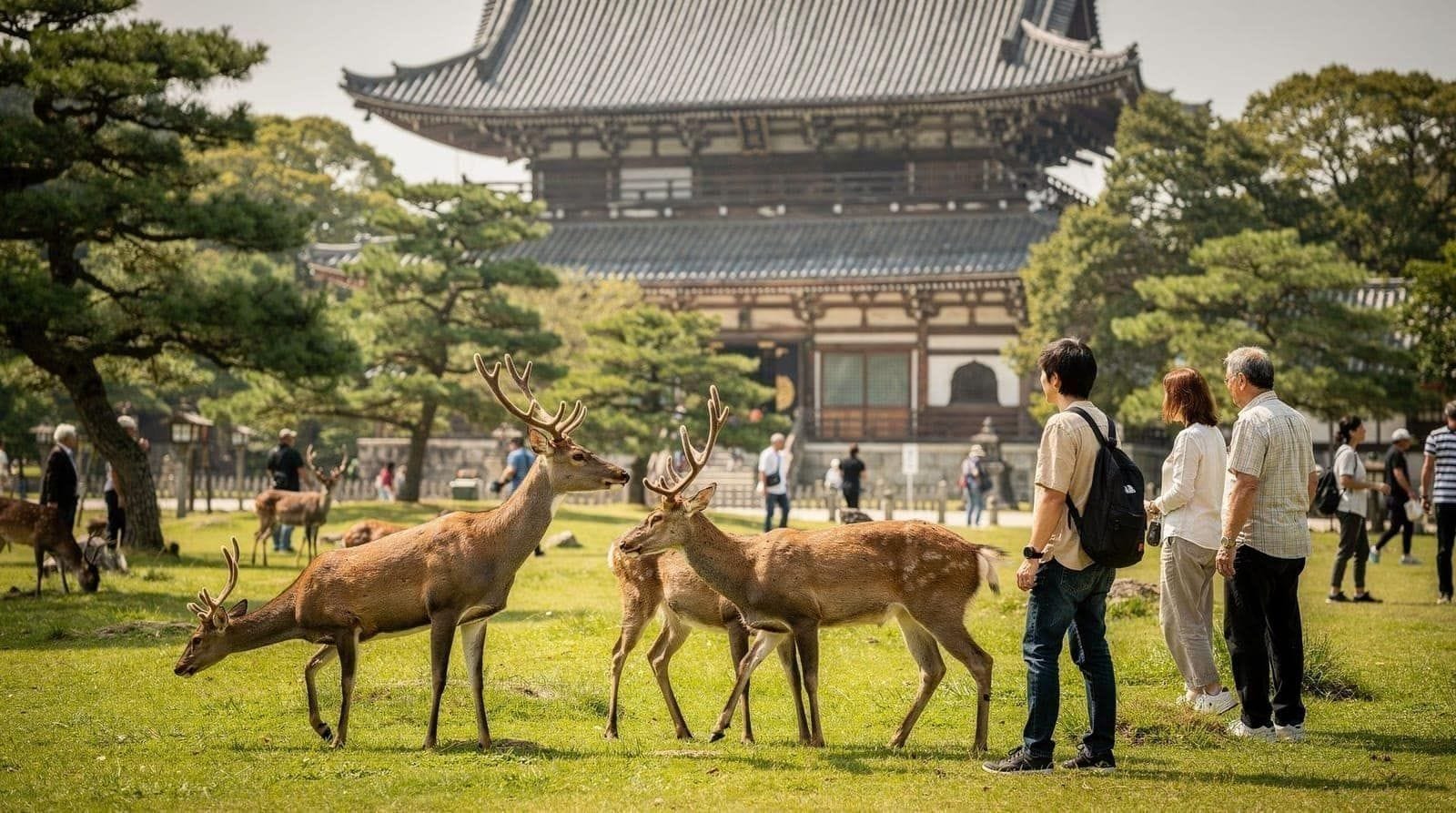
Kasuga Taisha sits roughly 1.2 kilometers east of Todai-ji, reached by a pleasant forest walk through Nara Park rather than a separate train or bus connection. The path passes more of the park’s sika deer, considered messengers of Kasuga’s deity, and a handful of smaller sub-shrines tucked into the forest. Combining the two sights into one visit is the standard approach for most Nara day trips from Osaka or Kyoto.
Combined Todai-ji, Kasuga Taisha, and Nara Park guided tour bundles both shrines and the deer park into a single route, useful for travelers who’d rather not navigate the forest paths without a map.
Deer etiquette near a sacred shrine
Because Kasuga Taisha’s founding myth ties directly to a deer messenger, deer here are treated with slightly more reverence by locals than the crowd-pleasing bowing deer near Todai-ji’s entrance, even though the animals themselves move freely between both areas. The same basic rules apply throughout the park: hold shika senbei crackers (about ¥200 a stack from nearby vendors) firmly and hand them over promptly, avoid teasing or waving food to provoke a reaction, and expect the occasional nose through a bag or pocket if a deer smells food and isn’t offered any.
Nara deer, temple, and tea ceremony walking tour pairs a Kasuga Taisha and deer park visit with a tea ceremony experience, a reasonable way to add a cultural activity to an otherwise sightseeing-focused day.
Seasonal timing
Beyond the twice-yearly Mantoro lantern festivals, Kasuga Taisha’s forest setting makes it a genuinely appealing autumn foliage spot, with maple color typically peaking in mid-to-late November alongside the rest of Nara Park. Spring cherry blossoms are less concentrated here than at dedicated viewing spots elsewhere in Nara, but the shrine’s greenery and lantern-lined paths photograph well in most seasons, including a light dusting of winter frost on the stone lanterns in January.
The shrine buildings themselves
Kasuga Taisha’s four main sanctuaries sit side by side, each dedicated to a different deity associated with the Fujiwara clan’s protection and prosperity, and each rebuilt on a fixed cycle historically tied to the Shikinen Sengu tradition — a periodic rebuilding practice shared with Ise Grand Shrine, in which shrine buildings are reconstructed at set intervals to keep the architecture perpetually fresh rather than allowing it to age indefinitely, a concept distinct from the Western idea of preserving an aging original structure.
The vermilion coloring, maintained through ongoing repainting rather than original centuries-old paint, is part of the same philosophy: what visitors see today is meant to represent an unbroken continuity of form rather than a literal ancient artifact.
Wisteria and seasonal flowers
Beyond the lanterns, Kasuga Taisha is known locally for its wisteria, particularly a specimen near the shrine’s Naoraiden hall said to be several centuries old, blooming in a cascade of pale purple in late April to early May — a smaller, less internationally known seasonal draw compared to Kyoto’s cherry blossoms but a genuine local highlight worth timing a visit around for travelers interested in Japanese garden flowers beyond sakura and momiji (maple).
Visiting the shrine’s sacred deer park museum
A short walk from the shrine, the Kasuga Taisha Homotsuden (treasure hall) displays ceremonial armor, ancient bugaku dance masks, and other artifacts connected to the shrine’s Fujiwara-era history, giving context that the lantern-lined outdoor paths alone don’t provide. Admission is separate from the shrine’s own ¥500 inner sanctuary fee, and the hall is a reasonable add-on for visitors with a deeper interest in Heian-period aristocratic culture rather than the shrine architecture alone.
Practical logistics for a Kasuga Taisha visit
Most visitors reach the shrine on foot from Todai-ji through Nara Park, a walk of 15-20 minutes through forest and deer-populated open ground, rather than by bus or taxi, which would mean missing the approach that’s arguably part of the experience. There’s no dedicated parking directly at the shrine for visitors arriving by car, and the walk from the nearest public parking areas near central Nara adds a similar amount of time to the walk from Todai-ji itself. Restrooms are available near the shrine’s main entrance and at intervals through Nara Park, and a handful of small shops near the forest path sell drinks and snacks, though selection is limited compared to the wider range near Todai-ji’s approach.
Comparing Kasuga Taisha to Kyoto’s shrines and temples
Kasuga Taisha’s vermilion architecture and lantern density share a visual language with Fushimi Inari’s torii gates, despite sitting in a different city — both are Shinto shrines built around the idea of cumulative donation over time, gates in one case and lanterns in the other. Visitors comparing shrine architecture across the region may find the Kansai temples and shrines overview useful for how Nara and Kyoto’s Shinto sites differ from Osaka’s older Buddhist temples like Shitenno-ji, and the best temples in Kyoto guide for how Kasuga Taisha’s forest setting compares to Kyoto’s more urban temple grounds.
The deeper forest paths behind the shrine
Beyond the main lantern-lined approach, Kasuga Taisha sits at the edge of Kasugayama Primeval Forest, a UNESCO-listed old-growth forest that has been protected from logging for over a thousand years specifically because of its sacred status tied to the shrine, making it one of the rare surviving examples of near-untouched forest so close to a major Japanese city. Hiking trails extend into this forest for visitors with more time and interest in nature beyond the shrine buildings themselves, offering a genuinely quiet, cooler alternative to the more heavily trafficked main approach, though trail markers are sparser and English information more limited than on the standard shrine path.
Shrine maidens and ongoing ritual life
Kasuga Taisha remains an active site of Shinto ritual practice, with miko (shrine maidens) performing ceremonial duties and, on specific festival days, sacred dance performances (kagura or bugaku, depending on the occasion) held within the shrine precincts. Visitors happening to arrive during one of these ceremonies — impossible to fully predict in advance without checking the shrine’s calendar — get a genuinely rare glimpse into Shinto ritual practice as it’s actually performed rather than described secondhand, though photography during active ceremonies is generally restricted out of respect.
Comparing the lantern tradition to other donation-based shrines
Kasuga Taisha’s roughly 3,000 lanterns function similarly to Fushimi Inari’s torii gates as a form of cumulative devotional donation, but the underlying logic differs slightly — lanterns were historically donated as a form of merit-making tied to specific prayers or thanks, often by individual families or small groups rather than primarily corporate donors, giving the collection a slightly more personal, less commercially inflected character than Fushimi Inari’s heavily corporate-donated gate network, though both traditions share the basic idea that physical objects accumulate as tangible evidence of faith over centuries.
The role of deer in Kasuga Taisha’s founding myth, in more depth
The legend of Takemikazuchi arriving on a white deer isn’t merely a decorative flourish — it directly shaped centuries of local law and custom, including historical periods when killing a deer in Nara was punishable by death, a policy enforced well into the Edo period that helps explain why the deer population has persisted so visibly and fearlessly around humans for well over a millennium, rather than being hunted to scarcity as deer populations were in many other parts of Japan and the world. Today the deer are managed as a protected natural monument rather than under strict religious law, but the underlying cultural reverence traces directly back to this shrine’s founding story.
Kasuga Taisha’s role in Shinto-Buddhist syncretism
For much of Japanese history prior to the Meiji-era forced separation of Shinto and Buddhism in the late 19th century, Kasuga Taisha operated in close association with the nearby Buddhist temple Kofuku-ji, sharing certain rituals, personnel, and even deities understood through a blended Shinto-Buddhist framework common across Japan before the government’s modern-era policy split the two religions into administratively separate institutions.
Traces of this older, blended relationship are still visible in some of the shrine’s iconography and in Kofuku-ji’s continued physical proximity within the same Nara Park complex, a detail that illuminates a broader, more syncretic history of Japanese religious practice than the modern Shinto-versus-Buddhist framing suggests.
A quieter alternative: visiting at dusk
While most Nara day-trip advice centers on morning timing to beat crowds at Todai-ji, Kasuga Taisha’s forest setting takes on a particularly different, quieter atmosphere in the hour before closing, when day-trip crowds have thinned and the lantern-lined paths fall into deepening shadow beneath the cedar canopy. This isn’t the illuminated Mantoro festival experience, but an ordinary late-afternoon visit here offers a meaningfully calmer version of the shrine than the more crowded late-morning window most visitors default to.
Accessibility along the forest path
The main approach to Kasuga Taisha from Todai-ji follows a mostly flat, packed-earth forest path suitable for most visitors, though the surface is less uniform than a paved city walkway and can turn muddy after rain, worth noting for wheelchair users or visitors with mobility concerns who may want to confirm current path conditions, particularly during the rainy season in June. The shrine’s inner sanctuary area involves some minor steps and uneven stone surfaces typical of older Shinto shrine architecture, which wasn’t originally designed with modern accessibility standards in mind.
Souvenirs and shrine-specific items
Kasuga Taisha’s shrine shop sells amulets (omamori) specifically associated with the site’s deer messenger tradition, small lantern-shaped charms referencing the shrine’s famous lantern collection, and shrine stamps (goshuin) for visitors building a collection across their Kansai trip. Deer-themed items are especially prominent here compared to other shrines, reflecting the shrine’s centuries-old association with Nara’s protected deer population, and prices for most small souvenirs run ¥500-1,500.
Kasuga Taisha’s relationship to modern Shinto administration
Kasuga Taisha holds the rank of ichinomiya (first shrine) of the former Yamato province, a historical classification system ranking the most important shrine in each of Japan’s old provinces — a designation that reflects the shrine’s outsized regional influence in the Nara and Heian periods, when the Fujiwara clan effectively controlled the imperial court through marriage alliances and political maneuvering, with Kasuga Taisha serving as their spiritual anchor point. This history explains why the shrine’s scale and lantern collection so significantly outstrips what a purely local, unconnected shrine might have accumulated over the same centuries.
A comparison with Nikko’s lantern-lined approach
Travelers who’ve visited Nikko, another major Japanese pilgrimage site north of Tokyo known for its own elaborately decorated shrine and temple complex, will find a loose structural parallel in Kasuga Taisha’s forested, lantern-lined approach, though the two sites express very different aesthetic sensibilities — Nikko leans toward maximalist, brightly colored ornamentation, while Kasuga Taisha’s weathered stone lanterns and understated vermilion buildings favor a quieter, more subdued visual register consistent with older, pre-Buddhist-influenced Shinto shrine design.
Practical timing for combining Kasuga Taisha with Mantoro
Visitors specifically planning around the Mantoro lantern festivals should note that the twice-yearly lighting typically runs for several consecutive evenings rather than a single date, in both the early February Setsubun window and the mid-August Obon window, giving some flexibility in scheduling around other travel commitments. Evening access during these events extends beyond the shrine’s standard daytime hours, and arriving specifically for the lantern-lit hours after dark, rather than treating it as an extension of a daytime visit, is necessary to see the full effect, since normal daylight visiting hours don’t overlap with the lit display.
Combining Kasuga Taisha with a broader Kansai shrine tour
Travelers with a specific interest in Shinto shrine architecture across multiple sites might combine Kasuga Taisha with Kyoto’s Fushimi Inari and Osaka’s Sumiyoshi Taisha into a loose, multi-day shrine-focused thread running through an otherwise temple-and-castle-heavy Kansai itinerary, giving a genuinely comparative sense of how the same broad religious tradition expresses itself differently across three distinct historical and regional contexts within a relatively compact geographic area.
Photographing the lanterns without a festival visit
Even outside the twice-yearly Mantoro festivals, the stone lanterns photograph well in the dappled forest light of mid-morning or late afternoon, when shadows fall across the moss-covered surfaces rather than the flatter, harsher light of midday. A short telephoto lens or phone zoom helps isolate individual lanterns from the dense rows lining the path, since a wide shot of the full approach tends to flatten the effect that makes the collection distinctive up close — the variation in weathering, moss growth, and carving detail between individual lanterns donated centuries apart.
What to bring for a Kasuga Taisha and deer park visit
A stack of shika senbei crackers (¥200 from vendors along the path) covers the deer-feeding portion of the visit, but comfortable closed-toe shoes matter more here than at most Kansai temples, given the forest path’s uneven, sometimes muddy surface. Bottled water and a hat or light rain layer are worth carrying regardless of forecast, since the forest canopy provides shade but little protection during a sudden shower, and the nearest reliable shops for both sit closer to Todai-ji’s approach than to Kasuga Taisha itself. A small amount of ¥500 coins or small bills speeds up the inner sanctuary admission line, which otherwise moves slowly during peak hours when staff make change for larger notes.
How Kasuga Taisha fits a first-time Nara day trip
For a first Nara visit, the standard, efficient sequence starts at Todai-ji’s Great Buddha Hall, continues on foot to Kasuga Taisha through the deer-populated forest path, and finishes back through the park toward the Kintetsu or JR Nara station for the return trip to Osaka or Kyoto. Building in the full 45 minutes to an hour for Kasuga Taisha itself, rather than treating it as a quick five-minute photo stop on the way past, is the single biggest adjustment first-time visitors get wrong, since the lantern-lined paths reward unhurried walking more than a rushed glance.
A brief closing comparison
Of all the shrines and temples covered across this site, Kasuga Taisha’s forest setting offers one of the more consistently calm experiences year-round, free of the dawn-timing urgency that defines a good Fushimi Inari visit or the hillside crowd management that shapes a Kiyomizu-dera trip — a genuinely different, lower-pressure kind of sightseeing that suits travelers who’d rather not plan their morning around beating a crowd.
Planning a Nara day trip around Kasuga Taisha
Most travelers reach Kasuga Taisha as part of a broader Nara day trip anchored by Todai-ji, typically from Osaka via the Kintetsu Nara Line (35-45 minutes) or from Kyoto via the JR Nara Line (about 45 minutes), both detailed in the Todai-ji guide. Travelers extending their Kansai trip further into the mountains may also want to see how Kasuga Taisha’s forest lantern path compares to the very different cemetery setting at Koyasan’s Okunoin, or return to Kyoto for the rest of a multi-day itinerary.
For those interested in Nara’s traditional crafts beyond the shrine visit, the calligraphy and crafts guide covers a nearby Horyu-ji experience that pairs well with a Kasuga Taisha morning. Families traveling with children may also want the Nara deer park family guide for safety and timing notes specific to feeding deer near this shrine.
Frequently asked questions about Kasuga Taisha guide
Do I need to pay to see Kasuga Taisha's lanterns?
No — the forested approach and the roughly 2,000 stone lanterns lining it are free to walk at any time. Only the inner sanctuary near the vermilion main hall, home to the closest bronze lantern displays, charges the ¥500 admission fee.How far is Kasuga Taisha from Todai-ji?
About 1.2 kilometers, covered by a pleasant forest walk through Nara Park rather than a separate train or bus. Most visitors combine both sights in a single Nara day trip from Osaka or Kyoto, since the walk itself passes more of the park's sika deer.
Top experiences
Bookable activities with verified prices and instant confirmation on GetYourGuide.