Todai-ji guide
Nara: Nara Todai-ji great buddha 2 hours
What is Todai-ji and how much does it cost to see the Great Buddha?
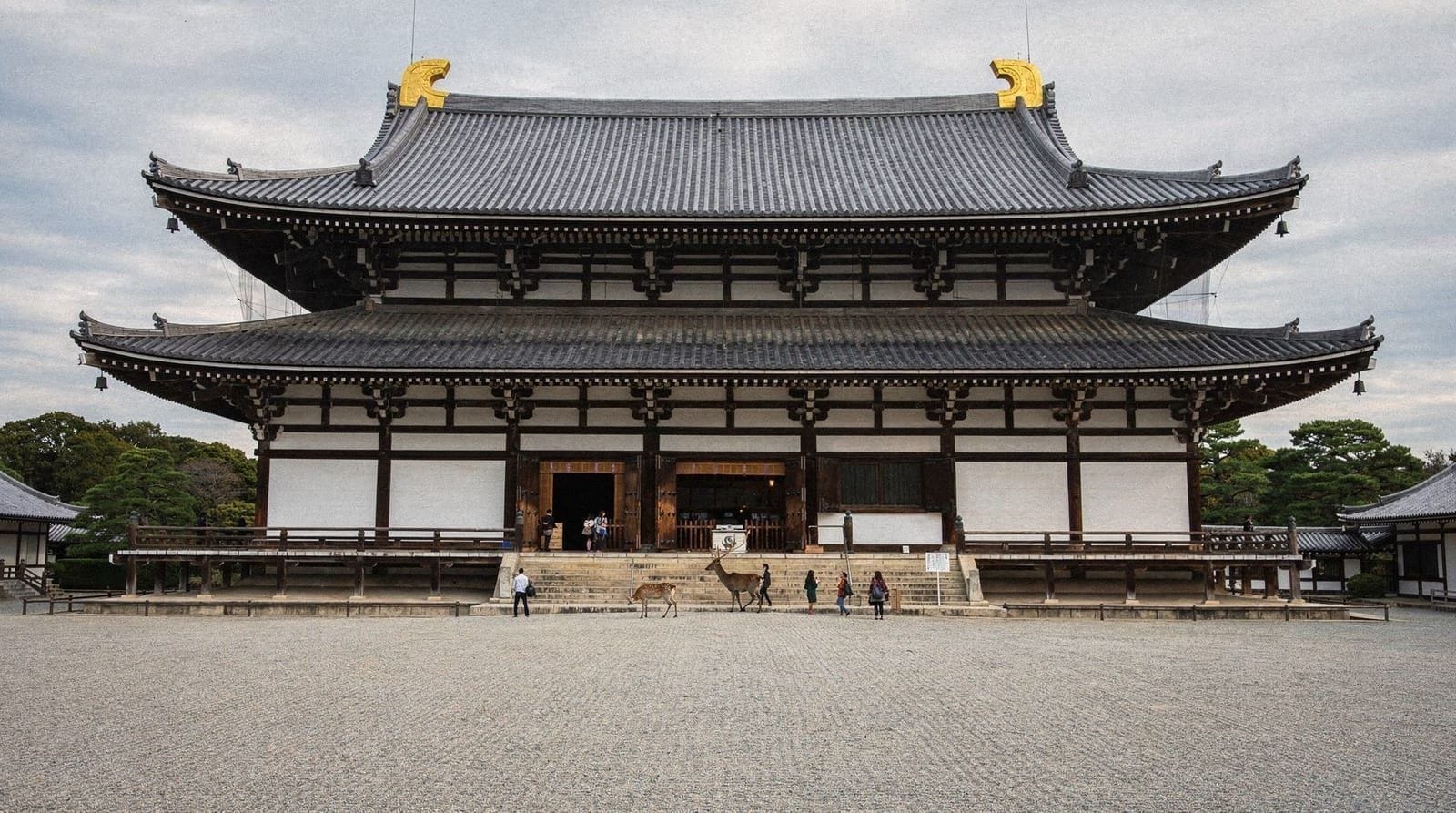
Todai-ji is a Buddhist temple in Nara housing Japan's largest bronze Buddha statue (Daibutsu) inside the Daibutsuden, one of the world's largest wooden buildings. Admission to the Daibutsuden is ¥800 (about $7.40), open roughly 7:30am-5:30pm in summer and 8am-5pm in winter, and it sits inside Nara Park where deer roam freely.
A 15-meter bronze Buddha sitting inside one of the largest wooden buildings on earth, surrounded by a park where roughly 1,200 wild deer wander freely and bow for crackers, makes Todai-ji one of the more unusual major sights in the Kansai region — equal parts serious Buddhist monument and unmistakably tourist-friendly park. Both halves of that combination are genuine: the temple’s scale and history are real UNESCO World Heritage material, and the deer really do bow, really do get hand-fed, and really can nip if visitors run out of crackers mid-transaction.
| Where | Nara Park, Nara (30-45 min from Osaka or Kyoto by train) |
| Cost | ¥800 Daibutsuden admission; grounds and Nandaimon free |
| Time needed | 2-3 hours for Todai-ji, deer park and Kasuga Taisha |
| Getting there | Kintetsu-Nara or JR Nara Station, then 20-25 min walk |
| Best time | First or last hour of opening hours to avoid tour-group peaks |
What Todai-ji actually is
Founded in 752 as the head temple of Japan’s provincial temple network under Emperor Shomu, Todai-ji was built partly as a national project meant to unify the country spiritually after a series of epidemics and unrest. The centerpiece, the Daibutsuden (Great Buddha Hall), has burned down and been rebuilt twice since the original construction — the current building, completed in 1709, is only about two-thirds the width of the original structure and is still, remarkably, one of the largest wooden buildings in the world.
Inside sits the Daibutsu, a bronze statue of Vairocana Buddha standing roughly 15 meters tall, cast using an estimated 500 tons of bronze — a scale that photos taken from ground level consistently fail to communicate until you’re standing beneath it.
Getting in: admission and hours
Entry to the Daibutsuden costs ¥800 (about $7.40) for adults, payable at the gate. Hours shift by season: roughly 7:30am to 5:30pm from April through October, and 8am to 5pm from November through March, with last entry typically 30 minutes before closing. The wider temple grounds, including the massive Nandaimon south gate, are free to walk through without a ticket — only the Daibutsuden interior requires admission.
The Nandaimon gate and its guardians
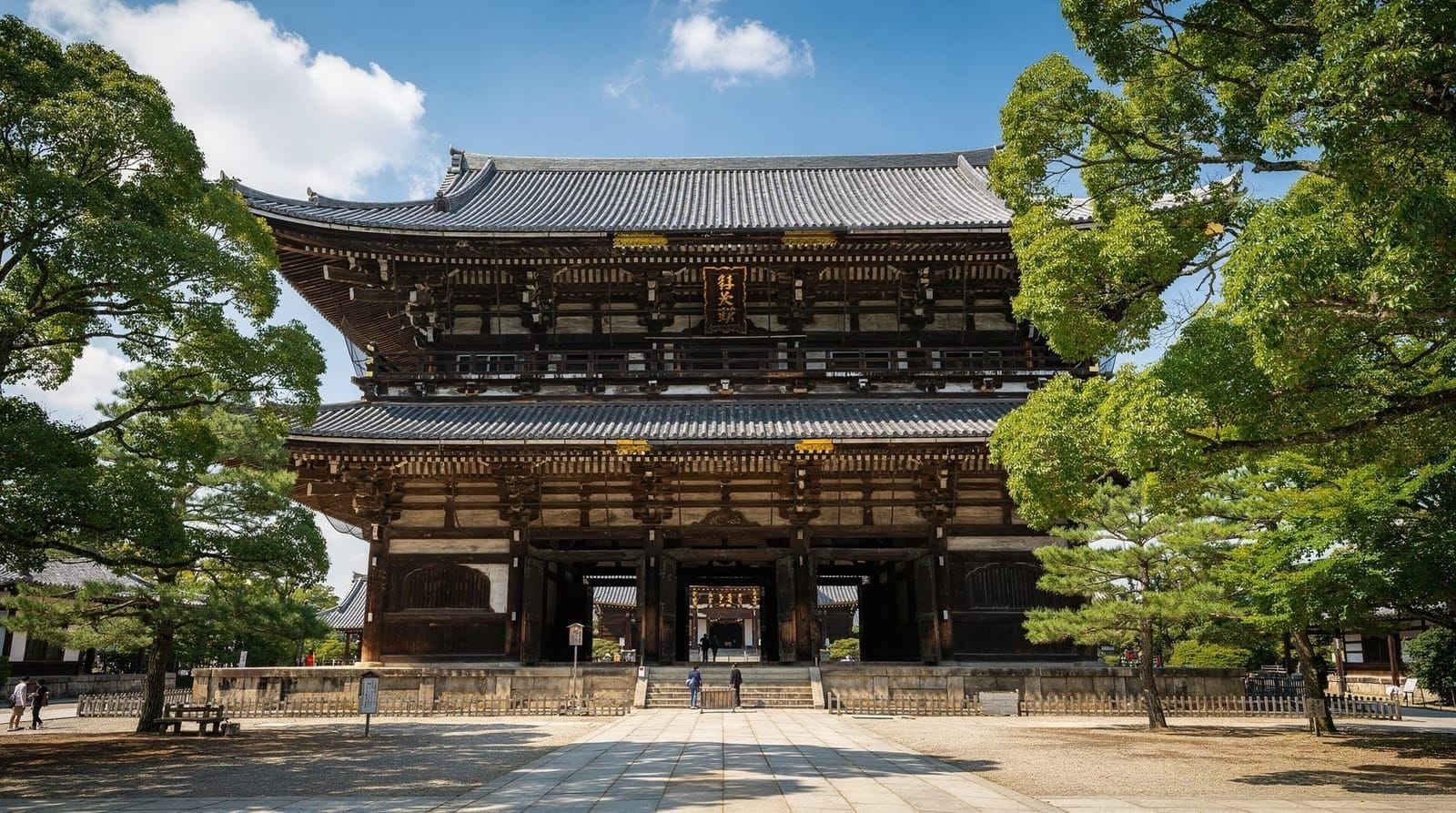
Before reaching the Daibutsuden, visitors pass through Nandaimon, a two-story wooden gate rebuilt in 1203 in a style imported from Song-dynasty China, notable for its exposed structural beams rather than a smooth ceiling. Flanking the passage are two enormous wooden Kongorikishi guardian statues, over 8 meters tall, carved in a burst of just under two months by the sculptor Unkei and his workshop — among the most technically admired wood carvings in Japanese art history, standing in intentionally dramatic, muscular poses meant to ward off evil.
Todai-ji Great Buddha guided tour covers the statue’s casting history and the symbolism behind Vairocana Buddha, which the hall’s signage explains only briefly in English.
Nara Park’s deer
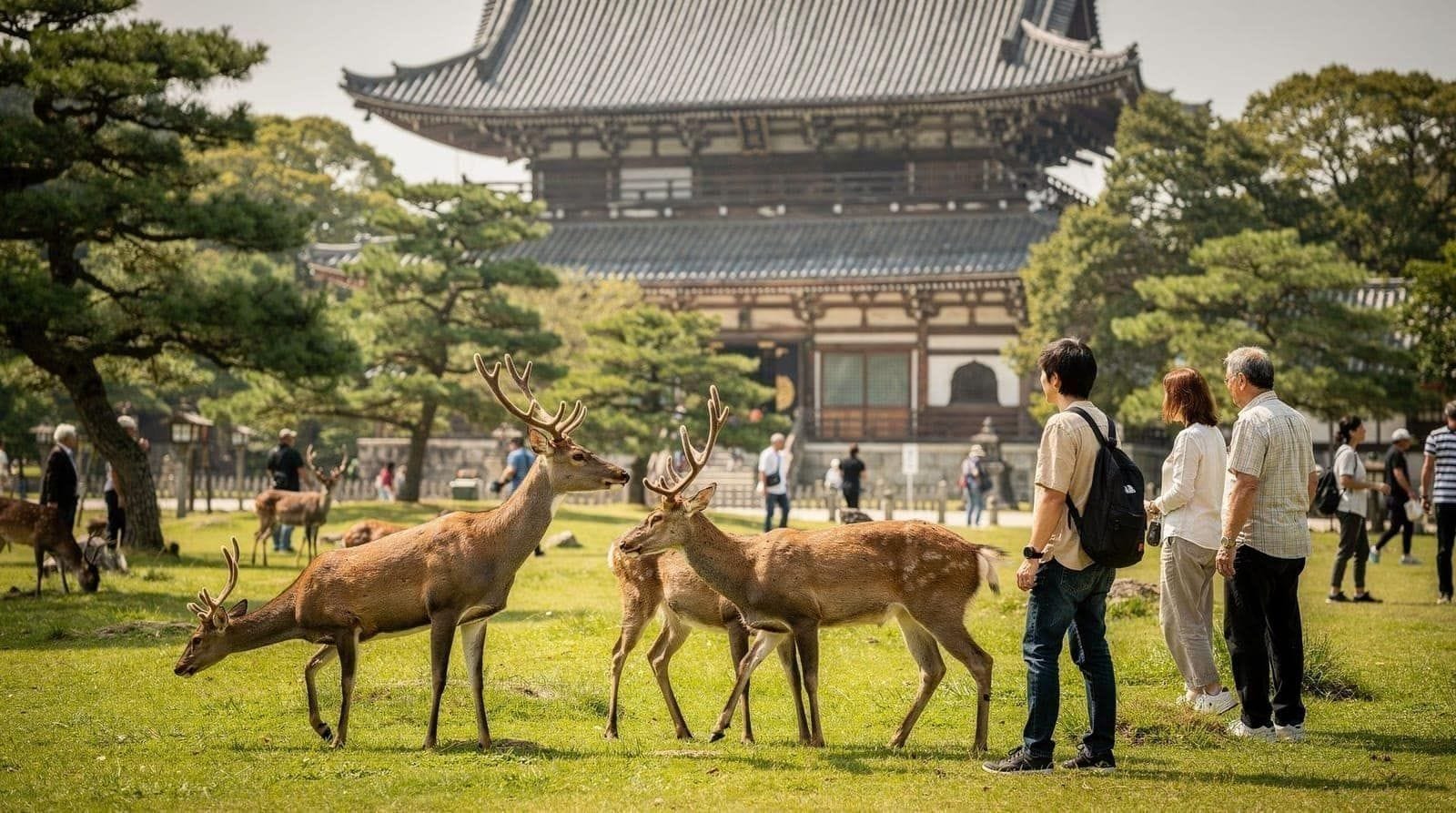
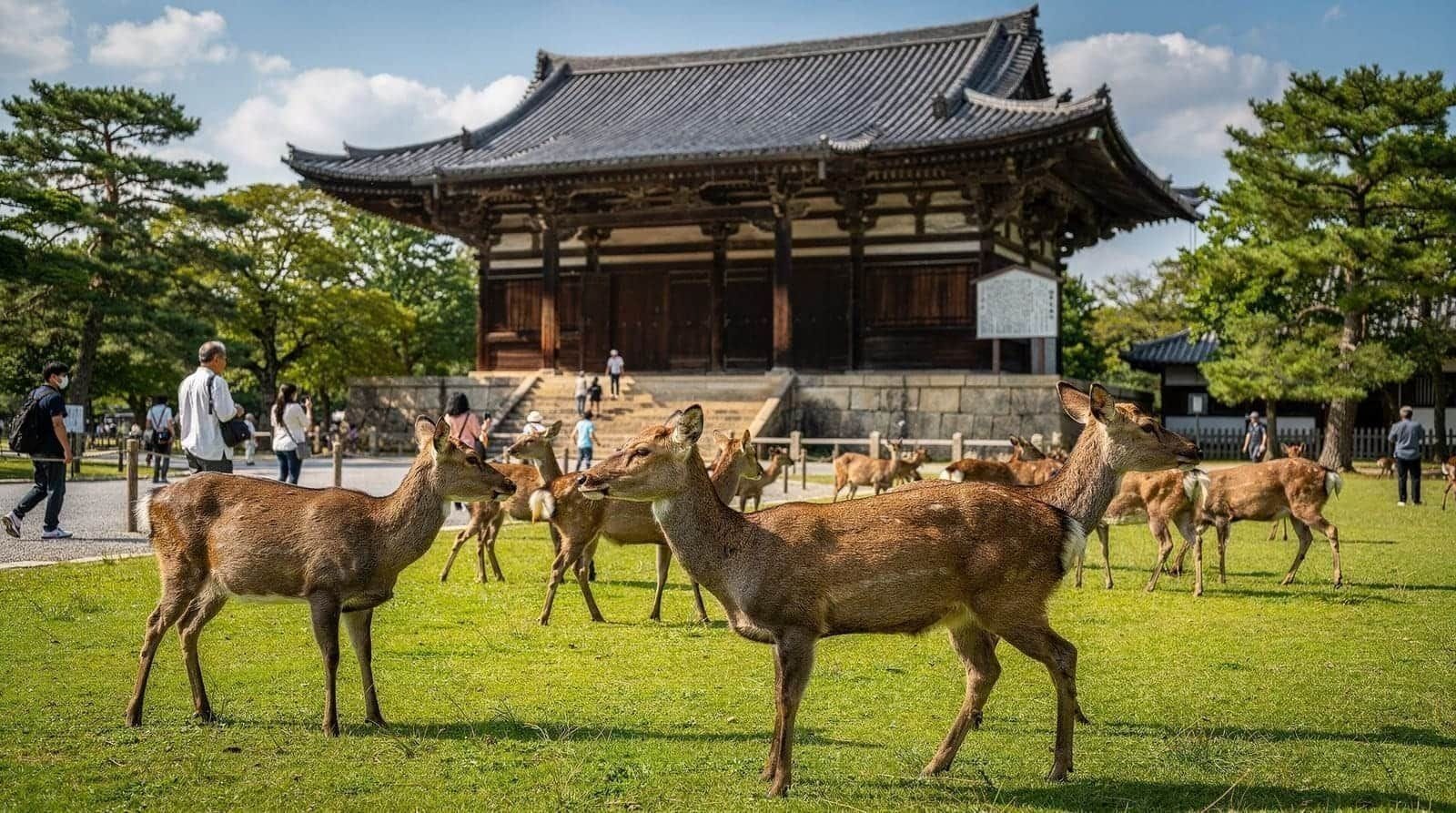
Nara Park, which surrounds Todai-ji and extends toward Kasuga Taisha, is home to roughly 1,200 sika deer considered messengers of the gods in local Shinto tradition, a status that has protected them from hunting for centuries and made them comfortable approaching people directly.
Vendors throughout the park sell shika senbei (deer crackers) for about ¥200 a stack, and many deer have learned to bow their heads before receiving one — a genuinely charming trick, though the deer are wild animals rather than pets, and can nip, headbutt, or nose through bags and pockets if a visitor is holding food and not handing it over fast enough. Keeping crackers visible but held firmly, and not waving food around to provoke a reaction for photos, avoids most of the minor incidents that happen daily in the park.
Between the station and the temple
Both main approaches to Todai-ji run through the park itself rather than city streets. From Kintetsu-Nara Station, it’s roughly a 20-minute walk past Kofuku-ji’s five-story pagoda and into the deer-populated parkland before reaching Todai-ji’s grounds; from JR Nara Station, add another 10 minutes or take a short bus connection. Neither approach requires a car or taxi, and the walk itself, deer encounters included, is often cited by visitors as part of the experience rather than a chore before the main event.
Omizutori: the fire ritual few tourists know about
Each March, Todai-ji’s Nigatsu-do hall hosts Omizutori, a purification ceremony dating back over 1,200 years, in which monks parade giant flaming torches along a wooden balcony, showering sparks onto the crowd below as a symbolic cleansing rite. The peak nights, typically in the second week of March, draw large local crowds and relatively few foreign tourists compared to cherry blossom season a few weeks later — a genuinely distinctive seasonal event for travelers whose trip happens to align with it.
Todai-ji Omizutori ceremony tour is worth checking for March travel dates specifically, since the ceremony’s exact schedule and best viewing points aren’t always obvious to first-time visitors.
Pairing Todai-ji with Kasuga Taisha
Roughly 1.2 kilometers further into Nara Park, reached via a forested path lined with stone and bronze lanterns, sits Kasuga Taisha, the region’s most important Shinto shrine and a natural second stop after Todai-ji. Most Nara day trips combine the two, along with time in the deer park itself, into a half-day or full-day visit depending on pace.
Combined Todai-ji and Kasuga Taisha guided tour covers both sites plus the deer park in a single guided route, useful for visitors who want the history explained rather than self-navigating with a paper map.
Getting to Nara from Osaka or Kyoto
From Osaka, the Kintetsu Nara Line runs direct trains from Osaka-Namba Station to Kintetsu-Nara Station in about 35-45 minutes depending on the service (limited express is faster but costs more). From Kyoto, the JR Nara Line takes roughly 45 minutes from Kyoto Station to JR Nara Station, with no transfer required. Both approaches make Nara a comfortable single-day trip from either base, and travelers splitting time across the wider Kansai region often slot Nara in as a half-day detour rather than a full overnight stay, given how compact the main sights are relative to Kyoto or Osaka.
Private Nara UNESCO heritage and deer park tour is worth considering for travelers who want a more flexible, private-guide pace rather than a fixed-group schedule.
Inside the Daibutsuden: what else to look for
Beyond the Great Buddha itself, the hall contains two large wooden guardian statues flanking the Daibutsu — Komokuten and Tamonten, part of the Four Heavenly Kings tradition in Buddhist iconography — along with a scale model showing the temple’s original, larger footprint before its 1709 reconstruction. A well-known detail near the rear of the hall is a wooden pillar with a hole cut through its base, roughly the same dimensions as one of the Daibutsu’s nostrils; local tradition holds that anyone who can squeeze through the hole will attain enlightenment, and it draws a steady stream of visitors, mostly children and flexible adults, attempting the crawl-through as a lighthearted ritual rather than a serious religious act.
Nara’s museums and treasures beyond the temple
The Nara National Museum, a short walk from Todai-ji, holds an extensive collection of Buddhist art and artifacts, including pieces connected to Todai-ji’s own history, and hosts the Shoso-in Exhibition each autumn (typically late October to early November), displaying a rotating selection of 8th-century imperial treasures normally kept in Todai-ji’s Shoso-in storehouse — a repository considered one of the most significant collections of Nara-period artifacts in Japan. The exhibition draws dedicated visitors specifically for its limited annual run, and checking dates in advance is worthwhile for travelers with a serious interest in Japanese art history rather than general sightseeing.
Budgeting a Nara day trip
A reasonably paced Nara day trip built around Todai-ji, Kasuga Taisha, and the deer park runs ¥2,000-4,000 per person in admission and deer crackers combined, plus round-trip transit from Osaka or Kyoto (roughly ¥600-1,200 depending on route and train class). This makes Nara one of the more affordable full-day excursions in the Kansai region relative to Kyoto’s higher concentration of paid attractions, and it’s a reasonable candidate for travelers managing a tighter daily budget who still want a UNESCO-caliber sight on the itinerary.
Crowds and timing at Todai-ji specifically
Unlike Fushimi Inari’s free, 24-hour model, Todai-ji’s fixed admission hours mean crowding follows a more predictable daily curve — heaviest from mid-morning through early afternoon, when both domestic school trips and international tour groups overlap inside the Daibutsuden, and calmer in the first hour after opening or the last hour before closing.
Weekends and Japanese national holidays add noticeably to the crowd, as does the cherry blossom season in late March and early April, when Nara Park’s overall visitor numbers spike alongside Kyoto’s. Because the hall itself is large enough to absorb a fair amount of foot traffic without feeling as bottlenecked as narrower sites like Kiyomizu-dera’s stage approach, Todai-ji tends to feel manageable even at moderately busy times, a contrast worth knowing if crowd-avoidance is a major planning factor.
Nara Park beyond Todai-ji and the deer
Nara Park itself extends well beyond the Todai-ji and Kasuga Taisha corridor, covering roughly 660 hectares of parkland that also includes Kofuku-ji’s five-story pagoda (one of Japan’s tallest, dating in its current form to 1426 after earlier versions burned), the Nara National Museum, and open grassy areas where deer congregate in particularly high numbers during quieter parts of the day. Visitors with extra time beyond the main Todai-ji and Kasuga Taisha stops can spend an additional hour or two simply walking the park’s quieter paths, an approach that also spreads out deer encounters rather than concentrating them entirely at the crowded main entrance areas near both temples.
Group tours versus independent visits at Todai-ji
Given the Daibutsuden’s straightforward, well-marked layout and abundant English signage compared to some other Kansai temples, Todai-ji is one of the more approachable major sights to visit independently without a guide, using a paper map or phone to navigate between Todai-ji, Kasuga Taisha, and the deer park. That said, a guide adds genuine value specifically around the Nandaimon gate’s guardian statues, the symbolism behind the Daibutsu’s specific hand gestures (mudras), and the deeper history of Emperor Shomu’s motivations for commissioning the temple, none of which is covered in much depth by on-site signage.
Practical notes on visiting with children
Nara Park’s deer are a significant draw for families traveling with children, and the interactive, hands-on nature of buying and feeding shika senbei makes Todai-ji an easier sell to younger visitors than some of Kyoto’s more purely architectural temple visits. That said, parents should supervise closely during feeding — young children holding visible crackers can be approached more assertively by deer than adults expect, and a deer nosing at a small child’s hands or pockets, while rarely dangerous, can be startling for a first-time visitor of any age.
The casting of the Great Buddha: an 8th-century engineering feat
Casting the Daibutsu required an estimated eight separate pours of bronze over several years in the mid-8th century, using techniques adapted from continental Asian bronze-casting methods, and the project consumed such a vast portion of Japan’s available copper and gold reserves at the time that it reportedly caused genuine economic strain on the imperial treasury — a scale of resource commitment comparable to a major national infrastructure project today. The statue’s original construction also required specialized labor and materials management on a scale unprecedented in Japan up to that point, involving tens of thousands of workers across the roughly decade-long project from planning to consecration in 752.
The statue has been repaired and partially recast multiple times since, following earthquake and fire damage across the centuries, meaning the bronze visible today is a patchwork of original 8th-century material and later restoration work, particularly visible in slight color and texture variations across the statue’s surface to a trained eye.
Combining Todai-ji with a longer stay in Nara
While most visitors treat Nara as a day trip from Osaka or Kyoto, staying overnight in Nara itself — a genuinely underused option given the city’s relatively limited hotel selection compared to its neighbors — allows an early morning visit to Todai-ji and the deer park before day-trip crowds arrive, similar in logic to the dawn-timing strategy recommended for Fushimi Inari. Nara’s evening atmosphere, with far fewer visitors than during the day and illuminated temple silhouettes visible from parts of the park after dark, is a genuinely different, quieter side of the city that day-trippers never see.
Accessibility at Todai-ji and Nara Park
The main approach paths through Nara Park and into the Daibutsuden are largely flat and paved, making Todai-ji one of the more wheelchair- and stroller-accessible major sights covered across this site, a contrast to the stone-step-heavy approaches at Fushimi Inari or Kiyomizu-dera. The Nandaimon gate’s threshold and some sections near the Daibutsuden’s entrance involve minor level changes, but overall the site is manageable for visitors with mobility limitations, and Nara Park’s wide, open pathways make navigating around deer and crowds somewhat easier than in the narrower streets of Kyoto’s Higashiyama district.
Combining a Nara visit with nearby Uji
For travelers approaching Nara from Kyoto rather than Osaka, a reasonable extended day trip can combine Todai-ji and Kasuga Taisha in the morning with a stop in Uji on the return journey, given Uji’s position roughly between the two cities on certain rail routes. This isn’t the most time-efficient combination — it requires careful attention to train connections and adds a longer overall day — but it appeals to travelers wanting to maximize a single day trip across multiple UNESCO-adjacent sights covering both Nara’s Buddhist history and Uji’s tea culture and Byodo-in temple.
What to eat near Todai-ji and Nara Park
Nara’s food scene sits somewhat in Kyoto and Osaka’s shadow, but a handful of local specialties are worth seeking out near the park — kakinoha-zushi (persimmon-leaf-wrapped sushi, a preserved regional style originally developed before refrigeration) and Nara-zuke (vegetables pickled in sake lees, a distinctly pungent, tangy local specialty) both showcase the region’s historical food preservation traditions. Small restaurants and stalls near Kintetsu-Nara Station and along the main approach to the park offer both, typically in the ¥800-1,500 range per portion, a reasonable lunch stop between Todai-ji and Kasuga Taisha.
Todai-ji’s role in Japan’s Buddhist administrative history
Beyond its religious significance, Todai-ji historically functioned as the head of a nationwide network of provincial temples (kokubunji) that Emperor Shomu established across Japan’s regions in the mid-8th century, a system designed to project centralized imperial authority through religious infrastructure during a period of political and social instability. This administrative role, largely forgotten by casual visitors focused on the Great Buddha itself, explains why Todai-ji’s scale and resources so dramatically outstripped an ordinary provincial temple of the same era — it was conceived from the outset as a national capital-level institution rather than a purely regional religious site.
Beyond Todai-ji: Nara’s other UNESCO sites
Nara’s UNESCO World Heritage listing covers several sites beyond Todai-ji, including Kofuku-ji’s pagoda near the station and, further out, Horyu-ji — believed to include the oldest surviving wooden buildings in the world, dating to the early 7th century. Visitors interested in calligraphy or hands-on cultural add-ons alongside the temple visits may also want the calligraphy and crafts guide, which covers a Horyu-ji name-writing experience in more detail.
For a broader look at how Todai-ji compares to other major Kansai temples and shrines, see the Kansai temples and shrines overview and the best temples in Kyoto guide, and for a very different mountain-temple experience entirely, the Koyasan Okunoin guide covers a Buddhist cemetery site that contrasts sharply with Todai-ji’s monumental single-building focus.
A hotel-pickup day trip option is a convenient alternative for travelers based in Osaka who’d rather not manage train transfers on a day-trip schedule, bundling transport directly from an Osaka hotel to Nara Park and back.
Luggage, cash, and connectivity for a day trip
Coin lockers are available at both Kintetsu-Nara and JR Nara stations, a useful option for travelers arriving mid-journey with bags rather than returning to a hotel first. Most food stalls and smaller shops near the park deal mainly in cash, so carrying enough yen for shika senbei, lunch, and small souvenirs avoids a mid-trip search for an ATM. An IC card (see the ICOCA card guide) covers both the Kintetsu and JR routes into Nara without needing a separate paper ticket, which speeds up the station transfer if the day trip is squeezed for time.
Todai-ji and Nara Park across the seasons
| Season | Conditions | Crowds |
|---|---|---|
| Spring (Mar-Apr) | Omizutori in March; cherry blossoms late March-early April | High, especially around sakura peak |
| Summer (Jun-Aug) | Hot, humid; deer seek shade more actively | Moderate-high, domestic school trips |
| Autumn (Nov) | Cool, clear; foliage color around the park | High, especially weekends |
| Winter (Dec-Feb) | Cold but dry; shortest lines of the year | Low, calmest time to visit |
Winter mornings, in particular, pair well with the earlier note about visiting in the first hour of opening — the two calmest windows of the year stack for anyone able to time a trip around them. For broader seasonal planning across the wider region, the best time to visit Osaka guide and autumn foliage guide cover conditions beyond Nara specifically.
Comparing the ways to visit Todai-ji
| Option | Cost beyond admission | Best for |
|---|---|---|
| Self-guided (train + walk) | Just round-trip transit fare | Independent travelers comfortable navigating with a map |
| Small-group guided tour | Moderate | Visitors who want the history and symbolism explained |
| Private guide | Higher | Flexible pace, families, or travelers with mobility needs |
| Hotel-pickup day trip | Higher, but bundled | Osaka-based visitors who’d rather skip train transfers entirely |
What to skip if you’re short on time
If a Nara stop is squeezed into a single half-day, the Daibutsuden and the deer park immediately around it deliver most of what makes Todai-ji worth the trip — the Nandaimon guardians are on the direct walking path and cost nothing extra to see, so there’s little reason to skip them.
What’s more skippable under real time pressure is the Nara National Museum (worthwhile, but a dedicated interest in Buddhist art helps justify the detour) and a full walk out to Kasuga Taisha, which adds a further 20-30 minutes each way through the park. Travelers combining Nara with Uji or a same-day return to Kyoto are usually better off prioritizing Todai-ji and the deer over a longer park walk.
A realistic half-day Nara plan
Arrive at Kintetsu-Nara or JR Nara Station by mid-morning, walk the 20-25 minutes through the park (budgeting extra time for deer encounters and photos at Kofuku-ji’s pagoda), and reach Todai-ji with enough time to see the Nandaimon gate, the Daibutsuden interior, and the surrounding grounds unhurried. From there, the walk to Kasuga Taisha adds roughly 20-30 minutes each way through forested, lantern-lined paths, comfortably fitting into a half-day if the pace stays brisk. Lunch near Kintetsu-Nara Station — kakinoha-zushi or a simple noodle shop — before the return train to Osaka or Kyoto rounds out a trip that rarely needs more than four to five hours door to door.
Frequently asked questions about Todai-ji guide
How much does it cost to enter Todai-ji's Great Buddha Hall?
Admission is ¥800 (roughly $7.40) for adults, paid at the Daibutsuden entrance. The surrounding temple grounds and Nandaimon gate are free to walk through without a ticket.What are the opening hours for Todai-ji?
Hours shift seasonally — approximately 7:30am to 5:30pm from April through October, and 8am to 5pm from November through March. Last entry is typically 30 minutes before closing.How big is the Great Buddha statue at Todai-ji?
The bronze Buddha (Vairocana) stands about 15 meters tall, one of the largest bronze Buddha statues in the world. The Daibutsuden hall housing it, while rebuilt smaller than the original after repeated fires, is still one of the largest wooden buildings on earth.Can I feed the deer in Nara Park near Todai-ji?
Yes — vendors near the park and Todai-ji's approach sell shika senbei (deer crackers) for about ¥200 a stack. The deer are accustomed to being fed and can bow for crackers, but they can also nip or headbutt if visitors tease them or run out of food while deer are still expecting more.How do I get from Osaka or Kyoto to Todai-ji in Nara?
From Osaka, the Kintetsu Nara Line runs directly to Kintetsu-Nara Station in about 35-45 minutes; from Kyoto, the JR Nara Line takes roughly 45 minutes to JR Nara Station. Both stations are a 20-25 minute walk (or short bus ride) from Todai-ji through Nara Park.What is the Omizutori ceremony at Todai-ji?
Omizutori is a centuries-old fire ritual held each March at Todai-ji's Nigatsu-do hall, where monks wave giant flaming torches off a wooden balcony as part of a purification rite. It draws large crowds on peak nights and is one of Nara's most distinctive seasonal events.Is Todai-ji worth visiting if I only have one day in Nara?
Yes — it's the anchor sight of most Nara day trips, typically paired with Nara Park's deer and a short walk to Kasuga Taisha, which sits about 1.2 kilometers further into the park through forest.
Top experiences
Bookable activities with verified prices and instant confirmation on GetYourGuide.