Koyasan's Okunoin cemetery guide
Koyasan: Koyasan Okunoin cemetery Kobo Daishi
Duration: 2 hours
What is Okunoin and why is it significant?
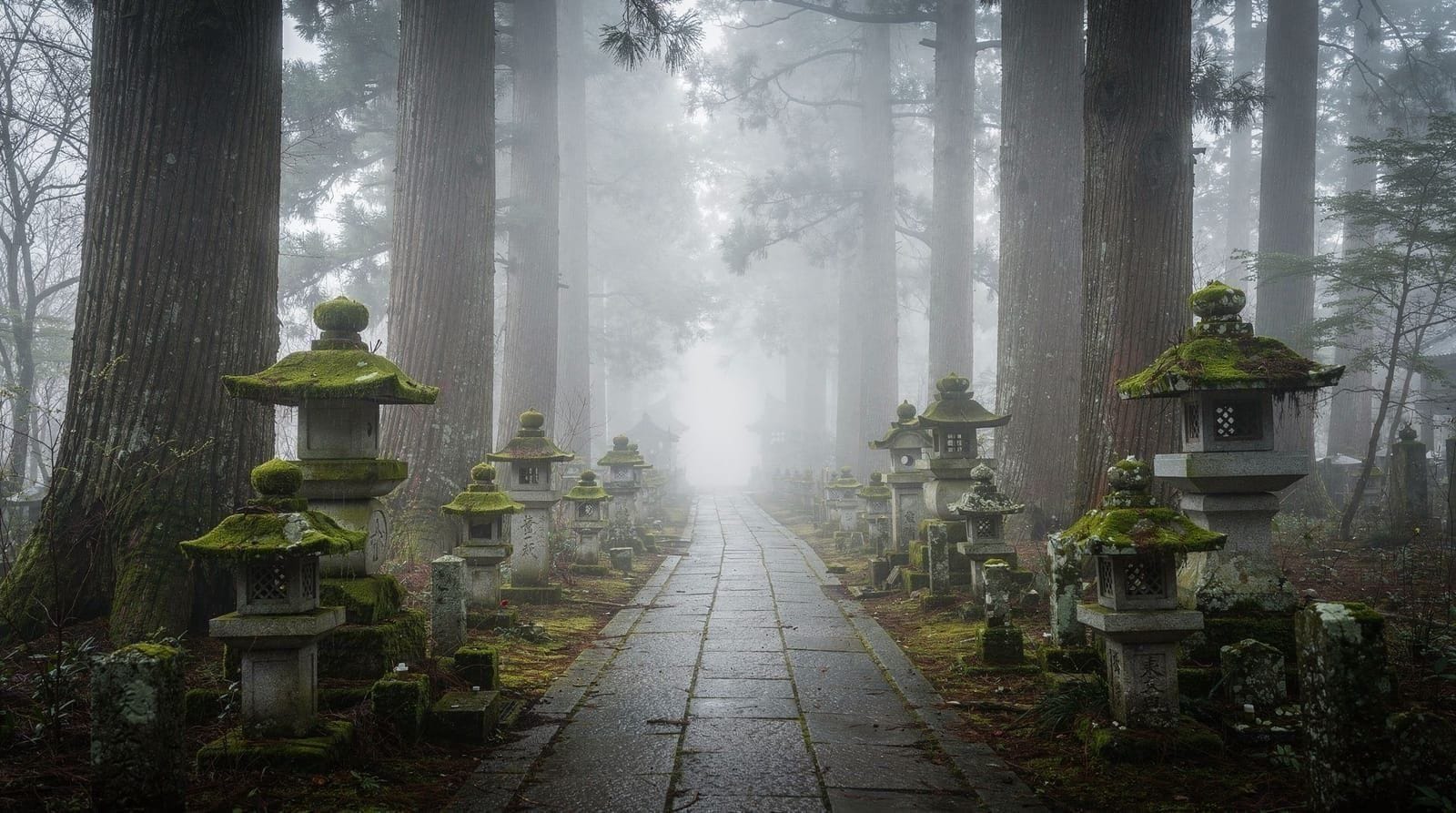
Okunoin is Japan's largest cemetery, roughly 200,000 tombstones spread through a cedar forest on Koyasan, leading to the mausoleum of Kobo Daishi, founder of Shingon Buddhism, who followers believe remains in eternal meditation rather than deceased. The walk is free and open at all hours, though photography stops at the Gobyobashi bridge near the mausoleum.
A two-kilometer forest path lined with roughly 200,000 tombstones, leading to a mausoleum where lanterns have burned continuously for over a thousand years, makes Okunoin one of the most atmospheric religious sites in Japan — and one that operates on entirely different terms from the temple-hopping pace of Kyoto or Nara. This is Japan’s largest cemetery, spread beneath towering cedar trees on the sacred mountain complex of Koyasan, and the destination for anyone whose mental image of a Buddhist pilgrimage site involves silence and scale rather than crowds and photo queues.
| Where | Koyasan (Mount Koya), roughly 2 hours from Osaka |
| Cost | Free |
| Time needed | 40-60 min one-way walk |
| Getting there | Nankai train + cable car + local bus |
| Best time | Dawn or after dark for atmosphere |
Kobo Daishi and why this isn’t a typical cemetery visit
Okunoin’s central purpose is housing the mausoleum of Kobo Daishi (born Kukai), the monk who founded Shingon Buddhism in the early 9th century after studying esoteric Buddhist teachings in China. According to Shingon tradition, Kobo Daishi did not die in 835 but entered eternal meditation (nyujo) and remains alive in a state of deep meditation inside the mausoleum, awaiting the future Buddha Maitreya’s arrival — a belief that shapes how the entire site is treated.
Monks still deliver two meals daily to the mausoleum as though Kobo Daishi were present, a practice maintained without interruption for over a millennium. The roughly 200,000 tombstones surrounding the path belong to worshippers, feudal lords, and companies who wanted their remains or memorials placed near Kobo Daishi for the same reason he’s believed to remain there — proximity to his ongoing meditation.
Walking the path
The main approach to Okunoin begins at Ichi-no-hashi bridge, the traditional entry point where visitors are meant to bow before crossing, and continues roughly 2 kilometers through cedar forest to the Gobyobashi bridge near the mausoleum itself. The walk takes 40-60 minutes at a relaxed pace, passing memorials ranging from centuries-old moss-covered stone markers to modern corporate memorials (several major Japanese companies maintain memorial stones here, some in unexpectedly playful shapes tied to their business).
Past Gobyobashi, photography is prohibited out of respect for the site’s sanctity, and the path narrows toward the Torodo Hall (Lantern Hall), where two lanterns are said to have burned continuously since 1088, alongside thousands of others donated over the centuries.
Okunoin cemetery and Kobo Daishi guided tour covers the history behind specific memorials along the path and the significance of the eternal meditation belief, details easy to miss walking through without context.
Dawn and night: the two best times to go
Okunoin is open at all hours, and unlike most sightseeing in Kansai, the case for visiting outside standard daytime hours here is less about avoiding crowds and more about atmosphere. Dawn light filtering through the cedar canopy over centuries-old moss-covered stones is genuinely different from the same path at midday, and guided night walks — using lanterns rather than the path’s limited electric lighting — turn the cemetery into something closer to a meditative experience than a sightseeing stop, with the Torodo Hall’s continuously burning lanterns taking on considerably more presence after dark.
Sacred silence: Okunoin at dawn and after dark tour is built specifically around these two low-light windows, worth prioritizing over a standard midday visit if the schedule allows.
Getting to Koyasan
Reaching Koyasan from Osaka takes roughly 2 hours, combining a Nankai Electric Railway train to Gokurakubashi Station with a short cable car (funicular) ride up the mountain, followed by a local bus into the town center — public transit rather than a direct train, which is part of why Koyasan sees fewer casual day-trippers than Kyoto or Nara despite its significance. The Koyasan World Heritage Ticket, sold at Nankai stations in Osaka, bundles the round-trip train, cable car, and unlimited local bus travel into a single discounted pass, worth buying before departure rather than paying each leg separately.
Koyasan highlights tour with a special guide covers Okunoin alongside Koyasan’s other major sites — the Danjo Garan temple complex and Kongobuji head temple — in a single 4-hour guided route for visitors with limited time on the mountain.
Beyond Okunoin
Koyasan’s other major site, the Danjo Garan complex, includes the vermilion Konpon Daito pagoda and a scattering of temple halls representing the mountain’s role as the headquarters of Shingon Buddhism. Kongobuji, the head temple of the Shingon sect, holds Banryutei, Japan’s largest rock garden, arranged to evoke a pair of dragons emerging from clouds using white granite gravel from Kyoto and stones from Shikoku.
Koyasan beyond Okunoin: other stories tour covers these additional sites for visitors who want more than the cemetery walk alone, and pairs naturally with a longer stay on the mountain rather than a rushed day trip.
Etiquette specific to Okunoin
Bowing before crossing Ichi-no-hashi at the start of the path is customary, and the same applies at Gobyobashi before the final stretch toward the mausoleum, where photography stops entirely — a stricter rule than almost anywhere else covered on this site, and one that’s enforced by signage and, occasionally, staff. Speaking quietly throughout the forest path is expected, given the site’s function as an active cemetery and pilgrimage destination rather than a general tourist attraction, even though it draws plenty of international visitors.
Day trip versus overnight
Okunoin can be visited as a long day trip from Osaka, but the roughly 2-hour transit each way eats a significant portion of the day, and the site’s dawn and after-dark appeal is difficult to access on a same-day round trip that starts and ends with a 2-hour train ride. Travelers with the flexibility are better served by an overnight temple stay at one of Koyasan’s shukubo lodgings, which allows an early-morning Okunoin walk before the day-trippers arrive and a proper evening visit after they’ve left — covered in full in the koyasan overnight itinerary.
What to eat near Okunoin before or after the walk
The town center near Ichi-no-hashi has a handful of small restaurants and cafes serving simple noodle dishes and Koyasan’s own goma-dofu (sesame tofu), a reasonable way to fuel up before the roughly hour-long walk or warm up afterward, particularly in cooler months. Options are considerably more limited than in central Osaka or Kyoto, reflecting the town’s small scale and monastic character rather than a tourist-dining district, so travelers with specific dietary needs are better served checking options in advance rather than assuming a wide range will be available on arrival.
Notable memorials along the path
Among the roughly 200,000 memorials lining Okunoin’s path, a handful draw particular visitor interest: a memorial for victims of Japan’s atomic bombings, memorials erected by major corporations including electronics and pharmaceutical companies (several in unexpectedly playful shapes tied to their business, such as a memorial resembling a rocket or a coffee cup), and the graves of numerous historical daimyo (feudal lords) from the Sengoku and Edo periods, including figures connected to Oda Nobunaga and Takeda Shingen, two of the most significant warlords in Japanese history.
A section near the middle of the path includes a memorial to Toyotomi Hideyoshi, one of Japan’s three great unifiers, reflecting how central Koyasan was to the political and spiritual life of the ruling class across multiple centuries, not merely a remote monastic retreat.
Weather and what to wear
Koyasan sits at roughly 800 meters elevation, meaningfully cooler than Osaka or Kyoto year-round — summer temperatures run several degrees lower, a genuine relief during the region’s hot, humid July and August, while winter brings occasional snow that dusts the cedar forest and stone memorials in a way many repeat visitors consider the most atmospheric version of the site, though it also makes the stone path underfoot considerably more slippery and requires proper footwear. Rain is common given the mountain’s elevation and forest cover, and a lightweight rain jacket is a more practical choice than an umbrella given the narrow, sometimes crowded path sections.
Guided versus independent visits
Okunoin’s path is well-marked and walkable without a guide — English information boards exist at intervals, though they cover only a fraction of the memorials’ individual stories. A guide adds genuine value here specifically because so much of the site’s meaning (the eternal meditation belief, the significance of specific memorials, the reasoning behind the strict photography rule past Gobyobashi) isn’t conveyed by signage alone, more so than at many other Kansai sights where a guide is more about convenience than content.
Independent visitors who want some of this context without booking a guide can find reasonably good information in guidebooks or downloaded audio guides, though neither fully replaces a knowledgeable human guide’s ability to answer specific questions on the spot.
Combining Okunoin with Koyasan’s food culture
Koyasan’s shojin ryori vegetarian cuisine, most commonly experienced through an overnight shukubo stay, is also available at a small number of standalone restaurants in the town center for day-trippers who want to try the food without booking a full temple stay. Goma-dofu, a sesame-based tofu unique to Koyasan’s culinary tradition, is a specific local specialty worth seeking out, distinct from standard soy tofu found elsewhere in Japan, and sold in small takeaway packages at shops along the town’s main street for travelers who want to bring a food souvenir home.
Ichi-no-hashi to Naka-no-hashi: the path in three segments
The roughly 2-kilometer walk from Ichi-no-hashi to the mausoleum breaks naturally into three segments. The first stretch, from Ichi-no-hashi to the mid-point bridge Naka-no-hashi, passes the oldest and most densely packed memorials, many centuries old and heavily weathered with moss, alongside the modern corporate memorials that draw curious attention for their unconventional shapes.
The second stretch, continuing toward Gobyobashi, opens into taller, older cedar growth and thins out the memorial density somewhat, offering the quietest stretch of forest walking on the entire path. The final approach to Gobyobashi and the Torodo Hall concentrates the most historically significant memorials, including those connected to major historical figures, before the photography restriction takes effect.
The cedar forest itself
Okunoin’s cedar trees, some estimated at several centuries old, form one of the more significant old-growth forest canopies in the Kansai region, contributing to the site’s markedly cooler, quieter microclimate compared to the open town center a short walk away. The scale of individual trees — some with trunks wide enough that several adults linking hands couldn’t encircle them — is easy to underappreciate on a first walk-through focused on the memorials underfoot rather than the canopy overhead, and slowing down periodically to look up rather than only at the path is worth the extra few minutes.
Koyasan’s broader temple complex beyond Okunoin
While Okunoin draws the most visitor attention, Koyasan’s status as Shingon Buddhism’s headquarters means the mountain hosts a genuinely large number of other temples beyond the roughly 50 offering overnight shukubo stays — well over 100 temples in total occupy the mountain, many not open to casual visitors but contributing to the town’s overall atmosphere of dense, continuous religious activity rarely matched elsewhere in Japan. Walking through the town center between Okunoin and the Danjo Garan complex, past temple gates and walled compounds not individually promoted to tourists, gives a sense of Koyasan’s scale as a functioning monastic town rather than a single curated tourist attraction.
Seasonal festivals specific to Koyasan
Beyond the general seasonal considerations already covered, Koyasan holds its own significant annual observance on Kobo Daishi’s memorial day (March 21, aligned with the traditional date of his entering eternal meditation), drawing large numbers of devoted pilgrims specifically for ceremonies at Okunoin’s Torodo Hall. Obon in mid-August brings additional lantern-lighting observances tied to ancestor veneration, a period when the mountain’s already atmospheric evening lantern displays take on heightened significance and additional ceremonial activity, worth checking specific dates for if travel plans happen to align with this window.
Accessibility along the Okunoin path
The main path from Ichi-no-hashi to Gobyobashi is a wide, mostly flat stone-paved walkway suitable for most visitors, including wheelchair users on the earlier, more established sections, though tree roots and slightly uneven paving stones appear more frequently in the older, less-maintained stretches closer to the mausoleum. This makes Okunoin somewhat more accessible than several other major Kansai temple approaches, despite its remote mountain location, since the path itself was designed for centuries of foot traffic by pilgrims of all ages and abilities rather than modern tourist convenience specifically.
Goshuin and souvenirs at Koyasan
Beyond Okunoin, small shops in Koyasan town sell temple stamps (goshuin) unique to individual temples across the mountain, along with prayer beads, incense, and Buddhist-themed souvenirs reflecting the town’s status as Shingon Buddhism’s headquarters rather than a general tourist destination. Goma-dofu, the sesame-based tofu specific to Koyasan cuisine, is also commonly sold in shelf-stable packaging as a food souvenir, distinct from the perishable fresh tofu served at shukubo meals.
Okunoin’s continuing role as an active burial site
Unlike many historical cemeteries that have effectively become museums of the past, Okunoin remains an active site where new memorials are still occasionally added by individuals, families, and organizations today, continuing a tradition unbroken since Kobo Daishi’s original interment in 835. This ongoing use is part of why the site carries a different weight than a purely historical monument — visitors are walking through a living religious practice with a continuous 1,200-year thread rather than touring a preserved but functionally frozen historical site.
How Okunoin compares to other major Japanese cemeteries
While Okunoin is widely cited as Japan’s largest cemetery by area and memorial count, it differs meaningfully in character from more conventional cemeteries elsewhere in the country, which typically serve individual family plots without the pilgrimage-route structure, forested setting, or singular devotional focal point (Kobo Daishi’s mausoleum) that defines Okunoin. Visitors expecting a typical graveyard layout are often struck by how much the site instead resembles a forest pilgrimage trail that happens to be lined with memorials, rather than an orderly grid of individual graves.
Final practical reminder
Given the roughly 2-hour transit time from Osaka in each direction, confirming train and cable car schedules before departure — particularly the last connections back down the mountain in the evening for day-trippers not staying overnight — avoids an unwanted scramble at the end of what should be an unhurried, contemplative day.
Bringing home more than photographs
Because photography stops well before the mausoleum itself, visitors leave Okunoin with fewer photos than most other major Kansai sights relative to time spent there — a deliberate design feature of the site rather than an oversight, and one that pushes the experience toward memory and reflection rather than a curated photo album, a genuinely different kind of takeaway than most other stops on a typical Kansai itinerary.
A closing note on pacing the visit
Rushing Okunoin defeats much of its purpose — this is a site built around slow, deliberate walking through history rather than a checklist stop to photograph and move past quickly. Visitors who treat the roughly hour-long walk as a genuine pause rather than another item to tick off a Kansai itinerary tend to describe it as one of the more memorable stops on their trip, a reaction less commonly reported from faster-paced, more crowded sights elsewhere in the region.
Comparing Okunoin to Kansai’s other major sites
Okunoin’s scale and atmosphere set it apart from anything in Kyoto or Nara — it’s a cemetery and pilgrimage site rather than a temple building or shrine, and the closest comparison in terms of contemplative pace is probably zen meditation practice rather than any single sightseeing stop.
Visitors building a temple-focused itinerary across the region, comparing Fushimi Inari’s torii gates or Kiyomizu-dera’s wooden stage against Okunoin’s forest cemetery, will find the best temples in Kyoto guide useful for prioritizing city sights before or after a Koyasan extension, and the Koyasan destination page for broader trip logistics.
Solo travelers at Okunoin
Okunoin is a genuinely comfortable solo destination, and the site’s contemplative pace arguably suits solo travelers particularly well, since there’s no need to negotiate a shared pace with companions through a walk that rewards slow, unhurried attention. Guided night walks are a reasonable way for solo travelers to experience the after-dark atmosphere without navigating the forest path alone in low light, and the group setting of a guided tour doesn’t meaningfully change the site’s contemplative character the way it might at a more social sightseeing stop.
Visiting Okunoin with children
Okunoin’s mostly flat, wide forest path is genuinely manageable for children, and the sheer scale of the cemetery — 200,000 tombstones, centuries-old cedar trees — tends to register as impressive rather than unsettling for most kids old enough to walk the full 2 kilometers. The strict no-photography rule past Gobyobashi and the general expectation of quiet are worth explaining beforehand, since they’re stricter than at most other Kansai sights children may have already visited, and the corporate memorials in unusual shapes (a rocket, a coffee cup) tend to be a genuine point of interest for younger visitors rather than a distraction from the site’s more solemn purpose.
What a dawn visit actually requires logistically
A genuine dawn visit to Okunoin means either staying overnight at a Koyasan shukubo, covered in the temple stay guide, or arriving on the mountain’s first bus or train connection of the day, which given the roughly 2-hour transit from Osaka means departing before sunrise regardless. For travelers not staying overnight, an early-morning day trip timed around the first available cable car and bus connections still arrives well after true dawn light has passed, making an overnight stay the only reliable way to catch the forest at its most atmospheric early hour — a genuine trade-off worth weighing against the convenience of a same-day round trip.
Frequently asked questions about Koyasan's Okunoin cemetery guide
Is Okunoin free to visit?
Yes — the roughly 2-kilometer forest path is free and open at all hours. Photography is prohibited past the Gobyobashi bridge near the mausoleum, but there's no admission fee anywhere along the walk.Is it disrespectful to visit Okunoin as a non-Buddhist tourist?
No — Okunoin welcomes visitors of all backgrounds, and treating the site with basic courtesy (quiet voices, bowing at the entry bridges, no photography past Gobyobashi) is all that's expected. Many visitors describe it as one of the more meaningful stops on a Japan trip regardless of personal belief.
Top experiences
Bookable activities with verified prices and instant confirmation on GetYourGuide.