Koyasan
Koyasan (Mount Koya) travel guide from Osaka — temple stays, Okunoin's cemetery at dusk, and shukubo etiquette, with real prices and train times.
Koyasan: Koyasan sacred silence Okunoin dawn dark
Quick facts
- Distance from Osaka
- ~2 hours (train + cable car)
- Days needed
- 1-2 (overnight recommended)
- Temple stay
- ¥15,000-25,000/person (~$139-$232)
- Elevation
- ~800m — cold nights
- Best months
- April-May, October-November
Koyasan, also called Mount Koya, is a temple town founded in 816 by the monk Kobo Daishi (posthumously Kukai) as the headquarters of Shingon Buddhism, sitting on a forested plateau roughly 800 meters up in the mountains south of Osaka. Around 117 temples remain active on the mountain today, more than half of which take overnight guests in a practice called shukubo — temple lodging with vegetarian monastic cuisine and, at some temples, an invitation to join morning prayers. It’s the most immersive single overnight in the Kansai region, and the roughly two-hour journey from Osaka (train plus a funicular cable car up the final stretch) is part of what keeps it from feeling like an extension of the city.
| Where | Mount Koya, Wakayama Prefecture |
| Cost | Temple stay ¥15,000-25,000/person incl. meals |
| Time needed | 1-2 days; overnight recommended |
| Getting there | ~2 hours from Osaka (Nankai train + cable car) |
| Best time | April-May or October-November |
Getting from Osaka to Koyasan
The standard route runs on the Nankai Koya Line: an express or limited express train from Osaka’s Namba Station to Gokurakubashi Station takes about 90-100 minutes (the limited express Koya, with reserved seating, costs an extra ¥760 for roughly 10 minutes saved over the regular express).
From Gokurakubashi, the Koyasan Cable Car climbs the final steep stretch to Koyasan Station in about 5 minutes, and a shared bus then covers the last 10 minutes into the temple town center, since the town itself is spread along a ridge rather than clustered right at the cable car terminus. Total one-way travel time runs close to two hours door to door, and total cost (Namba to Koyasan town) is roughly ¥2,860-3,620 (~$26.50-$33.50) depending on whether you take the limited express.
The Koyasan World Heritage Ticket bundles round-trip Nankai train travel with unlimited local bus rides around the mountain and small discounts at some temples and museums — worth it if you’re planning to move around the plateau rather than staying within walking distance of Okunoin and the main temple.
Okunoin, the cemetery
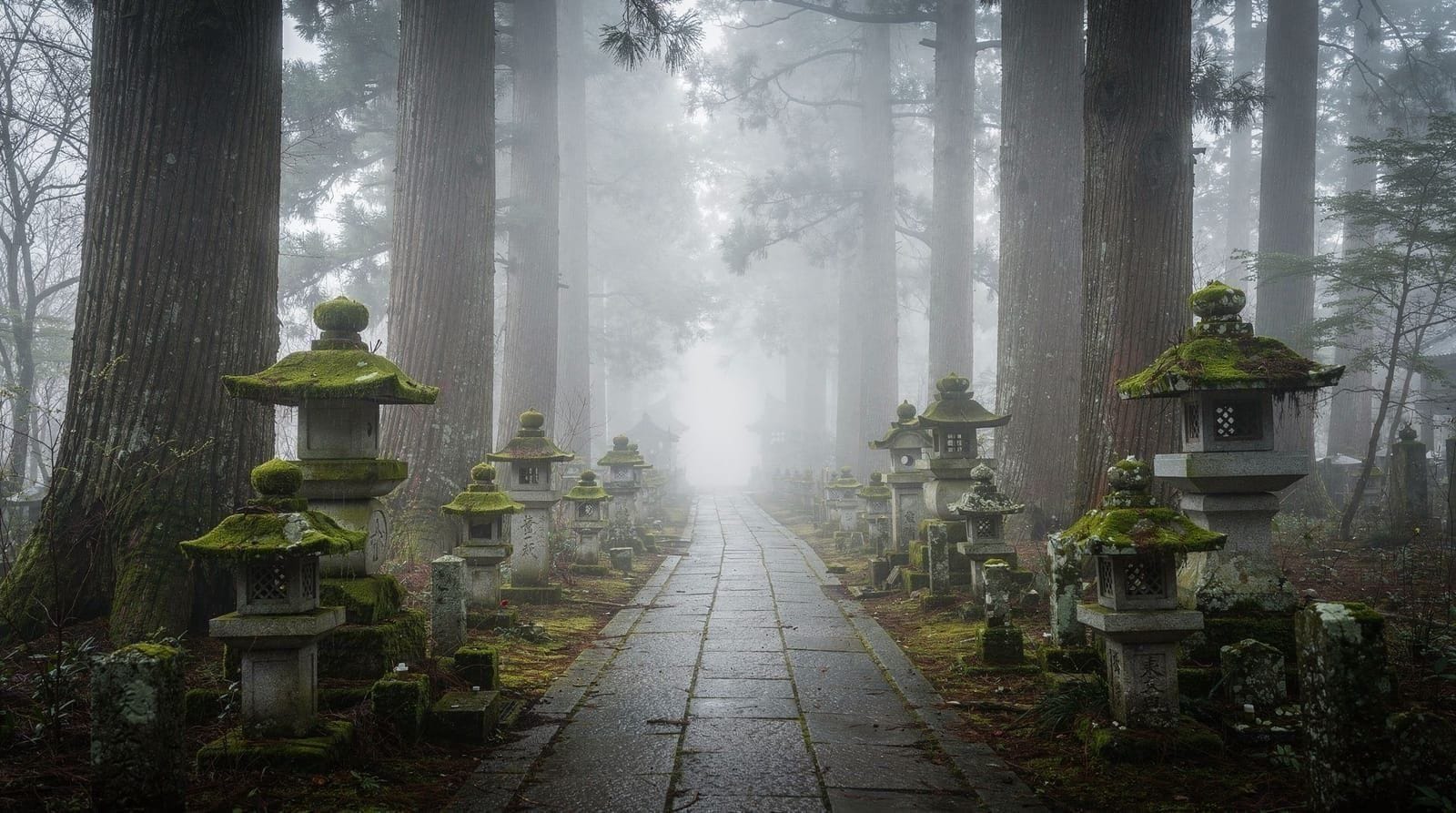
Okunoin is Japan’s largest cemetery, a two-kilometer path through old-growth cedar forest lined with over 200,000 gravestones, memorial monuments, and company-sponsored tombs (several major Japanese corporations maintain memorial markers here for deceased employees, an unusual but genuine tradition) leading to Kobo Daishi’s mausoleum, where Shingon tradition holds he remains in eternal meditation rather than having died.
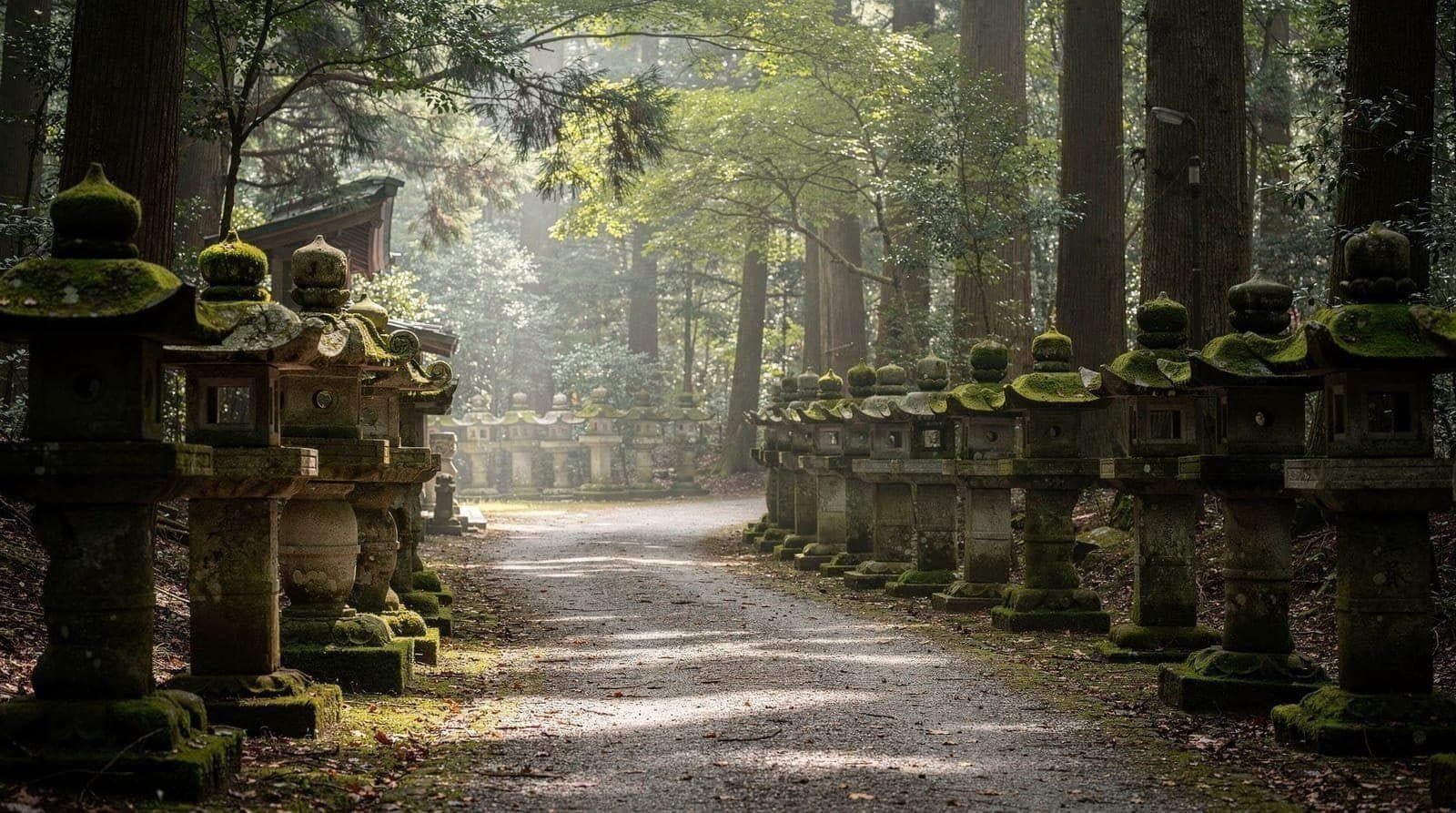
The walk from the Ichinohashi entrance bridge to the inner sanctuary takes about 40-50 minutes at an unhurried pace, and it’s a genuinely different experience depending on the time of day: midday brings a steady flow of visitors and tour groups, while early morning or after dark, when moss-covered stone lanterns line the path and mist often clings to the cedars, the cemetery takes on the quiet, slightly eerie atmosphere that draws people to Koyasan in the first place. The Torodo Hall, near the inner sanctuary, has burned continuously for over a thousand years according to temple tradition and houses thousands of lanterns donated by pilgrims.
Okunoin at dawn and after dark guided tour is built specifically around these two quieter windows, timed to avoid the midday tour bus crowds that otherwise dominate the main path.
Shukubo, staying at a temple
Around 50 of Koyasan’s temples offer shukubo lodging, and staying overnight is genuinely the point of visiting rather than an optional add-on — day-trippers see the major sights but miss the two things that make Koyasan distinct: an evening walk through Okunoin without crowds, and shojin ryori, the strict vegetarian monastic cuisine served at dinner and breakfast, built around tofu, seasonal vegetables, and no meat, fish, or pungent alliums (onion and garlic are excluded under traditional Buddhist dietary rules). A night’s stay typically runs ¥15,000-25,000 (~$139-$232) per person including both meals, and some temples invite guests to observe or join the morning goma fire ritual or sutra-chanting session, usually starting around 6am.
Rooms are traditional tatami-mat style with futon bedding, and most temples share communal or gender-separated baths rather than private en-suite facilities — a genuine adjustment for visitors used to hotel-standard privacy, and one worth knowing before booking rather than discovering on arrival.
The honest caveat on comfort: nights get cold given the mountain’s roughly 800-meter elevation, even in warmer months, and older temple buildings are not centrally heated the way a hotel is — bring a layer beyond what feels necessary in Osaka, especially for a spring or autumn visit, and expect a very early wake-up if you’re joining morning prayers.
Okunoin cemetery and Kobo Daishi mausoleum tour is a solid daytime introduction to the site’s history and Shingon Buddhist context if you’re not staying overnight, or want context before an evening walk on your own. For the practicalities of booking and what to expect from a night at a temple, see the Koyasan temple stay guide and the Koyasan first-timer notes.
Kongobu-ji and Danjo Garan
Kongobu-ji, the head temple of Shingon Buddhism, sits in the center of town and holds Japan’s largest rock garden, Banryutei, laid out in 1984 to represent a pair of dragons emerging from a sea of clouds using raked white gravel and over 140 granite stones sourced from Kobo Daishi’s home region of Shikoku. Entry (¥1,000, ~$9.25) includes access to the temple’s painted sliding-door screens (fusuma-e), some dating to the Edo period.
A short walk away, the Danjo Garan complex is Koyasan’s original monastic center, anchored by the vividly vermilion Konpon Daito, a two-story pagoda said to represent the cosmic center of Shingon Buddhist teaching, alongside the older Kondo (main hall). Entry to the pagoda’s interior is a modest additional fee (around ¥500, ~$4.65), and the grounds themselves are free to walk.
Koyasan highlights 4-hour guided tour covers Kongobu-ji, Danjo Garan, and a section of Okunoin in a single guided walk, a practical option for a day-trip visit that wants context on Shingon Buddhism without piecing it together from temple pamphlets.
Daimon Gate
At the western edge of town, the Daimon Gate marks the traditional main entrance to Koyasan — a towering vermilion two-story structure rebuilt in 1705 after earlier versions burned, flanked by a pair of fierce wooden Nio guardian statues. Standing beneath it on a clear day offers a sweeping view down the mountainside toward the Kii Peninsula’s ranges below, and it’s a genuinely striking, under-visited counterpoint to Okunoin’s forest atmosphere — most visitors arrive by cable car and bus into the town center and never see this gate unless they specifically walk or bus out to it. It’s free to visit and a reasonable stop on the way to or from a longer walk around the plateau’s western edge.
Kobo Daishi and Shingon Buddhism
Understanding why Koyasan looks and feels the way it does helps make sense of what might otherwise seem like an arbitrary collection of temples: Kobo Daishi, born Kukai in 774, studied esoteric Buddhism in China before returning to Japan and founding Shingon, a school built around ritual, mantra, and mandala rather than the meditation-focused practices more associated with Zen.
He chose Koyasan’s remote, flat mountaintop plateau specifically for its isolation from the political court in Kyoto and Nara, and the mountain has functioned as Shingon’s headquarters continuously since 816. Shingon tradition holds that Kobo Daishi did not die in 835 but entered eternal meditation (nyujo) inside his mausoleum at Okunoin, where monks continue to bring him meals twice daily to this day — a practice performed without interruption for over 1,100 years, regardless of whether anyone actually believes he’s still there in a literal sense.
Vegetarian and vegan travelers
Shojin ryori, the traditional shukubo dinner and breakfast, is naturally vegan by design — no meat, fish, dairy, egg, or the pungent alliums (onion and garlic) that some Buddhist dietary traditions exclude alongside meat — which makes Koyasan one of the more reliably accommodating overnight stops in Kansai for vegetarian and vegan travelers, without needing to request a special menu the way you might at a standard ryokan or hotel. Worth mentioning any specific allergies when booking, since some dishes use miso, soy sauce, or wheat-based gluten (fu) as protein substitutes.
Reiho-kan Museum
Koyasan’s Reiho-kan Museum, near the entrance to Danjo Garan, holds a collection of Buddhist statuary and temple treasures accumulated over the mountain’s 1,200-year history, including several nationally designated Important Cultural Properties. Entry is ¥1,300 (~$12.05), and it’s a useful stop for context on the artistic and religious history behind what you’re otherwise seeing spread across dozens of temple grounds.
Day trip versus overnight
A day trip from Osaka is logistically possible — round-trip travel takes roughly four hours, leaving four to five hours on the mountain, enough to see Okunoin’s main path, Kongobu-ji, and Danjo Garan at a reasonable pace. But it misses the two things that define Koyasan for most visitors: an evening or dawn walk through Okunoin without the midday crowds, and an overnight temple stay with shojin ryori cuisine. If your Kansai itinerary has any flexibility, one night here is the difference between “visited a UNESCO site” and actually experiencing what makes it distinct.
Private day trip walking tour from Osaka to Mt Koya is the practical option if an overnight genuinely isn’t possible, covering the main sights with transport handled in a single long day.
Luggage and practical notes
Because the journey up involves a train, a cable car, and a bus, hauling large suitcases the whole way is a genuine hassle — many visitors use a same-day or next-day luggage forwarding service (takuhaibin) from their Osaka or Kyoto hotel directly to their Koyasan temple, arriving separately from a lighter day bag. Cash is worth carrying in reasonable amounts, since some smaller temples and shops on the mountain don’t accept cards, and ATMs are limited to a couple of locations in town center. Wifi at shukubo temples varies from reliable to nonexistent, consistent with their generally unplugged, quiet character — worth setting expectations accordingly rather than assuming hotel-standard connectivity.
Getting around Koyasan
The town itself is walkable — Kongobu-ji, Danjo Garan, and the temple lodging district are within a 15-20 minute walk of each other, though Okunoin’s entrance is roughly 2km from the town center, a 25-30 minute walk or a short bus ride. Local buses run frequently between the cable car station, town center, and Okunoin’s two entrances (Ichinohashi and the closer Okunoin-mae, near the inner sanctuary), and are included in the Koyasan World Heritage Ticket.
Seasonal timing
Spring (April-May) and autumn (October-November) offer the most comfortable daytime temperatures for walking Okunoin’s forest path, with autumn foliage turning the cedar-and-maple mix along the cemetery path into one of the more striking seasonal displays in the Kansai region. Summer is cooler than Osaka thanks to the elevation, a genuine relief during the hottest months, though evenings still call for a light jacket.
Winter (December-February) brings snow, which transforms Okunoin’s lantern-lined path into something close to a different place entirely, but also closes some temple lodgings for the season and makes travel up the mountain slower and occasionally weather-dependent — worth checking specific temple availability before booking a winter stay. Visitors with time for a return trip beyond the main sights covered here will find plenty of lesser-visited temples and quieter corners of the mountain away from Okunoin’s main path, well suited to a second, slower visit.
Choosing a temple for your shukubo stay
With around 50 temples offering shukubo lodging, choosing between them can feel arbitrary from outside — a few practical distinctions help narrow it down. Some temples cater more heavily to English-speaking visitors, with staff able to explain the morning ritual and dietary details in English; others are more traditional and Japanese-only, which some visitors specifically seek out for authenticity.
Location within town matters too: temples closer to Okunoin’s Ichinohashi entrance suit an evening walk straight after check-in, while those nearer Kongobu-ji and Danjo Garan put you closer to the daytime sights. Booking through the Koyasan Shukubo Association’s official channels or a specialist agent generally gives clearer English-language information than contacting an individual temple directly without Japanese.
What to bring
Beyond warm layers for the cold nights, a few practical items make a shukubo stay noticeably more comfortable: slippers are usually provided but often run small for larger foreign feet, so a thin pair of your own socks or slip-ons helps; earplugs are worth packing if you’re a light sleeper, since older wooden buildings carry sound between rooms more than a modern hotel; and a portable phone charger is sensible, since outlets in traditional tatami rooms are sometimes limited to one per room. Toiletries are typically provided, but specific skincare or medication should be brought, since Koyasan’s small shops have a limited selection compared to a city convenience store.
Koyasan versus a Kyoto temple day trip
Visitors deciding between Koyasan and another day in Kyoto’s temple districts are comparing genuinely different experiences.
| Koyasan | Kyoto temple districts (e.g. Gion & Higashiyama) | |
|---|---|---|
| Travel time from Osaka | ~2 hours each way | 45-65 min each way |
| Best format | Overnight (shukubo) | Day trip |
| Crowd level | Low, even in peak season | High, especially 10am-4pm |
| Signature experience | Temple lodging, dawn cemetery walk | Historic streets, geisha district |
Koyasan asks for more time and logistics but rewards it with an experience — an evening walk through Okunoin without crowds, a monastic dinner — that no single-day Kyoto visit can replicate. If your schedule only allows day trips, Kyoto is the more time-efficient choice; if you can spare one overnight anywhere in Kansai, Koyasan is the strongest single candidate for it.
Koyasan beyond Okunoin guided tour is worth considering for a second visit or a longer stay, covering lesser-known corners of the mountain past the main cemetery path and Kongobu-ji.
Pairing Koyasan with the rest of Kansai
Koyasan sits in Wakayama Prefecture, and the same Nankai rail line that connects it to Osaka continues on toward Wakayama and the Kii Peninsula’s coast, making a Koyasan-plus-Wakayama loop a reasonable extension for visitors with three or more days to spend south of Osaka.
Some historic pilgrims also walked between Koyasan and the Kumano Kodo’s shrines further south, a route referenced today in a handful of guided itineraries connecting the two, though it requires a full extra day given the distances involved. For those focused on a single overnight, the Koyasan overnight itinerary lays out a two-day plan combining the cable car arrival, an afternoon at Danjo Garan, an evening Okunoin walk, a temple stay dinner, and a morning departure the next day.
What a two-day, one-night trip actually looks like
A realistic overnight plan: arrive by early afternoon via the Nankai Koya Line and cable car, check into your shukubo temple and drop bags, then spend the afternoon at Kongobu-ji and Danjo Garan before an early Okunoin walk as the light fades. Dinner (shojin ryori) is typically served early, often by 6pm, followed by a quiet evening on the mountain — most shops and even some temple areas close early.
If your temple offers a morning ritual, expect a wake-up around 6am, then breakfast, a final walk through Okunoin in the cooler morning light, and a return to Osaka by early afternoon. This structure gets the two things day-trippers miss (an uncrowded Okunoin visit and the shukubo experience itself) without requiring a second full day on top of the overnight.
Frequently asked questions about Koyasan
How do I get from Osaka to Koyasan?
Take the Nankai Koya Line from Namba Station to Gokurakubashi Station (about 90-100 minutes), then the Koyasan Cable Car up to Koyasan Station (5 minutes), followed by a short local bus into town. Total travel time is close to two hours, and the Koyasan World Heritage Ticket bundles the round-trip train fare with unlimited local buses.
Is a temple stay (shukubo) worth it?
Yes, if you can fit one night into your itinerary — it includes vegetarian monastic cuisine (shojin ryori) and, at many temples, an invitation to a morning prayer or fire ritual, which is the difference between seeing Koyasan’s sights and experiencing the mountain’s actual daily rhythm. Rooms are traditional tatami style, often with shared baths.
How cold does it get at Koyasan at night?
Given the roughly 800-meter elevation, nights are noticeably cooler than Osaka even in spring and summer, and temple buildings are not centrally heated the way hotels are. Bring a layer beyond what the daytime weather in Osaka would suggest, especially outside summer.
Can I visit Koyasan as a day trip?
Yes, logistically — round-trip travel takes about four hours, leaving four to five hours on the mountain, enough for Okunoin’s main path, Kongobu-ji, and Danjo Garan. It misses the evening cemetery walk and temple-stay cuisine that most visitors consider the point of coming.
What is Okunoin?
Okunoin is Japan’s largest cemetery, a two-kilometer path through old-growth cedar forest lined with over 200,000 memorial monuments, leading to the mausoleum of Kobo Daishi, the founder of Shingon Buddhism, who is held in tradition to remain in eternal meditation there.
What should I eat at a Koyasan temple stay?
Shojin ryori, strict Buddhist vegetarian cuisine built around tofu and seasonal vegetables, with no meat, fish, onion, or garlic. It’s typically served as a multi-course set for both dinner and breakfast, included in the price of the stay.
What’s the best time of year to visit Koyasan?
April-May or October-November for the most comfortable daytime temperatures. Summer is cooler than Osaka thanks to the elevation. Winter brings snow and a genuinely different atmosphere on the Okunoin path, but also colder nights and some temple lodgings closed for the season.
Is Koyasan better than a day trip to Kyoto for a temple experience?
They’re different rather than directly comparable — Kyoto’s temple districts are more time-efficient for a single day and pack in more variety, while Koyasan’s overnight shukubo experience goes deeper into a single, specific practice. If you have to choose only one for a short trip, Kyoto suits limited time; Koyasan suits travelers with a spare overnight who want something Kyoto’s day-trip pace can’t offer.
Do I need to book a temple stay in advance?
Yes — shukubo lodging has limited capacity per temple and fills up, especially on weekends and during spring and autumn foliage season, so booking at least a few weeks ahead is worth doing rather than arriving and hoping for a room.
Top experiences
Bookable activities with verified prices and instant confirmation on GetYourGuide.