Temple stays at Koyasan
Koyasan: Koyasan meditation journey Osaka
What is a Koyasan temple stay and how much does it cost?
A shukubo (temple lodging) stay at Koyasan runs roughly ¥15,000-25,000 per person per night, including a shojin ryori vegetarian dinner and breakfast, a tatami room, and access to the temple's morning prayer service. Around 50 of Koyasan's temples offer overnight stays to visitors, bookable through the Koyasan Shukubo Association or directly.
Spending a night inside one of Koyasan’s roughly 50 shukubo — temple lodgings offering overnight stays to ordinary visitors, not just pilgrims — is one of the more genuinely distinctive experiences available in the Kansai region, and one that most Kyoto- or Osaka-based itineraries skip entirely simply because it requires an overnight commitment rather than a day trip. A shukubo stay isn’t a themed hotel with temple decor; it’s an actual working Buddhist temple that happens to rent rooms, complete with vegetarian meals prepared by resident monks and an early-morning prayer service guests are welcome, though not required, to attend.
| Where | Koyasan (Mount Koya), roughly 2 hours from Osaka |
| Cost | ¥15,000-25,000/person/night, incl. 2 meals |
| Included | Tatami room, shojin ryori dinner + breakfast, morning prayer access |
| Booking | A few weeks ahead via Koyasan Shukubo Association |
| Best for | Early access to Okunoin before day-trippers arrive |
What Koyasan actually is
Koyasan (Mount Koya) is the headquarters of Shingon Buddhism, founded in the early 9th century by the monk Kobo Daishi (Kukai) as a secluded mountain training complex, and it has functioned continuously as a monastic center ever since. The town itself sits at roughly 800 meters elevation, surrounded by cedar forest, and includes both the working temple complex and Okunoin, Japan’s largest cemetery, covered in full in the Okunoin guide. The temple stay is what turns a Koyasan visit from a rushed day trip into something closer to a genuine retreat.
What’s actually included in a stay
A standard shukubo booking includes a tatami-mat room (often simple, futon-based bedding rather than a Western bed), a shojin ryori dinner, breakfast the following morning, and access to the temple’s early-morning prayer service. Shojin ryori is traditional Buddhist vegetarian cuisine — no meat, fish, garlic, or onion — built around tofu, seasonal vegetables, and rice, typically served as a multi-course meal that surprises guests expecting a plain, restrictive menu; many temples take real pride in the variety and presentation despite the ingredient limits. Prices run roughly ¥15,000-25,000 per person per night depending on the temple, room type, and whether the bathroom is private or shared.
Koyasan meditation journey from Osaka is a useful way to pair a day-trip introduction to Koyasan’s meditation practices with the option to extend into an overnight stay for travelers still deciding.
The morning prayer service
Most shukubo hold a morning service around 6am, involving sutra chanting led by resident monks, sometimes with a fire ritual (goma) at temples that practice it, and occasionally an opportunity for guests to participate directly in incense offerings. Attendance is optional at nearly every temple but strongly encouraged, and skipping it arguably defeats much of the reason to choose an overnight stay over a standard day trip — this is the one part of the experience that a day-tripper simply cannot access, since it happens before the first tour buses or trains arrive on the mountain.
Booking: what to know
The Koyasan Shukubo Association coordinates reservations across most of the roughly 50 participating temples and is the most straightforward starting point for first-time bookers, though many individual temples also accept direct reservations through their own sites or through general travel booking platforms. English-language support varies by temple — some are well set up for international guests, others less so — and booking at least a few weeks ahead is advisable, particularly around autumn foliage season (November) and summer school holidays, when demand rises noticeably.
Bathing and daily etiquette
Most shukubo provide a yukata (a light cotton robe) for guests to wear around the temple grounds and during the evening, and bathing generally follows standard Japanese onsen-style etiquette: washing and rinsing thoroughly before entering a shared communal bath, since the water itself is meant to stay clean for other bathers. Some temples offer private bathing options for guests uncomfortable with a shared bath. Toiletries are sometimes provided but not guaranteed across all temples, so packing a toothbrush and basic essentials is the safer approach.
Okunoin cemetery and Kobo Daishi guided tour pairs naturally with an overnight stay, since it allows a proper daytime visit to the cemetery in addition to any early-morning or evening walk guests take independently from their temple lodging.
Early morning at Okunoin: the real payoff
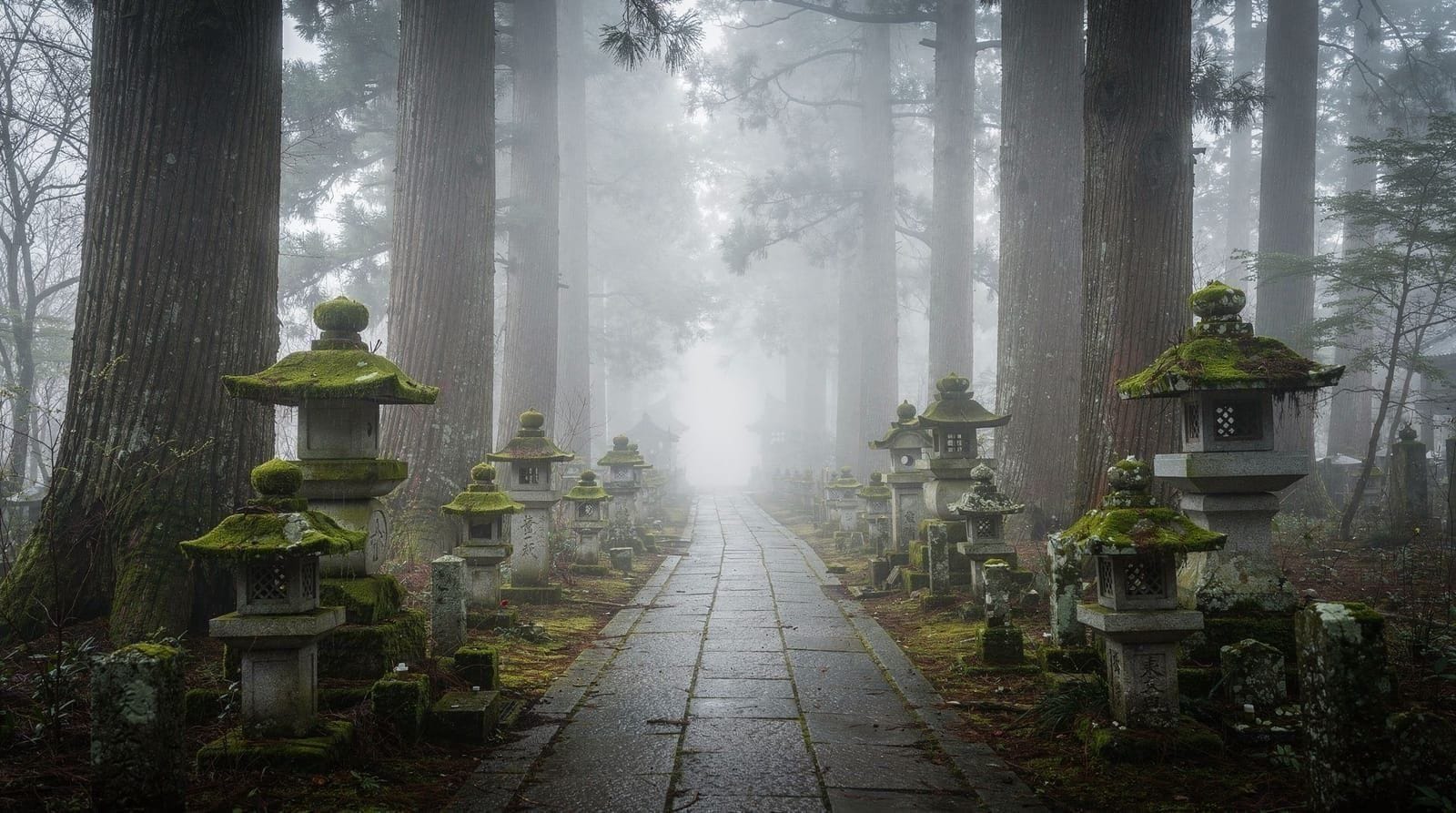
The single biggest practical advantage of staying overnight rather than day-tripping is timing access to Okunoin, the forest cemetery leading to Kobo Daishi’s mausoleum. Guests staying at a shukubo can walk the roughly 2-kilometer path at dawn, before day-trippers arrive from Osaka or Kyoto, when the cedar forest is at its quietest and the morning light filters through the canopy in a way that simply isn’t available to someone catching a return train that afternoon.
Sacred silence: Okunoin at dawn and after dark tour is built specifically around these low-light windows and pairs naturally with an overnight stay’s schedule.
Getting to Koyasan and planning the trip
Reaching Koyasan from Osaka takes roughly 2 hours via the Nankai Electric Railway to Gokurakubashi Station, followed by a cable car up the mountain and a short local bus into town — a combination covered by the discounted Koyasan World Heritage Ticket sold at Nankai stations in Osaka. Given the transit time in each direction, an overnight stay is a considerably more efficient use of the trip than a same-day round trip, which leaves little time on the mountain itself after accounting for roughly 4 hours of combined travel.
Mount Koya full-day private guided tour from Osaka is a solid option for travelers who want a guided day on the mountain before or after an independently booked overnight shukubo stay.
Choosing which shukubo to book
With roughly 50 temples offering stays, differences between them matter more than the general category suggests. Some, like Ekoin and Henjoson-in, have built particular reputations among international travelers for consistent English-language support, welcoming staff accustomed to non-Japanese guests, and clearly explained programs; others cater more to domestic pilgrims and Japanese tour groups, with less English signage or explanation.
Room configurations vary too — some temples offer private bathrooms as standard, others rely on shared bathing facilities down the hall, and a few offer more premium rooms with garden views at a price premium over the standard rate. Reading recent guest reviews focused specifically on English support and room type, rather than booking the first available option, tends to produce a better match for first-time visitors.
What a typical evening and morning schedule looks like
Check-in typically runs from mid-afternoon, followed by free time to explore the temple grounds or walk to nearby sights like the Danjo Garan complex before dinner, usually served around 5:30-6:30pm in a communal or private dining area depending on the temple. After dinner, some temples offer an evening meditation or informal talk session, though schedules vary. Lights-out and quiet hours are generally expected by around 9-10pm, in keeping with the early wake-up for the 6am service. Breakfast follows the morning prayer, typically simpler than dinner but still shojin ryori style, and check-out is usually by mid-morning, leaving a window for an early Okunoin walk beforehand for guests who prioritize that over a slower breakfast.
Family and solo travel considerations
Shukubo generally welcome families, though room configurations are built around Japanese-style group sleeping on tatami with futons rather than separate beds, which works well for families comfortable sharing a single room but less naturally for groups wanting private separate sleeping spaces. Solo travelers are also welcome at most temples, sometimes at a modest per-person surcharge compared to shared double-occupancy pricing, a common practice across Japanese lodging generally rather than something specific to shukubo.
Cancellation policies and flexibility
Cancellation terms vary meaningfully between temples, with some offering full refunds up to a few days before arrival and others enforcing stricter, non-refundable policies closer to check-in given the fixed cost of preparing a set meal count in advance — worth confirming at booking rather than assuming a standard hotel-style flexible cancellation window applies universally across all 50 participating temples. Travel insurance covering pre-paid accommodation is a reasonable safeguard given how far in advance a shukubo booking is typically made relative to the trip itself.
What guests say surprises them most
Repeat visitors and reviewers of Koyasan shukubo stays frequently mention two things that surprise first-timers: how genuinely good the shojin ryori food is despite the ingredient restrictions, often described as more flavorful and varied than expected from a purely vegetarian, no-allium menu, and how cold the rooms can get in shoulder and winter seasons, since many older temple buildings rely on space heaters and thick futons rather than centralized heating throughout. Packing an extra layer for sleeping, even in temperatures that wouldn’t feel cold in a modern hotel, is a commonly repeated piece of practical advice from past guests, particularly for stays between November and March.
A comparison: shukubo versus a standard ryokan
A shukubo shares some surface similarities with a standard Japanese ryokan (traditional inn) — tatami rooms, multi-course traditional meals, communal or shared bathing — but differs in its explicitly religious framework, the vegetarian shojin ryori menu rather than a ryokan’s typically seafood-and-meat-forward kaiseki dinner, and the option (though not requirement) to participate in the temple’s actual religious practice. Guests expecting a purely luxury hospitality experience identical to a high-end ryokan should adjust expectations toward something closer to comfortable, well-fed monastic simplicity rather than five-star indulgence, even at the more premium shukubo options.
Language and communication at a shukubo
Even at temples with strong English support, communication during a shukubo stay tends to be more limited than at a standard international hotel — monks and temple staff are primarily religious practitioners rather than hospitality professionals, and the interaction, while warm, is generally more formal and reserved than the customer-service-oriented friendliness expected at a Western hotel chain. Simple translation apps cover most practical needs (meal timing, bathing facility questions, check-out logistics), and most temples handling regular international guests have developed simple picture-based or bilingual signage for the most common questions.
Vegetarian and dietary considerations beyond shojin ryori
Because shojin ryori is already vegetarian by design, guests with standard vegetarian dietary needs are automatically accommodated without special request. Guests with additional allergies or dietary restrictions (nut allergies, severe soy sensitivity given tofu’s central role in the cuisine) should flag this clearly at booking, since substitution options may be limited given the traditional, fixed nature of most shukubo meal programs compared to a modern restaurant’s flexible menu. Vegan guests are generally well served by default, since shojin ryori excludes dairy and eggs as a matter of traditional practice, though confirming this with the specific temple avoids any surprises around less obvious ingredients.
Packing for a Koyasan overnight stay
Beyond standard overnight essentials, a few Koyasan-specific packing notes are worth keeping in mind: warm layers even in shoulder seasons given the mountain’s cooler elevation and often under-heated older buildings, comfortable slip-on shoes given how frequently guests remove and put on footwear moving between rooms and communal areas, and a flashlight or phone light for navigating between buildings after dark at some of the older, dimly lit temple compounds. Formal or fancy clothing isn’t expected or necessary — the overall atmosphere is simple and monastic rather than upscale hospitality, and casual, comfortable clothing suits the setting better than anything more formal.
Reviews and choosing a first-time shukubo
For a first Koyasan stay, choosing a temple with an established track record of hosting international guests — reflected in consistent, detailed reviews mentioning English support and clear explanations of the schedule — reduces the chance of a communication gap disrupting an otherwise valuable experience. Some travelers specifically prioritize temples known for a more elaborate morning goma fire ritual over others with a simpler sutra-chanting-only service, a distinction worth researching in advance if a specific ceremonial experience is the primary motivation for choosing a shukubo stay over a standard hotel in the first place.
Why some temples decline same-day or last-minute bookings
Because shukubo meals are prepared fresh for a known number of guests and staff schedules are built around a fixed set of daily services, most temples require reservations well in advance rather than accommodating same-day walk-ins, a contrast to how a standard hotel might handle last-minute availability. This isn’t simply a booking preference — it reflects the genuine logistics of a small monastic community preparing traditional multi-course meals and managing a working religious schedule alongside guest hospitality, rather than a hotel with dedicated, scalable hospitality staff.
The wider Koyasan Shukubo Association’s role
Beyond simply coordinating bookings, the Koyasan Shukubo Association plays a broader role in maintaining consistent standards across the roughly 50 participating temples, including guidance on guest treatment, meal quality, and English-language accessibility for the growing number of international visitors choosing Koyasan as a cultural stay destination rather than a purely religious pilgrimage stop. This institutional support has helped Koyasan’s shukubo tradition adapt to modern tourism demand while preserving its essential religious character, a balance that’s made the mountain’s temple stays considerably more accessible to first-time international visitors than they might have been a generation ago.
Koyasan’s status as a UNESCO World Heritage pilgrimage site
Koyasan is inscribed as part of the “Sacred Sites and Pilgrimage Routes in the Kii Mountain Range” UNESCO listing alongside the Kumano Kodo pilgrimage trails in nearby Wakayama, a designation recognizing the mountain’s continuous role as a living center of religious practice rather than simply a historical monument. This distinguishes Koyasan’s shukubo tradition from many other “experience a temple stay” offerings marketed to tourists elsewhere in Japan, since the practice here sits within a formally recognized, unbroken pilgrimage tradition rather than a recently packaged cultural product designed primarily for visitors.
A brief note on cost relative to the experience
At ¥15,000-25,000 per person per night, a shukubo stay costs roughly in line with a mid-range business hotel in Osaka or Kyoto once meals are factored in, making it a reasonable rather than extravagant addition to a Kansai budget for travelers who’ve priced out standard accommodation for the same nights. Given that the price includes two meals and an experience unavailable at any conventional hotel, most travelers who’ve done the comparison consider it good value relative to a standard hotel stay plus separately purchased dinner and breakfast.
Why this experience resonates with travelers who try it
Reviewers who’ve stayed at a Koyasan shukubo consistently describe it as one of the more meaningful stops on a Japan trip, distinct from the sightseeing-heavy pace of Kyoto or Osaka precisely because it asks for less rather than more — an early bedtime, an early wake-up, a simple meal, a quiet forest walk — in a travel context that otherwise often rewards packing in as many sights as possible. This deliberate slowness, uncommon elsewhere on a typical Kansai itinerary, is frequently cited as the specific reason travelers remember a Koyasan overnight long after other, more visually spectacular stops have blurred together.
Solo travelers at a shukubo
Solo travelers are genuinely well accommodated at most shukubo, sometimes at a modest single-occupancy surcharge over shared double pricing, a common practice across Japanese lodging rather than something shukubo-specific. The communal aspects of a stay — shared dining in some temples, the morning prayer service alongside other guests — give solo travelers a built-in social touchpoint that a purely private hotel stay doesn’t offer, without requiring any active effort to seek out company, which some solo travelers specifically appreciate about the format.
Combining a shukubo stay with Koyasan’s broader temple complex
Beyond Okunoin, a shukubo stay leaves comfortable time to explore Koyasan’s Danjo Garan complex and Kongobuji head temple, both a short walk from most temple lodgings in the town center, without the time pressure a same-day round trip from Osaka would impose. Check-in’s mid-afternoon start typically leaves two to three hours free before dinner, enough for an unhurried visit to at least one of these additional sites, making the overnight stay a more complete introduction to Koyasan’s role as Shingon Buddhism’s headquarters than a single-site Okunoin day trip alone.
Shukubo versus a day trip: a direct comparison
| Day trip | Overnight shukubo | |
|---|---|---|
| Okunoin access | Daytime only | Dawn and after-dark |
| Morning prayer service | Not accessible | Included, optional |
| Total transit burden | 4 hours round trip in one day | Spread across two days |
| Meals | Bring your own or limited town options | Shojin ryori dinner and breakfast included |
| Cost | Transit only | ¥15,000-25,000/person/night |
| Best for | Tight schedules, limited time | Travelers prioritizing atmosphere over efficiency |
Photography and phone use during a shukubo stay
Beyond the strict no-photography rule near Okunoin’s mausoleum, covered in the Okunoin guide, most temples ask guests to keep phone use discreet during the morning prayer service and quiet hours in the evening, in keeping with the setting’s monastic character rather than a hard rule enforced by staff. Photographing the temple grounds, gardens, and your own room is generally fine outside the service itself, and many guests find the requested restraint during the prayer service adds rather than detracts from the experience, since it removes the usual impulse to document rather than simply be present for a genuinely rare morning ritual.
Building a temple stay into a Kansai itinerary
A Koyasan overnight works best as a dedicated one- or two-night detour from a broader Kansai trip based in Osaka or Kyoto, detailed in the Koyasan overnight itinerary, which sequences the trip from Osaka, through the temple stay, and back.
Travelers weighing whether a temple stay is worth the transit time against Kyoto’s more accessible temples — Fushimi Inari, Kinkaku-ji, and Kiyomizu-dera — should note that this isn’t a substitute for those visits so much as a genuinely different category of experience, closer in spirit to the practices covered in the zen meditation guide than to conventional sightseeing. For broader orientation to the Koyasan destination and how it fits alongside Nara and Kyoto in a longer Kansai trip, see those guides for sequencing advice.
Frequently asked questions about Temple stays at Koyasan
How much does a Koyasan shukubo temple stay cost?
Prices typically run ¥15,000-25,000 per person per night, including two shojin ryori meals (vegetarian temple cuisine) and a tatami-style room. Prices vary by temple, room type, and whether a private bathroom is included versus a shared facility.What is shojin ryori, the food served at a temple stay?
Shojin ryori is traditional Buddhist vegetarian cuisine, excluding meat, fish, and pungent vegetables like garlic and onion, based on principles of minimizing harm and cultivating mindfulness through eating. Meals are typically multi-course, using tofu, seasonal vegetables, and rice prepared in varied, often surprisingly rich ways despite the restrictions.Do guests have to attend the morning prayer service?
Attendance is usually optional but strongly encouraged, and most guests do attend — it typically starts around 6am and includes sutra chanting, sometimes with an opportunity to try the ceremonial incense offering. It's one of the main reasons to choose an overnight stay over a day trip.How do I book a temple stay at Koyasan?
The Koyasan Shukubo Association coordinates bookings across most participating temples, and many temples also accept direct reservations through their own websites or third-party booking platforms. Booking at least a few weeks ahead is recommended, especially for temples with English-language support or during peak autumn foliage and summer travel seasons.What should I bring or expect regarding bathing at a shukubo?
Most shukubo provide a yukata (light cotton robe) to wear during the stay, and bathing follows standard Japanese onsen-style etiquette — washing and rinsing before entering a shared bath, though some temples offer private bathing options. A toothbrush and basic toiletries are sometimes provided but not guaranteed, so packing your own is safer.Is a Koyasan temple stay worth it if I'm not religious?
Yes — most guests aren't Buddhist practitioners, and the temples are accustomed to hosting visitors purely interested in the cultural and historical experience. The value is in the food, the setting, the early-morning access to Okunoin before day-trippers arrive, and the prayer service itself, regardless of personal belief.How cold do Koyasan shukubo rooms get in winter?
Genuinely cold by modern hotel standards — many older temple buildings rely on space heaters and thick futons rather than centralized heating. Packing an extra sleeping layer is commonly recommended by past guests, especially for stays between November and March.Can families with children stay at a Koyasan shukubo?
Yes, most temples welcome families, though rooms are typically shared tatami spaces with futons rather than separate beds, which suits families comfortable sleeping in one room together better than those wanting private separate spaces.
Top experiences
Bookable activities with verified prices and instant confirmation on GetYourGuide.