Kinkaku-ji guide
Kyoto: Kyoto Kinkaku-ji golden pavilion guided tour
Duration: 1.5 hours
What is Kinkaku-ji and how much does it cost to visit?
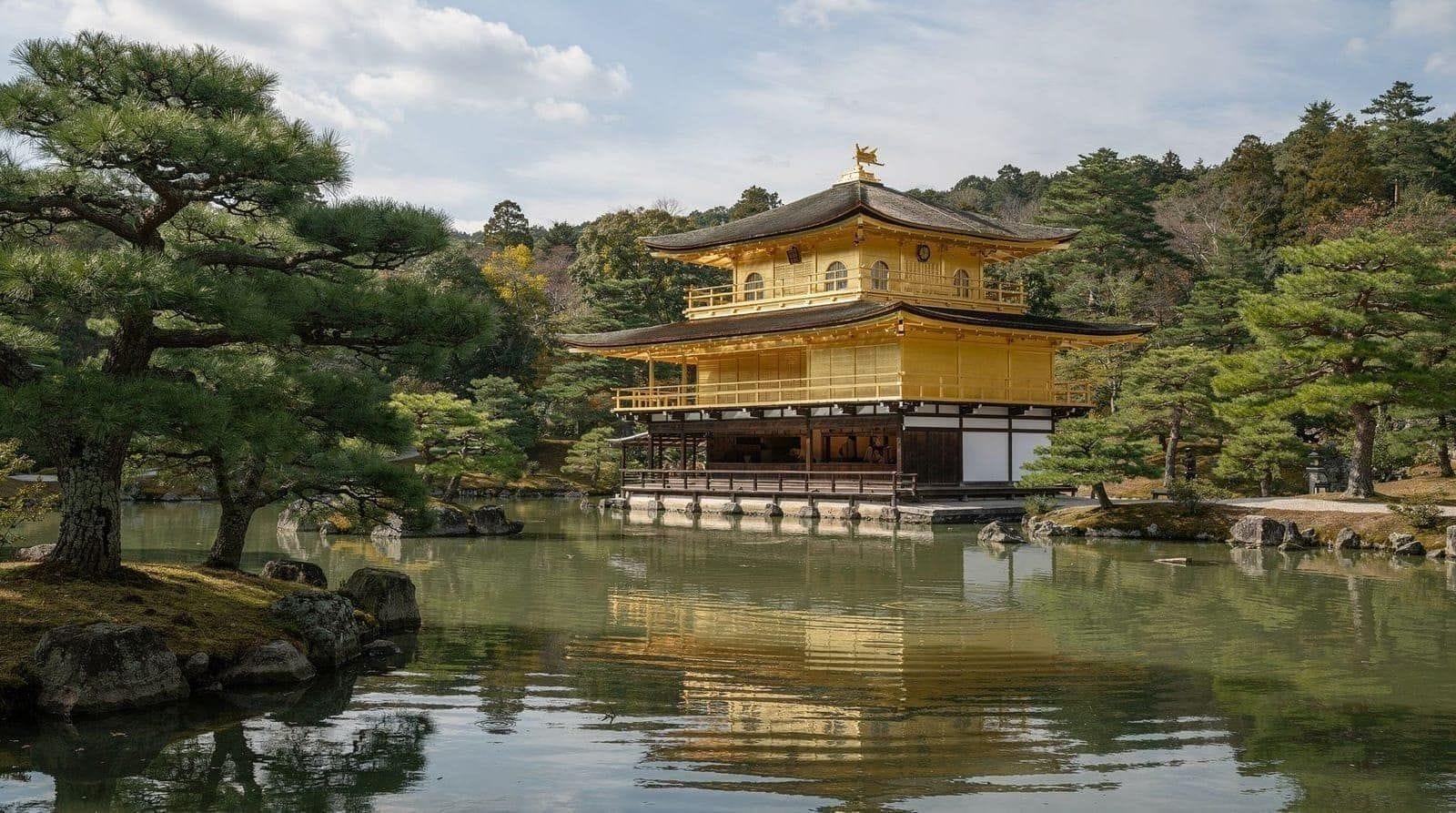
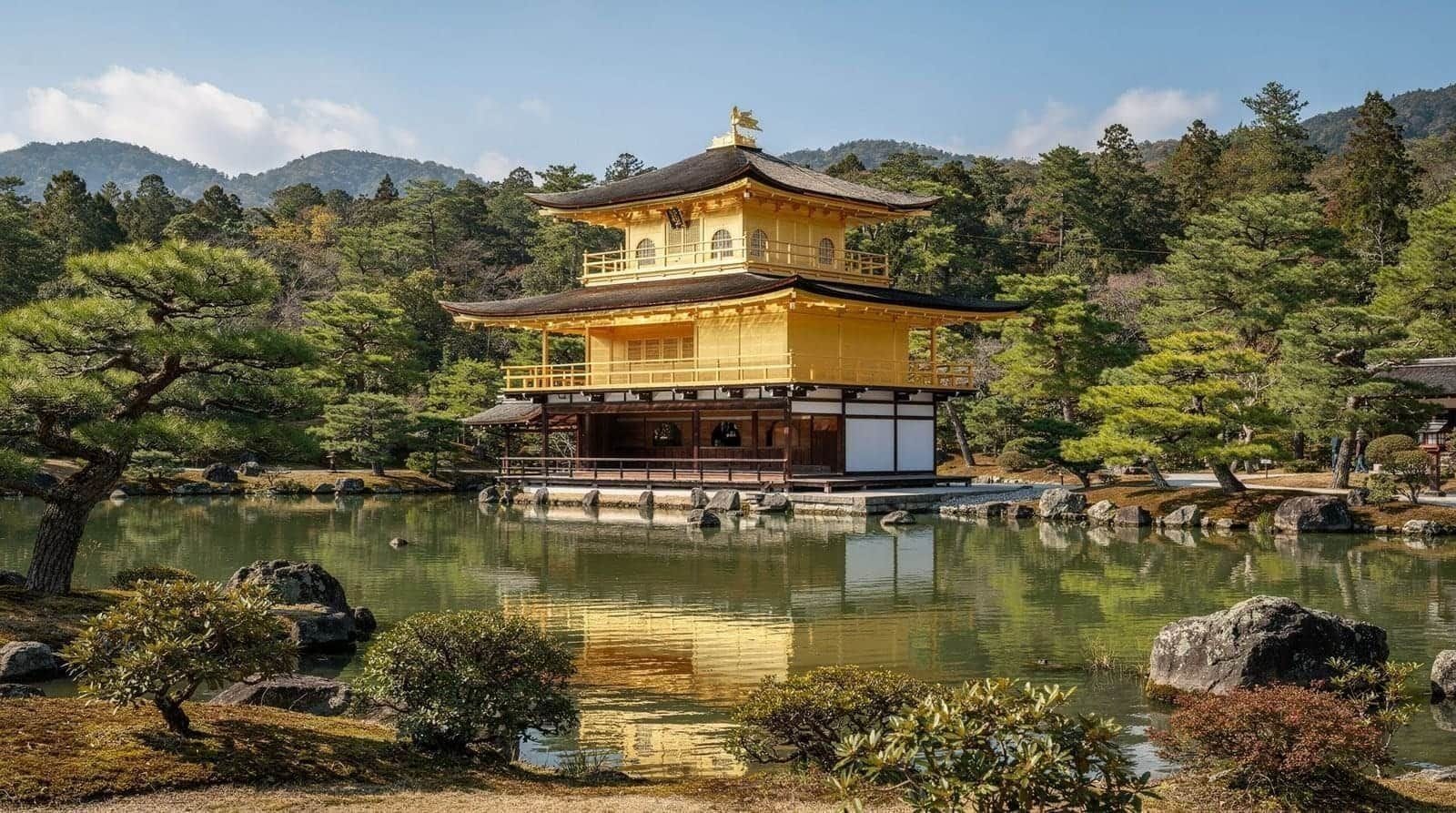
Kinkaku-ji (formally Rokuon-ji) is a Zen temple in northern Kyoto whose top two floors are covered in gold leaf, reflected in a pond garden. Admission is ¥500 (about $3.70), open daily 9am-5pm, with no interior access — visitors follow a garden path viewing the pavilion from set points rather than entering the building.
A three-story pavilion covered in gold leaf, sitting on the edge of a still pond that doubles its image on a calm day, is a striking enough sight that Kinkaku-ji doesn’t need much marketing — it’s Kyoto’s second most-visited site after Fushimi Inari and shows up on nearly every list of Japan’s essential views. What tends to surprise first-time visitors is how compact the site is, how firmly access is limited to a single garden path, and how much of the temple’s real story involves a 1950 arson case rather than the placid image on the postcards.
| Where | Northern Kyoto, reached by bus (101/205) |
| Cost | ¥500 (about $3.70) |
| Time needed | 30-45 min |
| Hours | Daily 9am-5pm |
| Best time | First hour after opening or last hour before close |
What Kinkaku-ji actually is
Formally named Rokuon-ji, the temple began as a retirement villa for shogun Ashikaga Yoshimitsu in the late 14th century and was converted into a Zen Buddhist temple after his death, per his will. The building’s top two floors are covered in gold leaf — the third floor represents a Zen Buddhist style, the second a samurai residence style, and the ground floor a Heian-period aristocratic style, a deliberate layering of eras in a single structure. It sits within the Kyoko-chi pond (“mirror pond”), which contains several small islands and rocks, each with symbolic meaning tied to Buddhist cosmology, and the reflection of the gold facade in the water is the image most visitors come for.
The fire that everyone eventually asks about
The building standing today is not the 14th-century original. In 1950, a young monk at the temple set fire to the pavilion, destroying it completely; he was later found to have serious mental health issues and the case became a significant cultural event in postwar Japan, forming the basis for Yukio Mishima’s 1956 novel “The Temple of the Golden Pavilion.” The current structure is a 1955 reconstruction, and the gold leaf covering seen today — considerably more extensive and lustrous than what covered the original building — dates to a more thorough 1987 restoration.
None of this diminishes the site’s UNESCO World Heritage status, which recognizes the temple grounds and garden design as part of the Historic Monuments of Ancient Kyoto, but it’s worth knowing before assuming you’re looking at a 600-year-old building.
Visiting: admission, hours, what you’ll actually see
Admission is ¥500 (about $3.70), paid at the entrance gate, and the ticket itself is a printed wooden talisman rather than a standard paper stub — a small, distinctive souvenir in its own right. The temple is open daily from 9am to 5pm with last entry shortly before closing. There is no access to the building’s interior; the visit follows a fixed, one-way garden path that loops past the main pond-view photo point, up a small rise past a secondary garden and teahouse (Sekkatei), and out through a gift shop near the exit. The full loop takes most visitors 30-45 minutes, making Kinkaku-ji one of the faster major sights to work into a half-day itinerary alongside other northern Kyoto stops.
Guided Kinkaku-ji tour covers the three architectural styles stacked in the building and the details of the 1950 fire and reconstruction — context that the temple’s posted signage only briefly mentions.
Crowd timing
Unlike free, 24-hour sites such as Fushimi Inari, Kinkaku-ji’s admission fee and set closing time mean visitor numbers spread more evenly across the day rather than concentrating at sunrise. That said, the first hour after opening and the last hour before the 5pm close tend to be noticeably calmer than the late-morning to early-afternoon stretch, when tour groups and school trips are most likely to overlap at the main viewing point. Weekends and the cherry blossom and autumn foliage seasons intensify crowding at all hours.
Getting there
There’s no direct train service to Kinkaku-ji — it sits in northern Kyoto, away from the rail network that serves most of the city’s other major sights. City bus routes 101 and 205 run from Kyoto Station to the Kinkakuji-michi stop, a trip of roughly 40 minutes depending on traffic and time of day, and a one-day bus pass (available at the Kyoto Station bus terminal) usually pays for itself if Kinkaku-ji is one of two or more bus-reliant stops in the day. A taxi from central Kyoto takes about 20-25 minutes and costs more but sidesteps bus delays during rush hour or peak season.
What’s nearby
Ryoan-ji, a short bus ride from Kinkaku-ji, holds Japan’s most famous rock garden — a rectangle of raked white gravel with 15 stones arranged so that, from any single viewing angle along the veranda, at least one stone is always hidden from view, a design puzzle debated by scholars for centuries. Admission runs around ¥500-600.
Daitoku-ji, a working Zen monastery complex a bit further out, has several sub-temples open to visitors on rotating schedules — Daisen-in and Koto-in among them — with gardens that see a fraction of Kinkaku-ji’s foot traffic and reward visitors willing to add an extra bus connection. Both pair naturally with Kinkaku-ji into a northern Kyoto half-day, covered in more depth on the northern Kyoto destination page.
Combined Kinkaku-ji, Nijo Castle, and Nishiki Market tour is a reasonable option if you want to cover northern and central Kyoto’s highlights in a single guided day without managing bus transfers yourself.
The garden design behind the pond
Beyond the pavilion itself, Kyoko-chi pond was designed under the shogunate era’s aesthetic principles to represent the Buddhist Pure Land, a paradise realm described in Buddhist scripture, with ten small islands and rocks arranged across the water each carrying a specific symbolic reading tied to Chinese and Japanese Buddhist cosmology — a level of intentional design that’s easy to walk past without noticing, since most visitors’ attention understandably locks onto the gold facade rather than the water’s careful arrangement.
The garden path itself climbs a small hill above the pond, offering a slightly elevated, less crowded second view of the pavilion from behind and above, a composition fewer visitors bother to seek out compared to the standard ground-level shot.
What a visit actually feels like
Because access is restricted to a single fixed loop with no benches or extended lingering points beyond the main photo area, Kinkaku-ji functions more like a well-curated viewing experience than a wander-at-your-own-pace temple visit. Most visitors describe spending the bulk of their 30-45 minutes at the two or three designated viewing points, moving through the rest of the loop — the tea house, a small gift shop, a minor shrine dedicated to Fudo Myo-o along the path — at a brisker pace.
This isn’t a criticism so much as a practical note: arriving expecting a long, contemplative garden wander (the kind Ryoan-ji or Tenryu-ji offer) will feel different from what Kinkaku-ji actually delivers, which is closer to a single outstanding image experienced efficiently.
Weather and seasonal considerations
Kinkaku-ji’s gold facade against the pond photographs differently depending on season and weather. A light dusting of snow on the roof, which happens most winters at least briefly, is considered one of the most striking seasonal versions of the site by repeat visitors and photographers, though it’s unpredictable and can’t be planned around specifically.
Autumn maple color frames the pavilion from certain angles in November, and spring cherry blossoms are present in smaller numbers than at dedicated sakura spots elsewhere in the city. On overcast days, the pond’s mirror effect is often more pronounced than on bright sunny days, since direct sun creates glare on the water’s surface — a detail worth knowing if a cloudy day comes right when a Kinkaku-ji visit is scheduled and it’s tempting to reschedule.
Photography tips
The classic reflection shot works best from the main viewing platform roughly a third of the way around the loop, ideally with calm water (windy days disturb the reflection) and either soft overcast light or the golden hour shortly after opening or before closing. Crowds make it difficult to hold a single spot for long during peak hours, so patience or an early/late visit improves the odds of an unobstructed shot considerably. Tripods and extended setup are generally discouraged given the site’s foot traffic, and most visitors get a solid photo within a minute or two of reaching the main viewpoint rather than needing an extended session.
Comparing Kinkaku-ji to Kyoto’s other major temples
Kinkaku-ji’s appeal is fundamentally different from Fushimi Inari’s — one is a single striking image against water, the other a sprawling mountain trail of thousands of gates. It’s also a different experience from Kiyomizu-dera’s wooden hillside stage, which rewards a longer visit and pairs with the Higashiyama slope streets. Visitors trying to decide which Kyoto temples are worth prioritizing on a tight schedule will find a fuller side-by-side comparison in the best temples in Kyoto guide, which ranks Kinkaku-ji alongside Fushimi Inari, Kiyomizu-dera, Tenryu-ji, and Ryoan-ji by what each one actually offers rather than by general fame.
Budget and combination options
At ¥500, Kinkaku-ji is one of the more affordable paid temple admissions in Kyoto, though the wooden talisman ticket itself has become enough of a minor collector’s item that some repeat visitors keep every one from past trips. There’s no combination ticket bundling Kinkaku-ji with Ryoan-ji or Daitoku-ji, so a northern Kyoto day covering all three should budget each admission separately — roughly ¥1,000-1,100 total for Kinkaku-ji and Ryoan-ji, plus whatever specific Daitoku-ji sub-temples happen to be open that day, which typically charge ¥400-600 each.
What locals think of Kinkaku-ji versus visitors
Kinkaku-ji occupies an interesting position in Kyoto’s own relationship with its temples — locals generally regard it as a genuinely significant historical and religious site, but its intense popularity with tour groups and the relatively brief, tightly controlled visiting experience mean many Kyoto residents visit rarely if at all after childhood school trips, reserving repeat visits for quieter temples with more room to linger. This isn’t a reason for visitors to skip it — the site’s visual impact is real regardless of who else is looking at it — but it’s worth calibrating expectations around a fast, crowd-managed experience rather than the contemplative, unhurried visit some other Kyoto temples offer.
Rainy day considerations
Kinkaku-ji’s garden path has some covered sections near the tea house but is largely exposed along the main pond-viewing stretch, so rain gear matters here more than at fully indoor sights. On the positive side, rain tends to thin crowds noticeably, and the pond’s reflection can look striking under overcast, misty conditions, with the gold pavilion appearing to float against a muted grey backdrop — a genuinely different, less commonly photographed version of the site that some visitors end up preferring to the classic sunny-day shot.
The phoenix on the roof and other overlooked details
Atop Kinkaku-ji’s roof sits a bronze phoenix (hoo), a mythical bird associated in Chinese and Japanese tradition with good fortune and imperial authority, easy to miss from ground level given the visual dominance of the gold-covered walls below it. The building’s roof itself uses a traditional shingle style called kokerabuki, made from thin layers of hand-split wood rather than tile, a construction method requiring specialized, increasingly rare craftsmanship to maintain during restoration work. Few visitors linger on these architectural details given the pull of the main reflection photo, but temple guides and more detailed guided tours typically point them out as part of a fuller appreciation of the building beyond its gold surface.
How Kinkaku-ji compares to its sister temple Ginkaku-ji
Kinkaku-ji has a direct architectural and historical counterpart in Ginkaku-ji, the “Silver Pavilion,” built roughly a century later by Yoshimitsu’s grandson Ashikaga Yoshimasa in deliberate emulation of his grandfather’s retirement villa concept, though Yoshimasa’s building was never actually covered in silver despite the name — a planned silver-leaf covering was never completed, possibly due to financial constraints during a period of war, leaving the wood exposed in its natural, understated state instead.
The contrast between Kinkaku-ji’s ostentatious gold and Ginkaku-ji’s restrained, unfinished simplicity is often cited by scholars of Japanese aesthetics as representing two different value systems within the same shogunal family, one generation apart — a detail that adds useful context for visitors planning to see both temples during an extended Kyoto stay.
Visiting with limited mobility
Kinkaku-ji’s garden path includes a modest uphill section past the main pond view, with some uneven stone paving rather than a fully flat, paved surface throughout, which can present a challenge for wheelchair users or visitors with significant mobility limitations. The temple does provide some accommodation for visitors who cannot manage the full loop, though the site’s fixed, one-directional path design means there’s limited flexibility to skip sections compared to more open temple grounds. Contacting the temple or a tour operator in advance about specific accessibility needs is worthwhile for visitors with mobility concerns, since options may vary depending on season and current path conditions.
Visiting on a tight Kyoto schedule
For travelers with only a single day in Kyoto and Kinkaku-ji competing against Fushimi Inari, Kiyomizu-dera, and Arashiyama for a limited number of time slots, Kinkaku-ji’s compact format makes it the easiest of the four to slot in without derailing the rest of the day — a bus detour of roughly an hour round trip including the visit itself, versus the half-day commitments the other three typically require. Whether it’s worth that hour on an already packed single day comes down to how much the gold pavilion image specifically matters to you; the best temples in Kyoto guide ranks all four by what they actually deliver for a time-constrained itinerary.
Souvenirs and what’s sold at the exit
The gift shop near the exit sells a range of Kinkaku-ji-specific souvenirs, including small gold-leaf-accented trinkets, temple stamps (goshuin) for visitors collecting them across multiple sites, and seasonal snacks tied to the temple’s branding. Prices run somewhat higher than generic Kyoto souvenir shops elsewhere in the city, reflecting the site’s status as one of Kyoto’s two or three most recognizable single images, though the wooden admission ticket itself remains the most distinctive and cost-free keepsake most visitors end up keeping.
Combining Kinkaku-ji with a full northern Kyoto morning
Given its compact 30-45 minute visit time, Kinkaku-ji works best as the anchor of a longer northern Kyoto morning rather than a standalone trip requiring its own dedicated bus journey. A typical sequence starts at Kinkaku-ji shortly after its 9am opening, continues to Ryoan-ji’s rock garden a short bus ride away, and finishes at Daitoku-ji’s sub-temples before lunch, covering three distinct Zen sites — a gold pavilion, a rock garden, and a working monastery complex — that together give a genuinely fuller picture of Kyoto’s Zen Buddhist heritage than any single stop provides alone.
Where Kinkaku-ji fits in a Kyoto itinerary
Because it requires a bus rather than a train and sits apart from Kyoto’s other districts, Kinkaku-ji works best as an anchor for a dedicated northern Kyoto half-day rather than an add-on to a Gion or Arashiyama day. Visitors spending three or more days in the city — as outlined on the main Kyoto destination page — typically fit Kinkaku-ji into a third day alongside Ryoan-ji and Daitoku-ji, once the first two days have covered Fushimi Inari, Arashiyama, and Gion.
For travelers weighing whether to add a Nara day trip to see Todai-ji’s Great Buddha or continue further into the mountains toward Koyasan, Kinkaku-ji’s compact half-day format leaves room for either without derailing a tight schedule.
Those building a broader temple-focused itinerary across the region may also want the Kansai temples and shrines overview for how Kinkaku-ji’s Zen aesthetic compares to Osaka’s older Buddhist foundations like Shitenno-ji, or the tea ceremony guide for pairing a cultural experience with the temple visit.
Kinkaku-ji guided tour with entry ticket bundles admission with a guide, which removes the need to queue separately for tickets during peak-season weekends.
Kinkaku-ji with young children
The fixed, gently uphill garden path is manageable for most families with young children, though strollers face some friction on the uneven stone sections past the main viewing point, and there’s nowhere within the loop to sit and rest beyond a small bench near the tea house. Because the visit runs a fast 30-45 minutes with a single clear photo highlight, it tends to hold children’s attention better than a longer, more sprawling temple complex would, making it one of the more forgiving Kyoto temple stops for a family itinerary already covering several sights in a day.
What surprises visitors most on a first visit
Beyond the gold facade itself, the two most common first-time surprises are the site’s speed and its restriction: most visitors expect a longer, more sprawling temple complex given Kinkaku-ji’s fame, and are caught off guard by how quickly the fixed 30-45 minute garden loop concludes. The second surprise is the total lack of interior access — some visitors arrive expecting at least a partial building tour and are disappointed to learn the entire experience is external, garden-path viewing rather than anything resembling a museum walkthrough. Knowing both of these ahead of time helps calibrate expectations toward what Kinkaku-ji actually offers: an efficient, visually striking stop rather than an extended, wandering temple visit.
What the wooden ticket says and why it’s kept
The wooden talisman ticket sold at the entrance gate is printed with Buddhist blessing text rather than functioning purely as an admission stub, since it doubles as a small protective charm intended to be kept rather than discarded — a detail that surprises visitors used to standard paper tickets elsewhere. Many repeat visitors keep every ticket from past Kinkaku-ji trips as a low-cost, distinctive souvenir, and the practice has made the ticket itself something of a minor collector’s item independent of the temple visit.
Combining Kinkaku-ji with central Kyoto in one day
Visitors with limited time sometimes combine Kinkaku-ji with a central Kyoto stop like Nijo Castle or Nishiki Market on the same day rather than dedicating a full morning purely to the northern district, since the compact 30-45 minute visit leaves considerable time free. The trade-off is added bus transit time crossing between northern and central Kyoto, roughly 20-30 minutes each direction depending on traffic, worth weighing against simply pairing Kinkaku-ji with Ryoan-ji and Daitoku-ji for a tighter, single-district northern Kyoto morning instead.
Frequently asked questions about Kinkaku-ji guide
Can you go inside Kinkaku-ji?
No. Visitors follow a one-way garden path around the Kyoko-chi pond, viewing the pavilion from several fixed points, but the building itself is closed to the public. The interior housed Buddhist relics and was not designed as a walkthrough space even in its original use.How much does it cost to enter Kinkaku-ji?
Admission is ¥500 (roughly $3.70) for adults, paid at the entrance gate. The ticket itself is a wooden talisman-style card rather than a paper stub, a small detail unique to this temple.What happened to the original Kinkaku-ji building?
The current pavilion is a 1955 reconstruction. A 22-year-old monk at the temple burned the original 14th-century building down in 1950, an event that became the basis for Yukio Mishima's novel "The Temple of the Golden Pavilion." The gold leaf covering seen today, added during a later 1987 restoration, is more extensive than on the original structure.How long does a Kinkaku-ji visit take?
Most visitors spend 30-45 minutes walking the garden loop, which includes the main pavilion view, a smaller pond and garden section, and a tea house near the exit. It's a compact site rather than a sprawling temple complex.What's the best time of day to visit Kinkaku-ji?
Kinkaku-ji's admission fee and fixed closing time mean crowds spread more evenly across the day than at free, 24-hour sites like Fushimi Inari, but late afternoon (after 3:30pm) and the first hour after opening tend to be calmer than midday.How do I get to Kinkaku-ji from Kyoto Station?
There's no direct train — city bus routes 101 and 205 run from Kyoto Station to the Kinkakuji-michi stop in about 40 minutes depending on traffic. A taxi takes roughly 20-25 minutes and costs more but avoids the bus system's rush-hour delays.Is Kinkaku-ji worth visiting if I've already seen photos of it?
Yes — the reflection effect in the Kyoko-chi pond and the scale of the gold facade come across differently in person than in photos, and the garden path itself offers a second, elevated view most photos don't show. It's a fast, compact visit relative to its impact.Can I combine Kinkaku-ji with a temple pass or combo ticket?
No — there's no combination ticket bundling Kinkaku-ji with nearby Ryoan-ji or Daitoku-ji, so budget each admission fee separately if visiting more than one site in the same northern Kyoto day.
Top experiences
Bookable activities with verified prices and instant confirmation on GetYourGuide.