Arashiyama
Arashiyama guide — bamboo grove, Tenryu-ji, Togetsukyo Bridge, and the monkey park, with real prices, train times from Osaka, and crowd timing.
Kyoto: Kyoto Arashiyama bamboo grove temple tour
Quick facts
- Distance from Osaka
- 50-60 min by train (one change)
- Bamboo grove entry
- Free
- Best time to visit
- Before 8am
- Monkey park entry
- ¥550 (~$5.10)
Arashiyama sits on Kyoto’s western edge, built around a bend in the Katsura (also called Hozu) River, and it’s known almost entirely for one image: the bamboo grove. That image is real, but the grove itself is smaller and busier than most photos suggest, and it’s only one part of a district that also has a major UNESCO-listed temple, a historic bridge, and a genuine hiking hill full of wild monkeys. Arriving early is less a suggestion here than the entire strategy — Arashiyama is one of the most crowded single districts in Kyoto by mid-morning.
| Where | Western Kyoto, along the Katsura/Hozu River |
| Cost | Bamboo grove free; Tenryu-ji ~¥500-800; monkey park ¥550 |
| Time needed | Half a day, ideally morning |
| Getting there | ~50-60 min from Osaka, one train change |
| Best time | Before 8am, or November for foliage |
Getting there from Osaka
There’s no direct train from Osaka to Arashiyama. The standard route is JR Special Rapid from Osaka Station to Kyoto Station (28-29 minutes), then a transfer to the JR Sagano/San-in Line to Saga-Arashiyama Station (another 15-20 minutes), putting total travel time around 50-60 minutes including the change. An alternative is the Hankyu Kyoto Line from Umeda toward Katsura, then the Hankyu Arashiyama Line — slower overall but useful if you’re already routing through Hankyu stations.
Within Kyoto, the Randen (Keifuku) tram also reaches Arashiyama from the city center, a scenic if slow option. Because this involves at least one transfer either way, Arashiyama pairs more naturally with an early-morning start than a late-afternoon add-on to another district. If you’re weighing a rail pass for the wider trip, the JR Kansai Area Pass guide covers whether it’s worth it for this specific route.
The bamboo grove
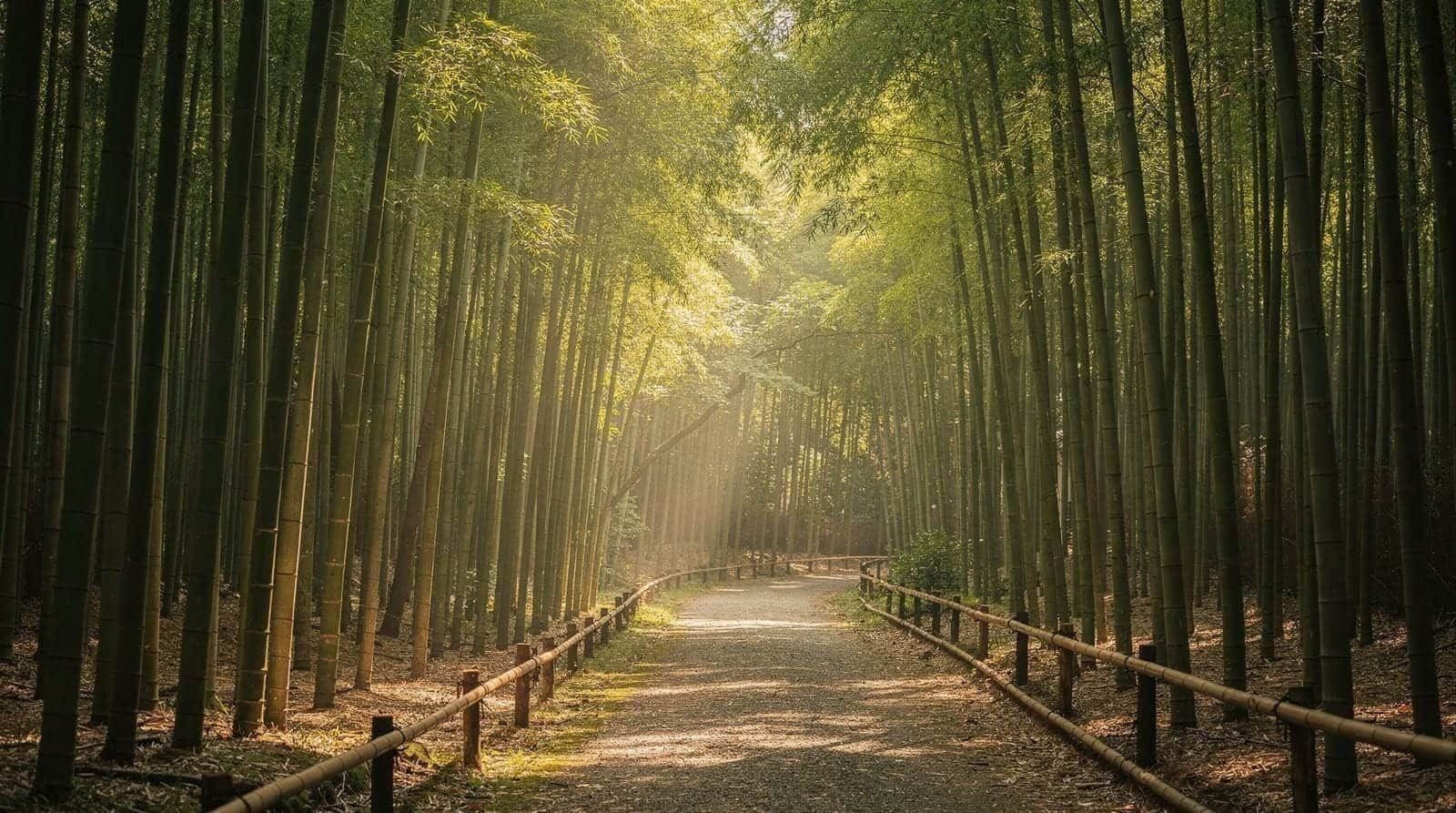
The Sagano Bamboo Grove’s main path runs about 10-15 minutes end to end — considerably shorter than photos imply, since the visual effect (tall bamboo stalks blocking out most of the sky) is dense but the walkable stretch itself is compact. This also means it fills up fast: by 10am on any decent-weather day, the path is a slow shuffle of tour groups and selfie sticks. Before 8am, the same path is close to empty, with soft morning light through the bamboo that photographs far better than the midday crowd shots anyway. Entry is free and there’s no gate, so the crowd level is purely a function of what time you show up.
Arashiyama bamboo grove morning walk is built specifically around this early window, timed to beat the tour bus arrivals.
Tenryu-ji
Tenryu-ji is a working Zen Buddhist temple founded in 1339, a UNESCO World Heritage Site, and the main reason to treat Arashiyama as more than a bamboo photo stop. Its garden, designed around a central pond with the surrounding mountains borrowed into the composition (a technique called shakkei, or “borrowed scenery”), is widely considered one of Kyoto’s best surviving Muromachi-period gardens. Entry to the garden runs around ¥500 (~$4.60), with an additional ¥300 to enter the temple’s main hall and see its dragon ceiling painting. The temple’s north gate opens directly into the bamboo grove, which is the reason most visitors do them as a single loop.
Togetsukyo Bridge and the river
The Togetsukyo Bridge (“moon crossing bridge”) spans the Katsura River with the Arashiyama mountains as a backdrop, and it’s a free, no-timing-required sight — it looks good at most times of day, though sunset adds noticeably to the scene. From the riverbank near the bridge, traditional wooden boats (the Hozugawa River trip) run downstream from further upriver at Kameoka, a roughly two-hour rafting-style journey through a gorge that ends near Arashiyama itself; it’s a half-day commitment but a genuinely different way to see the surrounding hills compared to walking.
Hozugawa river boat and Arashiyama day tour combines the river trip with time in the bamboo grove and around the bridge, useful if you don’t want to arrange the boat departure point separately.
Iwatayama Monkey Park
Iwatayama Monkey Park is an actual hike, not a zoo enclosure — a roughly 20-minute uphill walk from the entrance near Togetsukyo Bridge to a summit area where wild Japanese macaques roam freely and visitors are enclosed instead (feeding is done from inside a caged hut, which is the reverse of most zoo layouts and worth knowing so it doesn’t come as a surprise). Entry is ¥550 for adults, ¥250 for children, and the summit has a clear view over Kyoto on a clear day. It’s a legitimate way to add physical activity to an otherwise flat, temple-and-photo-focused morning.
Arashiyama walking tour with temple and monkey park bundles the hike with Tenryu-ji in a single guided route, useful for pacing if you’re short on time.
Nonomiya Shrine and the smaller temples
Just before the bamboo grove’s main entrance, Nonomiya Shrine is a small, easy-to-miss stop associated with purification rituals once performed by imperial princesses before serving at Ise Grand Shrine — it also appears in “The Tale of Genji,” Japan’s classical 11th-century novel, which gives it a literary pedigree well beyond its modest size.
It’s free, takes only a few minutes to see, and sits directly on the path most visitors already walk between the main street and the bamboo grove. Further into Arashiyama, Jojakko-ji and Gio-ji are two smaller temples away from the main tourist flow, both known for moss gardens rather than any single headline sight — worth the extra 10-15 minute walk if the bamboo grove and Tenryu-ji already feel crowded and a quieter stop is the priority.
The Sagano Scenic Railway
The Sagano Scenic Railway (also called the Sagano Romantic Train) runs a slow, open-window trolley service along the Hozugawa River gorge between Saga-Torokko Station (near the bamboo grove) and Kameoka, the same stretch the Hozugawa river boats cover by water. The one-way trip takes about 25 minutes and costs around ¥880 (~$8.15) for adults, and it’s most popular in autumn foliage season when the gorge’s maple trees turn color — tickets for peak-season departures sell out days in advance, so booking ahead matters more here than for most Arashiyama activities. It pairs naturally with the river boat as a one-way-each-direction loop: train up the gorge, boat back down, or vice versa.
Practical notes
Coin lockers and toilets cluster near Saga-Arashiyama Station and along the main approach street to the bamboo grove, but thin out past Tenryu-ji’s north gate and on the monkey park’s uphill trail — plan bathroom stops before starting either. The monkey park hike involves genuine stairs and an uneven dirt path, not a paved walkway, so it’s a poor fit for wheelchairs or strollers; Tenryu-ji’s garden path, by contrast, is flat and accessible throughout. Souvenir shops along the main street sell fresh yatsuhashi (a cinnamon-and-sweet-bean confection that’s one of Kyoto’s signature souvenirs) alongside the more generic matcha snacks, worth a stop on the way back toward the station.
When crowds actually get bad
The bamboo grove and the immediate area around Togetsukyo Bridge are packed from roughly 10am to 4pm on any weekend and most weekdays in cherry blossom season (late March-early April) and autumn foliage season (mid-to-late November, when the surrounding hillsides turn red and orange and Arashiyama becomes one of the most popular autumn viewing spots in the entire Kansai region). Tenryu-ji’s garden and the monkey park hike see noticeably less crowding even at peak times, since both require a small fee and a bit more effort than a free photo stop.
Food and tea in Arashiyama
Yudofu (simmered tofu) restaurants cluster around the Tenryu-ji approach, a tradition tied to the area’s historic Zen temples and their vegetarian dietary customs — a set meal typically runs ¥2,500-5,000 (~$23-$46). Matcha soft-serve and matcha-flavored sweets are sold throughout the main street leading to the bamboo grove, a lighter and cheaper option if you’re moving on to lunch elsewhere.
Getting back to Osaka or elsewhere in Kyoto
Return trips follow the same route in reverse — Saga-Arashiyama Station to Kyoto Station on the JR Sagano Line, then JR Special Rapid back to Osaka. If you’re continuing on to another Kyoto district the same day, allow at least 30-40 minutes for the return leg through Kyoto Station before starting a second sightseeing block, since the transfer itself eats into the afternoon more than it feels like it should on paper.
How Arashiyama compares to Kyoto’s other districts
If you’re deciding how to split limited time across Kyoto, this is roughly how Arashiyama stacks up against the city’s other main draws.
| District | Signature sight | Crowd pattern | Time needed |
|---|---|---|---|
| Arashiyama | Bamboo grove, Tenryu-ji | Worst 10am-4pm, empty before 8am | Half a day |
| Fushimi | Torii gate trail | Worst 10am onward, empty before 8am | Half a day |
| Gion & Higashiyama | Kiyomizu-dera, geisha lanes | Worst 10am-4pm, calmer evenings | Half to full day |
| Central Kyoto | Nijo Castle, Nishiki Market | Fairly even all day | Half to full day |
Arashiyama and Fushimi share the same crowd logic — free, photogenic, and mobbed by mid-morning — which is why both reward an early start more than a late one. Gion and central Kyoto are more forgiving of a mid-afternoon arrival since neither has a single free photo-magnet the way the bamboo grove and torii gates do.
A realistic half-day route
Arriving at Saga-Arashiyama Station by 7:30-7:45am gives roughly 30-45 uncrowded minutes in the bamboo grove before the first tour buses show up. From there, Tenryu-ji’s garden (entering through the grove’s north gate) takes 30-40 minutes, followed by the roughly 20-minute climb to Iwatayama Monkey Park if the hike appeals.
That’s a tight but genuinely doable loop finished by late morning, leaving the early afternoon free to head into central Kyoto or backtrack toward Osaka if Arashiyama is a standalone day trip rather than part of a longer Kyoto stay. For a broader look at sequencing Kyoto’s districts across a multi-day trip, the getting around Osaka guide and the Kansai attraction passes guide cover the transport-pass side of the logistics.
Arashiyama bamboo grove and temple tour covers this same early-morning loop with a guide, useful if you’d rather not plan the Tenryu-ji-to-monkey-park sequencing yourself.
Related planning
Arashiyama pairs naturally with a morning-only visit before heading to central Kyoto or Gion and Higashiyama in the afternoon, since both require backtracking through Kyoto Station anyway. For the rest of Kyoto, see the main Kyoto destination page, Fushimi Inari, and northern Kyoto around Kinkaku-ji.
The Arashiyama bamboo guide covers photography timing in more depth, and the Kyoto day trip itinerary from Osaka shows how to fit Arashiyama into a single-day visit if you’re not staying overnight. For a longer regional trip, the 5-day Kansai itinerary pairs a Kyoto base with day trips to Nara and beyond.
Frequently asked questions about Arashiyama
Is the bamboo grove really that crowded?
Yes, from roughly 10am onward on most days, and especially on weekends and during cherry blossom or autumn foliage season. Before 8am, the same path is close to empty. The grove itself is also shorter than most photos suggest — the main walkable stretch takes about 10-15 minutes.
Do I need to pay to enter the bamboo grove?
No, the bamboo grove path itself is free with no gate or ticket. Fees apply to Tenryu-ji’s garden (around ¥500) and temple interior (an extra ¥300), and separately to Iwatayama Monkey Park (¥550 adults).
How do I get to Arashiyama from Osaka?
There’s no direct train. Take JR Special Rapid from Osaka Station to Kyoto Station (28-29 minutes), then transfer to the JR Sagano Line to Saga-Arashiyama Station (15-20 minutes more), for a total of roughly 50-60 minutes including the change.
Can I combine Arashiyama with other parts of Kyoto in one day?
It’s possible but tight, since Arashiyama requires backtracking through Kyoto Station to reach other districts. The most efficient plan is Arashiyama in the early morning, then central Kyoto or Gion in the afternoon and evening.
Is the monkey park safe with kids?
Generally yes — the macaques are wild but accustomed to visitors, and feeding is done from an enclosed hut rather than by hand outside it. Staff post basic rules (no direct eye contact, no touching) that are worth reading at the entrance before the climb.
What’s the best month to visit Arashiyama?
Late March into early April for cherry blossoms along the river, or mid-to-late November for autumn foliage on the surrounding hillsides — both are also the most crowded windows. For a calmer visit with decent weather, late spring (May) or early autumn (October) before peak foliage are reasonable alternatives.
Top experiences
Bookable activities with verified prices and instant confirmation on GetYourGuide.