Osaka travel tips for first-time visitors
Osaka: Osaka welcome tour local host
What should first-time visitors to Osaka know before arriving?
Get an ICOCA card for transport, carry some cash even though card acceptance has grown, download an offline map and translation app, and expect a genuinely low-crime, low-hassle city where the main pitfalls are overpriced tourist-strip restaurants and USJ queue times rather than safety concerns.
Osaka is an easy city to visit for the first time — low crime, an efficient transit network, and a food culture that rewards curiosity over caution — but a handful of practical details make the difference between a smooth trip and one spent troubleshooting avoidable friction. This guide covers the logistics that matter before arrival: transport cards, money, connectivity, etiquette basics, and the specific small mistakes first-time visitors tend to repeat.
| Transport card | ICOCA, around ¥2,000 (¥1,500 usable) at the airport or any station |
| Cash buffer | Around ¥10,000-15,000, 7-Eleven ATMs most reliable |
| Connectivity | eSIM before departure, or airport SIM/pocket WiFi pickup |
| Escalators | Stand right, walk left (opposite of Tokyo) |
| Emergency numbers | 110 (police), 119 (fire/ambulance), free from any phone |
Get an ICOCA card on arrival
An ICOCA card (a rechargeable IC card usable across trains, subways, buses, and most convenience stores and vending machines) is the single most useful purchase for getting around Osaka and Kansai generally — buy one at Kansai Airport or any major station on arrival (¥2,000 initial cost, of which ¥1,500 is usable balance, the rest a refundable deposit). It eliminates the need to calculate individual fares or navigate ticket machines in a foreign script for most single-leg trips, though day-focused passes like the Osaka Amazing Pass can work out cheaper if you’re hitting several paid attractions in one day — the Osaka trip cost and budget guide breaks down when each option makes sense.
Kansai Airport private transfer is worth considering for the first leg into the city if arriving with heavy luggage or on a late flight, skipping the need to navigate the Haruka express or Nankai line on minimal sleep.
Cash still matters, but less than it used to
Card and contactless payment acceptance has expanded significantly across Osaka in recent years, but smaller izakaya, some older shops, and certain shrine or temple ticket counters still operate cash-only. Carry ¥10,000-15,000 as a working buffer, and know that 7-Eleven ATMs are the most reliable option for withdrawing cash on a foreign card — other convenience store ATMs (Lawson, FamilyMart) are inconsistent with international cards. Japan does not have a tipping culture; leaving extra money at a restaurant or for a guide can cause more confusion than goodwill.
SIM cards, eSIMs, and connectivity
An eSIM purchased before departure (activated on arrival) or a physical SIM/pocket WiFi rental picked up at Kansai Airport both work well — Osaka’s mobile coverage is uniformly strong, and free WiFi at stations and convenience stores fills gaps if connectivity briefly runs out. Having offline maps downloaded in advance (Google Maps supports offline area downloads) is worth doing regardless, useful in the subway where signal occasionally drops.
Etiquette basics that actually come up
Removing shoes is expected at traditional restaurants with tatami seating, some temple interiors, and any accommodation with genkan (entryway) shoe-removal areas — look for a step-up or shoe rack as the cue. Escalator etiquette in Osaka is the reverse of Tokyo: stand on the right, walk on the left (Tokyo does the opposite), a genuinely easy thing to get backward if you’ve been to Tokyo first.
Eating while walking is mildly frowned upon in most contexts, though Dotonbori’s street-food culture is a partial, tourist-tolerant exception. Speaking loudly on trains, especially phone calls, draws disapproving looks more reliably than almost any other faux pas — trains are notably quiet by international standards. The Japanese etiquette Kansai guide covers this in more depth, including temple and shrine-specific customs.
Transport passes worth knowing
Beyond the ICOCA card, the JR Kansai Area Pass and the region-wide Kansai Wide Area Pass cover multi-city rail travel including Shinkansen segments on some routes, worth it specifically for visitors planning several day trips (Kyoto, Nara, Kobe, Himeji) within a short window rather than single one-off trips, where standard tickets work out cheaper.
Kansai 1-week free pass is worth pricing against your specific day-trip plans — it pays off with three or more longer-distance day trips within the validity window, less so for a single Kyoto or Nara excursion.
Safety, and what actually to watch for
Osaka is a low-crime city by nearly any international standard, and violent crime against tourists is rare enough that it shouldn’t factor meaningfully into trip planning. The realistic risks are financial rather than physical: Dotonbori-area touts steering visitors toward overpriced, sometimes deceptively billed bars (a broader pattern than Osaka-specific, but concentrated here in the main nightlife strip) and inflated menu prices at a handful of tourist-facing restaurants directly on the main canal-front. Walking a block or two off the main strip for dinner, rather than eating at the first available spot, reliably avoids both issues — see the Dotonbori nightlife guide for specifics on what to avoid.
Osaka main sights and hidden spots walking tour is a solid first-day option precisely because it routes around the most tourist-trap-prone stretches while still covering the essential sights, useful orientation before venturing out independently later in the trip.
Language basics that go a long way
English signage is common at stations and major attractions, less so at smaller restaurants and shops, where a translation app’s camera-scan feature (Google Translate handles Japanese menus reasonably well) solves most on-the-spot confusion. A handful of phrases — sumimasen (excuse me/sorry, useful for getting attention), arigatou gozaimasu (thank you), and kore o kudasai (this one, please, useful for pointing at a menu item or display) — cover a surprising share of daily interactions without needing conversational fluency.
Money-saving habits worth adopting early
Convenience stores (7-Eleven, Lawson, FamilyMart) sell genuinely good, cheap food — onigiri, sandwiches, hot items from the counter — a legitimate meal option rather than a fallback, and worth using for at least one meal a day to keep costs down without sacrificing much. Refillable water bottles paired with the city’s numerous free water fountains and low-cost vending machines cut down on a surprisingly persistent small expense. The Osaka trip cost and budget guide covers this in more depth, alongside where the larger, harder-to-avoid costs (USJ, Kobe beef, accommodation) actually sit.
Common first-time mistakes
Underestimating transit time between Osaka’s neighborhoods and day-trip destinations is the most common planning error — see the 3-day Osaka planning guide for realistic timing rather than optimistic assumptions. A second common mistake is treating Universal Studios Japan as a half-day add-on rather than the full-day commitment it actually requires, detailed in the Universal Studios Japan guide. A third is skipping trip insurance or travel-specific data plans and then losing connectivity or facing an unexpected medical cost — both cheap to sort out in advance and expensive to fix after the fact.
Packing and weather prep
Layered clothing works across nearly every season given how much daily temperatures swing, particularly in spring and autumn — see the best time to visit Osaka guide for month-by-month weather specifics. Comfortable walking shoes matter more than any single packing decision, given the walking volume most Osaka itineraries involve. The Kansai packing list tool generates a season-specific list rather than relying on general Japan packing advice that may not match Kansai’s specific climate.
Where to base yourself
Namba, Shinsaibashi, and Umeda are the three neighborhoods that work best for a first-time visitor prioritizing walkability and transit access — the where to stay in Osaka guide breaks down the trade-offs in full, including budget-friendly Tennoji for visitors prioritizing lower accommodation cost over central-strip proximity.
Health, pharmacies, and minor medical needs
Pharmacies (marked with a green cross or the word “yakkyoku”) are common throughout central Osaka and stock basic over-the-counter medication, though selection and labeling in English can be limited — bringing a small supply of familiar medications (pain relievers, allergy medication, any prescription drugs with accompanying documentation) is a reasonable precaution rather than assuming an exact equivalent will be easy to identify locally.
Convenience stores also stock a basic range of over-the-counter items (pain relievers, motion sickness tablets, bandages) for minor needs without requiring a dedicated pharmacy visit. For anything beyond minor issues, Osaka has well-equipped hospitals with some English-speaking staff, particularly at larger facilities — travel insurance covering medical treatment is worth having regardless of how healthy the trip is expected to be, given how genuinely high out-of-pocket costs can run without it.
Emergency numbers and what to do if something goes wrong
Japan’s emergency numbers are 110 for police and 119 for fire or ambulance, both free to call from any phone including one without an active Japanese SIM. Japan’s low crime rate means these numbers see far less tourist use than in many other countries, but they’re worth knowing regardless. Lost items have a genuinely good recovery rate in Japan by international standards — reporting a lost item to the nearest koban (small neighborhood police box, common near major stations) is often more effective than it would be elsewhere, since found items are frequently turned in rather than kept.
Public restroom and trash disposal etiquette
Public restrooms are widely available at stations, department stores, convenience stores, and most attractions, generally clean and free to use — carrying a small hand towel is worth doing since many public restrooms don’t provide paper towels or hand dryers. Public trash bins are noticeably less common on Osaka’s streets than in many other major cities, a legacy of security measures from decades past — the practical habit most visitors adopt quickly is carrying a small bag for trash until reaching a train station, convenience store, or other location with bins available, rather than expecting street-corner bins at regular intervals.
Business hours and what stays open when
Most shops and restaurants in Osaka’s central districts operate from roughly 10am or 11am to 8-9pm, later in Namba and other nightlife-adjacent areas. Convenience stores (7-Eleven, Lawson, FamilyMart) operate 24 hours and function as a genuine safety net for food, basic supplies, and ATM access at any hour. Museums and some paid attractions frequently close one day a week (often Monday), worth checking specific opening days before building a schedule around a particular sight, particularly for smaller or less-visited museums where closure days aren’t always intuitive.
Solo female travel considerations
Osaka is a genuinely comfortable city for solo female travelers by most standard safety measures — low overall crime rate, well-lit and busy streets even late at night in central areas, and a generally low-hassle public environment. Women-only train cars operate during weekday rush hours on some lines as an additional option rather than a necessity, marked clearly on platforms and car exteriors. As with the general safety notes above, the more realistic concerns are financial (overpriced venues, aggressive touts in Dotonbori) rather than personal safety, and the same practical habit — walking a block off the main tourist strip before choosing a bar or restaurant — applies equally here.
Accessibility for travelers with disabilities
Major train stations in Osaka have step-free access via elevators, though smaller local stations, particularly on some day-trip routes, have more limited accessibility — worth checking specific station accessibility in advance for travelers with mobility needs, since it varies more than city-center infrastructure might suggest.
Many newer hotels and attractions meet reasonable accessibility standards, while some older, smaller establishments (traditional restaurants, some temple interiors) present genuine physical barriers — steps, narrow doorways, or tatami-floor seating without chair alternatives. Staff at major attractions are generally accommodating when accessibility needs are communicated in advance, even with a language barrier, though advance planning matters more here than in destinations with more universally modernized infrastructure.
Photography etiquette and restrictions
Photography is welcomed at most outdoor sights and street scenes, but several temples and shrines restrict or prohibit photography in specific interior areas — signage generally marks these restrictions clearly, and Koyasan’s Okunoin cemetery is a notable example where photography stops entirely near the mausoleum, detailed in the Koyasan Okunoin guide. Photographing individuals, particularly geisha or maiko in Kyoto’s Gion district, without consent has become enough of an issue that some areas now impose fines for it — the geisha Gion guide covers this specific etiquette point in more depth, worth reading before a Kyoto day trip if photography is a priority.
A short list of things that trip up nearly everyone once
Nearly every first-time visitor makes at least one of these mistakes, and none of them are serious: standing on the wrong side of an escalator (right in Osaka, opposite of Tokyo), being surprised that many smaller restaurants are cash-only despite the broader card-acceptance trend, underestimating how early some shops and restaurants close relative to home-country norms, and misjudging how long Universal Studios Japan actually requires as a full-day rather than half-day commitment. None of these derail a trip, but knowing about them in advance smooths out day one and two in particular, when unfamiliarity compounds fastest.
Adjusting for jet lag on arrival
Most international arrivals into Kansai land in the afternoon or evening after a long-haul flight, and the temptation to push straight into sightseeing on arrival day often backfires by day two — a lighter arrival-day plan (checking into accommodation, a nearby meal, an early night) generally produces a stronger day two and three than an ambitious arrival-day itinerary followed by exhaustion.
Morning light exposure and staying awake until a reasonable local bedtime on arrival day are the two most effective jet lag countermeasures, more useful than caffeine timing or other common tricks. The 3-day Osaka planning guide is structured with this in mind, keeping day one’s pace manageable rather than front-loading the most demanding day of the trip immediately after travel.
Connecting from the airport without stress
Kansai Airport’s signage is bilingual (Japanese and English) throughout, and both the Haruka express and Nankai lines have clearly marked ticket counters with English-speaking staff available during standard operating hours — arriving without a pre-booked airport transfer is entirely manageable for a first-time visitor, though booking one in advance removes any decision-making at the point of maximum travel fatigue.
Itami Airport private transfer is the equivalent option for visitors arriving via Osaka’s domestic airport (Itami) rather than Kansai International, relevant for anyone connecting through another Japanese city before reaching Osaka.
A pre-departure checklist
Before leaving home: confirm passport validity (six months beyond the travel dates is a common requirement, though Japan’s own entry rules may differ — check current requirements directly), arrange an eSIM or pocket WiFi, download offline maps and a translation app, notify your bank of international travel to avoid card declines, and consider travel insurance covering both medical treatment and trip interruption. None of these take long individually, but handling them a week or more before departure, rather than the night before, avoids the scramble that otherwise eats into the excitement of an upcoming first trip to Osaka.
Wi-Fi at hotels and cafes
Most business hotels and even capsule hotels provide free in-room or lobby WiFi, generally reliable enough for video calls and photo uploads, though speeds vary more at older, smaller properties than at chain hotels. Cafes and department stores increasingly offer free guest WiFi networks requiring a quick email or social-login signup, a reasonable backup if a phone’s data connection briefly drops in a basement mall or underground station. None of this replaces a personal eSIM or pocket WiFi for reliable navigation between stops, but it’s a useful supplement for anyone trying to conserve data on a limited plan.
What first-timers get wrong about queueing and lines
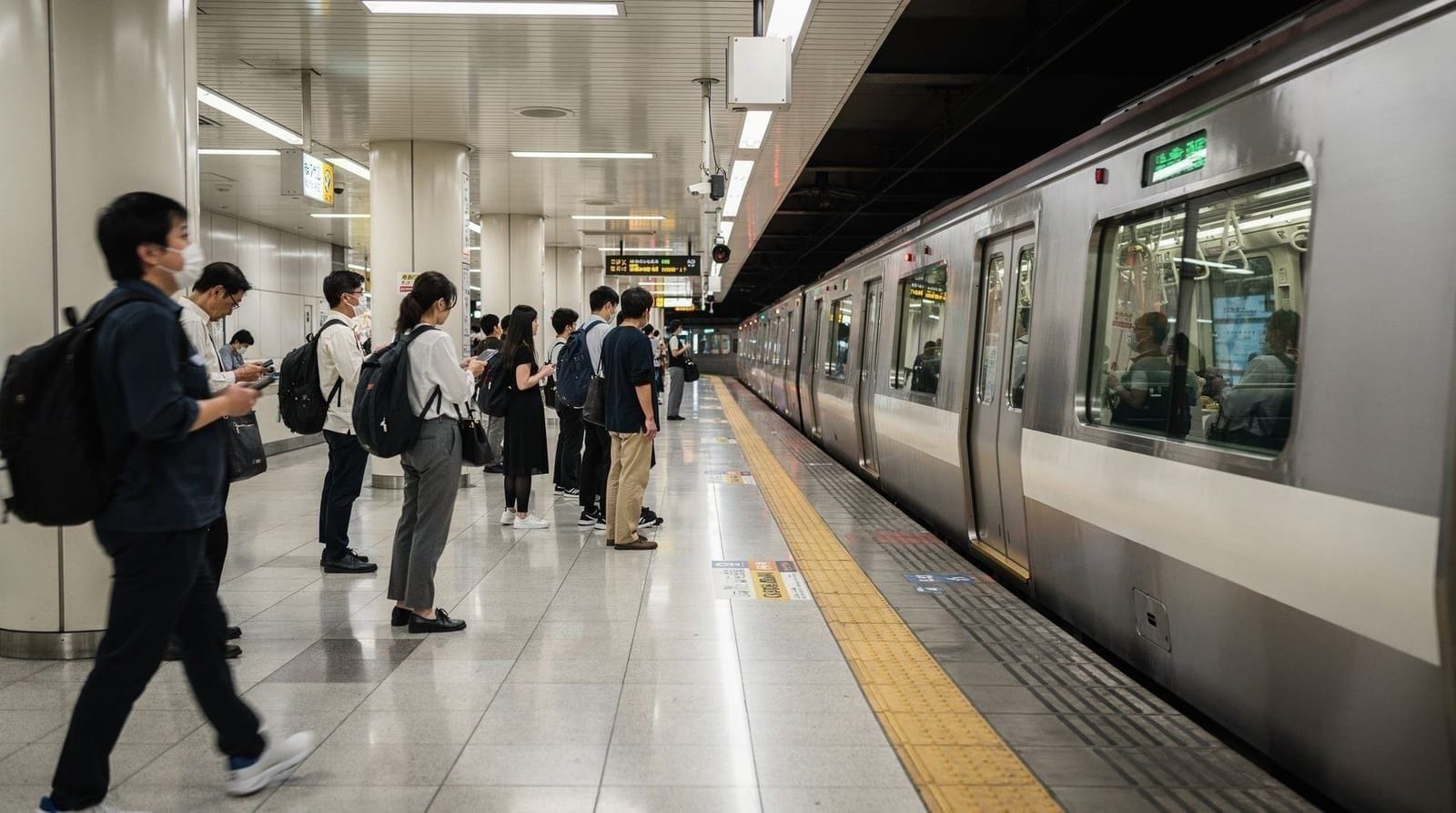
Japan’s queueing culture is more orderly and more universally observed than most first-time visitors expect — lines form for trains (marked floor decals show where doors will open), popular restaurants, and even escalators, and cutting or crowding is noticed and mildly frowned upon rather than shrugged off as it might be elsewhere. The mistake first-timers most often make isn’t rudeness but hesitation: standing off to the side unsure where a queue actually starts, rather than simply joining the visible line. Watching where locals stand for a moment before joining resolves this faster than trying to read posted signage, especially at train platforms where queue markings vary station to station.
Konbini as a genuine daily tool, not just a snack stop
Convenience stores in Osaka do considerably more than sell snacks: most locations have a printer for boarding passes and event tickets, a working ATM, bill-payment terminals, and a counter that will heat food on request — genuinely useful services rather than novelties, and worth remembering on days when a hotel’s front desk is unavailable or a specific errand (printing a document, paying a small bill, finding a working restroom late at night) needs solving quickly.
Combined with the earlier note on 24-hour opening above, konbini function as a genuine safety net across nearly every category of small first-trip friction — a useful complement to the Osaka trip cost and budget guide’s coverage of eating cheaply without sacrificing quality.
Frequently asked questions about Osaka
Do I need cash in Osaka, or does card cover everything?
Card and contactless acceptance has grown substantially, but carry a cash buffer of roughly ¥10,000-15,000 — some smaller izakaya, older shops, and certain temple or shrine ticket counters remain cash-only, and Japan has no tipping culture to offset the difference.
Is an eSIM enough, or should I rent a pocket WiFi?
Either works well for a solo traveler or couple; a pocket WiFi is worth the extra cost for a group sharing one device, since it supports multiple connections at once, while an eSIM is simpler for a single traveler who wants to skip airport pickup and return logistics entirely.
Top experiences
Bookable activities with verified prices and instant confirmation on GetYourGuide.