Osaka Aquarium Kaiyukan guide
Osaka: Osaka aquarium Kaiyukan ticket
How long does a visit to Kaiyukan Aquarium take?
Ninety minutes to two hours for a full walk-through of the spiraling main tank route, including proper time to see the whale sharks in the central tank. Add another hour if pairing the visit with Tempozan Harbor Village's ferris wheel or the Santa Maria bay cruise next door.
Kaiyukan is one of the larger single-tank aquariums in the world by volume, built around a central tank deep enough to house whale sharks, and it anchors Osaka Bay’s cluster of family attractions alongside Universal Studios Japan and Tempozan Harbor Village. Unlike USJ, which demands a full day and a queue strategy, Kaiyukan is a genuinely relaxed half-day visit — no timed entry stress, no ride reservations, just a spiraling walk past re-created ecosystems that takes as long as you want it to.
| Where | Tempozan Harbor Village, Osaka Bay |
| Cost | Booked ticket recommended; skip the counter queue |
| Time needed | 90 min-2 hours |
| Getting there | Osakako Station (Chuo Line), ~20-25 min from central Osaka |
| Best time | Soon after opening, weekdays |
The tank and the route
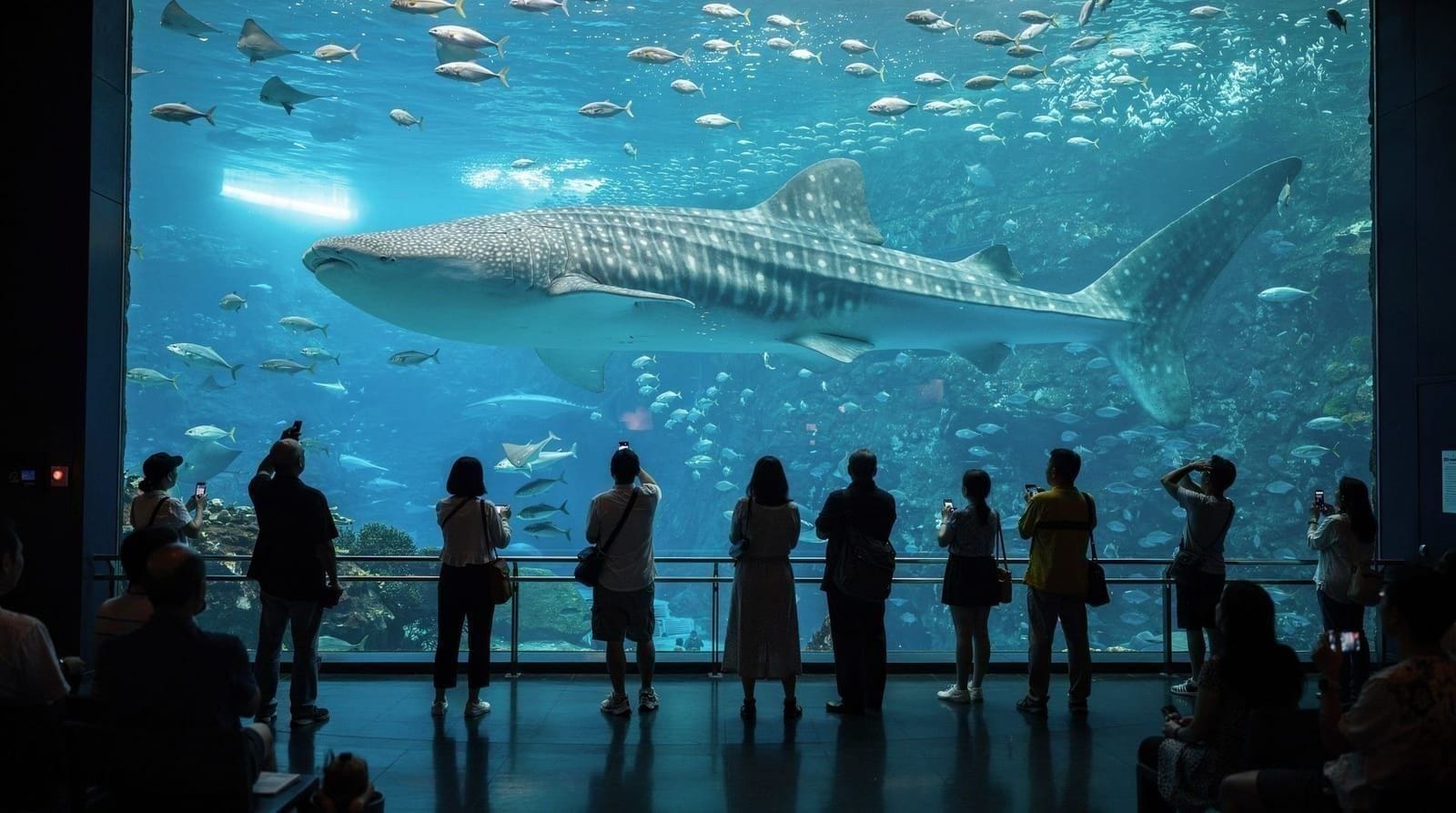
Kaiyukan’s design routes visitors down a spiraling walkway that descends past re-created Pacific Rim ecosystems in sequence — starting near the top with Japanese forest streams and working progressively deeper toward the central tank at the bottom, home to whale sharks alongside manta rays and a range of other pelagic species. The layout means you see the same central tank from multiple depths and angles as you descend, rather than a single flat viewing window, which is a large part of what makes the main tank feel considerably bigger than its already substantial size. A full walk-through, done at a pace that allows genuine time in front of the whale shark tank rather than a quick pass-by, takes 90 minutes to two hours.
Tickets
A Kaiyukan entry ticket bought ahead skips the ticket-counter line, which matters most on weekends and during summer school holidays, when the counter queue alone can run 20-30 minutes before you’re even inside. There’s no dynamic pricing or timed-entry system here the way USJ uses for Super Nintendo World — a ticket for a given day gets you in at any point during opening hours, making Kaiyukan considerably less schedule-sensitive to plan around.
What’s worth slowing down for
Beyond the whale sharks, the descending route passes tanks representing specific Pacific ecosystems — Antarctic penguins, an Ecuadorian rainforest section with capybaras and caimans, and a jellyfish display that’s become one of the aquarium’s more Instagram-friendly stops in recent years, its slow-moving, backlit tanks photographing well even on a phone camera. Feeding times for several species are posted near the entrance and worth checking on arrival, since watching a scheduled feeding (rather than passing an empty-looking tank at a random hour) is a meaningfully different experience for younger visitors especially.
Combining with Tempozan Harbor Village
Kaiyukan sits directly within Tempozan Harbor Village, adjacent to a large ferris wheel (one of the biggest in Japan when it was built) and the Tempozan Marketplace, a shopping and dining complex with a retro Naniwa-themed food court alongside more standard chain restaurants. A short Osaka Bay cruise aboard the Santa Maria, a replica of Christopher Columbus’s ship, gives a relaxed hour on the water with views back toward the city skyline — a reasonable way to fill an afternoon gap between the aquarium and dinner, or a lower-key alternative for visitors traveling with very young children or limited mobility who want time on the water without a technical boat tour.
Inside the same Tempozan Marketplace complex, a LEGOLAND Discovery Center ticket covers an indoor, weather-independent attraction built for younger children specifically — a useful backup plan on a rainy day, or simply a second activity that doesn’t require leaving the immediate area around the aquarium.
A realistic half-day schedule
Arriving at Kaiyukan by mid-morning, budgeting 90 minutes to two hours inside, then moving to the adjacent marketplace for lunch and either the ferris wheel or the Santa Maria cruise in the early afternoon covers the Tempozan area comfortably without feeling rushed. Families with very young children should build in extra time for stroller navigation on the aquarium’s spiraling ramp, which is stroller-friendly throughout but can get congested on weekends when the aquarium approaches capacity.
Getting here from central Osaka
Osakako Station, on the Chuo subway line, serves both Kaiyukan and Tempozan directly, connecting back into central Osaka in about 20-25 minutes. This is a different station from Universal City Station (JR Yumesaki Line), which serves USJ — the two attractions, while both grouped under “Osaka Bay” in general trip planning, sit a genuine 15-20 minutes apart by transit and aren’t walking distance from each other, worth knowing if considering both on the same day.
Should you combine Kaiyukan with USJ on the same day?
It’s possible but tight. USJ alone typically fills 8-10 hours for a family wanting to cover the major rides properly, leaving limited time and energy for a relaxed aquarium visit afterward. Most visitors either dedicate a full day to USJ and a separate half-day to Kaiyukan and Tempozan, or treat USJ as one full day of a longer Osaka stay and fold Kaiyukan into a lower-key day elsewhere in the trip. For the full USJ planning breakdown, see the Universal Studios Japan guide.
Food and practical notes
The Tempozan Marketplace has a wide range of dining, from the Naniwa-themed retro food court (built to evoke early-20th-century Osaka streetscapes) to standard chain restaurants, generally at normal Osaka prices rather than the premium markup common inside theme parks. Coin lockers and stroller rental are available near Kaiyukan’s main entrance. The aquarium can get genuinely crowded on weekends and during Japanese school holidays, particularly around the whale shark tank at the bottom of the route, where visitors naturally linger longest — arriving soon after opening avoids most of this.
Seasonal notes
Kaiyukan is an indoor attraction throughout, making it a reliable option regardless of weather or season — a useful counterbalance on a trip otherwise built around outdoor sightseeing during Kansai’s hot, humid summers or unpredictable rainy season (tsuyu, mid-June into July). Special seasonal exhibits occasionally rotate through, generally announced on the aquarium’s site closer to the date, worth checking if visiting during a specific season.
Visiting with children of different ages
Kaiyukan works for a wide spread of ages because the experience is passive in the best sense: nobody needs to be tall enough, brave enough or patient enough to queue. Toddlers tend to be happiest at the lower viewing levels of the central tank, where the glass is close and the animals are large and slow. Older children usually get more out of the descent itself, treating the spiral as a trail of habitats to tick off and compare. A simple trick is to let a child choose which tank to stop at longest, which turns a walk-through into a small expedition and keeps the whole group moving at a pace everyone enjoys.
If your family is also weighing other options around the bay, the Osaka with kids guide compares them side by side, and the Osaka with toddlers blog post goes deeper on naps, strollers and short attention spans. Parents who want a cooking activity on another day can look at the family-friendly options in the Kansai family attractions guide.
Making the most of the descent
The route rewards a slightly slower rhythm than most people naturally adopt. The first tanks near the top are quiet and uncrowded, so it is tempting to hurry through them to reach the main attraction. Resist that. The smaller habitats are where you notice individual animals, their behaviour and the way each ecosystem has been staged, and they make the whale shark tank feel like a payoff rather than a checkbox.
- Read the signage at each habitat before moving on; it explains what links the animals to a particular stretch of the Pacific.
- Keep a loose eye on the feeding notices posted near the entrance and plan your stops around the ones that interest your group.
- Step aside at busy viewing windows once you have had your look, so others can enjoy the glass and you can come back later when the crowd has shifted.
- Photograph the jellyfish tanks without flash; the backlighting does the work for you.
Rainy days and flexible plans
Because the aquarium is entirely indoors, it is a natural fallback when weather rearranges a trip. If a day of temple walking or castle sightseeing is washed out, Kaiyukan and the neighbouring marketplace make a comfortable substitute that needs no advance scheduling beyond a ticket. The Osaka rainy day ideas blog post collects other indoor options if you would rather vary the plan, and the best time to visit Osaka guide explains how the seasons shape which outdoor activities are worth saving for better weather.
Equally, on a clear day you can flip the order: take the bay cruise or the ferris wheel while the sky is bright, then head inside to the aquarium when you want to be out of the sun or the wind. The relaxed format means you are never locked into a sequence.
Fitting Kaiyukan into a longer Osaka trip
Kaiyukan suits the slower days of an itinerary, the ones that follow a heavy sightseeing day or precede an early departure. In a three-day Osaka plan, it fits naturally as a half-day anchored on the bay, with the rest of the day left for the marketplace and a relaxed evening. Travellers using the Osaka 3 days planning guide can slot it into whichever day has the most breathing room.
If you are collecting discounts across several attractions, the Osaka Amazing Pass guide and the Kansai attraction passes overview explain how the passes work and whether they suit a trip with an aquarium visit in it. For moving around the city and reaching the bay smoothly, the getting around Osaka guide covers the subway network, and the ICOCA card guide explains the tap-in payment card that makes short rides on the Chuo Line simple.
Who might enjoy it less
Honesty matters here: not every traveller will love Kaiyukan equally. Visitors who dislike crowds on weekends may find the narrow ramp stressful, and those who prefer active or adrenaline-driven days may find the pace slow compared with a theme park. If that sounds like you, the Universal Studios Japan guide covers the opposite kind of day. For everyone else, particularly anyone who enjoys watching large animals glide past at an unhurried pace, the aquarium is an easy recommendation and a calm counterweight to the busier parts of a Kansai trip.
Related planning
For the broader Osaka Bay area, including full USJ planning and the wider Tempozan context, see the Osaka Bay and USJ destination page. For a wider single-day or multi-day family itinerary that includes Kaiyukan alongside other Kansai family stops, see Osaka with kids and the Kansai family attractions guide.
For families balancing an aquarium day against Nara’s deer park or Kyoto’s temple circuit, the Nara deer park family guide offers a comparably relaxed, low-planning alternative day. The main Osaka destination page covers how a Kaiyukan half-day fits around central Osaka sightseeing on the same trip.
What makes the whale shark tank worth the wait
The central tank’s design, viewed from multiple depths as you descend the spiraling route, is worth budgeting genuine time for rather than a quick pass-by on the way to the exit — most visitors underestimate how much longer a proper look at the whale sharks takes compared with the rest of the route combined. Late morning on a weekday, after the initial opening rush but before the afternoon school-holiday crowds build, tends to give the calmest few minutes directly in front of the tank’s lowest viewing level, where the whale sharks are most visible feeding along the bottom.
Frequently asked questions about Osaka Aquarium Kaiyukan guide
Is Kaiyukan Aquarium worth visiting with the Osaka Amazing Pass?
Not directly for entry — Kaiyukan typically only gets a modest discount coupon with the Osaka Amazing Pass rather than free admission, unlike Osaka Castle or the Umeda Sky Building. It's still worth a booked ticket on its own merits, just don't expect the pass to cover it outright.How crowded does Kaiyukan get?
Weekends and Japanese school holidays bring genuine crowding, especially around the whale shark tank at the bottom of the spiraling route, where visitors naturally linger longest. Arriving soon after opening avoids most of this, and a pre-booked ticket skips the counter queue that can run 20-30 minutes at peak times.
Top experiences
Bookable activities with verified prices and instant confirmation on GetYourGuide.