Samurai and ninja experiences in Kansai
Kyoto: Kyoto samurai ninja museum guided tour
What samurai and ninja experiences are available in Kansai?
Kyoto's Samurai Ninja Museum offers hands-on sword handling and ninja tool demonstrations for all ages, plus a separate ninja weapon-forging class for adults. Wakayama Castle runs a samurai costume-and-tour experience. Most sessions are 1.5-2.5 hours and don't require advance martial arts knowledge.
Samurai and ninja culture sits somewhere between serious history and pop-culture spectacle in modern Japan, and Kansai’s visitor experiences generally lean into that tension honestly — expect genuine historical context on how samurai actually lived and fought, delivered alongside hands-on activities (sword handling, shuriken throwing) that are clearly built for enjoyment as much as education. Neither ninjas nor samurai as popularly imagined are perfectly historically accurate, and a good guide will say so rather than lean fully into myth.
| Where | Kyoto (museum, weapon-forging), Wakayama Castle |
| Duration | 1-2.5 hours depending on program |
| Price | ¥3,000-12,000 depending on program |
| Best for | Families (museum), adults (weapon-forging) |
| Language | English standard, no prior fluency needed |
The Samurai Ninja Museum in Kyoto
Kyoto’s Samurai Ninja Museum runs guided sessions combining a small collection of genuine period armor and weapons with hands-on demonstrations — trying on armor, handling a real (blunted) katana under supervision, and learning basic ninja tool mechanics like shuriken (throwing stars) and their actual historical use, which was considerably more limited and situational than films suggest.
Samurai Ninja Museum guided tour covers both the historical collection and the hands-on activities in a single session, roughly 1-1.5 hours, suitable for most ages.
Ninja classes for families
A separate, more explicitly kid-friendly program at the same museum focuses on ninja movement techniques, basic stealth exercises, and simplified weapon handling, designed around younger visitors without losing the historical framing entirely.
Kid-friendly ninja class at the Samurai Ninja Museum is built specifically for families traveling with children, with activities scaled to different age groups within the same session.
Forging your own ninja weapon
For a more involved, adult-oriented experience, a separate program held at a historic mansion setting walks participants through actually forging a simplified ninja weapon under instruction, rather than simply handling pre-made replicas.
Ninja weapon-making class at a historic mansion runs roughly 2.5 hours and gives participants a completed item to take home, a genuinely different format from the shorter museum-based sessions.
What’s historically accurate and what’s embellished
The popular image of ninjas as black-clad night assassins owes more to Edo-period theater and 20th-century film than to historical record — actual ninja (shinobi) were more often used for espionage, sabotage, and information gathering than dramatic combat, and their clothing was typically ordinary rather than the iconic black outfit associated with the trope today. Samurai history is better documented, and museum programs tend to be more careful distinguishing the genuine armor, weapons, and code of conduct (bushido, itself partly idealized in later retellings) from the more theatrical elements built into visitor programs for entertainment value.
Wakayama’s castle samurai experience
Beyond Kyoto, Wakayama Castle offers a samurai-themed program combining historical costume with a guided tour of the castle grounds, giving a different angle on the experience — set inside an actual Edo-period castle complex (Wakayama Castle, associated with the Kishu Tokugawa clan) rather than a purpose-built museum.
Wakayama samurai experience with castle tour combines the costume element with real castle history, worth considering for travelers extending a trip toward Koyasan or Wakayama’s coast.
Who these experiences suit
Families with children tend to get the most straightforward value from the museum-based programs, given their hands-on, low-stakes format and flexible pacing. Adults specifically interested in a deeper historical dive may prefer pairing a samurai museum visit with Osaka Castle’s own history, since Osaka Castle itself played a pivotal role in the samurai-era conflicts that ended the Warring States period. Visitors who’d rather skip the costume-and-photo elements entirely and focus purely on genuine period history may get more out of a temple or castle history tour without the interactive weapon-handling component.
Samurai armor and weapons, explained briefly
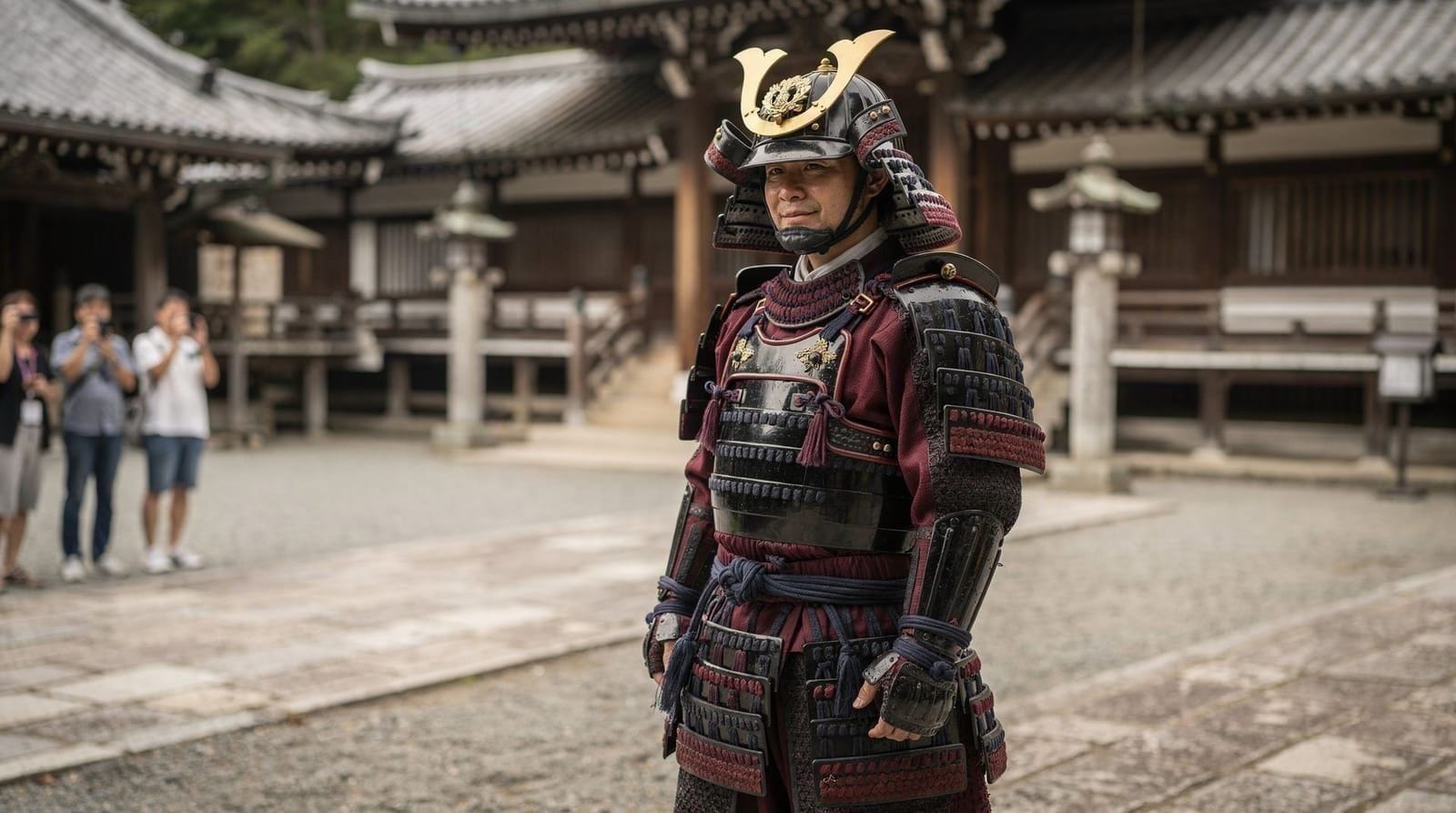
The armor featured in most museum programs typically represents Edo-period (1603-1868) styles, made of lacquered plates laced together with cord, lighter and more decorative than the earlier, heavier armor used in actual Warring States period combat, since Edo-period samurai spent most of their careers as administrators rather than active soldiers during Japan’s roughly 250-year era of relative internal peace under Tokugawa rule. The katana itself, the curved single-edged sword most associated with samurai, was one of a pair carried alongside a shorter blade (wakizashi) as a matched set called daisho, a visible marker of samurai social status that commoners were legally forbidden from carrying during the Edo period.
Booking considerations and group sizes
Most samurai and ninja experiences run in small groups, and some offer private session options for families or couples wanting a more personalized pace, particularly useful for the weapon-forging class given its hands-on, one-on-one instruction needs. Sessions are generally conducted in English or with English-speaking staff available, given how squarely these programs are marketed toward international visitors, and advance booking is recommended during peak travel seasons (spring cherry blossom and autumn foliage periods) when popular time slots fill quickly.
Photos and what you get to keep
Museum-based sessions typically allow photography throughout, including while wearing armor or handling weapons under supervision, and most programs build in a dedicated photo opportunity as part of the session rather than treating photography as an afterthought. The weapon-forging class is the clear standout for a genuine take-home souvenir, since participants complete and keep an actual crafted item, distinct from the photo-and-experience format of the shorter museum visits.
How these experiences fit alongside genuine historical sites
For travelers who want the interactive samurai and ninja experiences to connect to something more substantial than a museum visit alone, pairing the activity with a genuine historical site adds useful context — Osaka Castle’s museum covers the site’s central role in the conflicts that ended Japan’s Warring States period and established Tokugawa rule, and Himeji Castle, the best-preserved original samurai-era castle in Japan, offers an unmodernized look at actual period architecture and defensive design rather than a reconstructed or purpose-built experience venue.
The real history of ninja tools
Shuriken, the star-shaped throwing weapons most associated with ninja in popular culture, were historically a minor, secondary tool rather than a primary weapon — actual shinobi relied more heavily on tools suited to infiltration and information gathering: lock-picking implements, collapsible ladders and grappling hooks, and simple disguises allowing them to pass as merchants, monks, or laborers rather than combat specialists. Museum programs that include shuriken-throwing activities generally frame this honestly as an enjoyable, hands-on activity rather than historically central to ninja practice, which is a useful distinction for visitors who arrive expecting the more dramatic, combat-focused ninja portrayed in film.
What to wear and physical requirements
Most samurai and ninja museum activities involve minimal physical exertion — trying on armor, handling a blunted sword under supervision, throwing foam or blunted shuriken at a target — and don’t require any particular fitness level or prior experience, making them accessible to a wide range of ages and physical abilities. Comfortable, flexible clothing helps for the armor-wearing portions specifically, since some armor sets involve wrapping or securing pieces that fit more easily over simpler outfits than bulky layers.
Seasonal and time-of-day considerations
Unlike outdoor temple visits, these museum-based experiences are entirely indoor and unaffected by weather, making them a useful contingency activity for a rainy day that would otherwise disrupt an outdoor-heavy itinerary. Most run on a fixed session schedule throughout the day rather than the crowd-timing considerations relevant to free, always-open sites like Fushimi Inari, so booking a convenient time slot matters more than trying to catch a particular quiet window.
Bushido and the samurai code, briefly
Bushido, often translated as “the way of the warrior,” is frequently presented to visitors as an ancient, fixed samurai code of honor, but historians generally treat it as a more complex, evolving concept, formalized in writing largely during the peaceful Edo period and further romanticized in the early 20th century as Japan sought a unifying national ethical narrative during a period of modernization and militarization.
This doesn’t make the core values commonly associated with it — loyalty, discipline, honor, self-restraint — fabricated, but it does mean the tidy, singular “ancient samurai code” often presented in tourist contexts is itself a somewhat later cultural construction layered onto older, more varied warrior-class customs and obligations that differed across regions and eras.
Where else in Japan to see genuine samurai history
For travelers whose interest in samurai history extends beyond Kansai, Himeji Castle stands out as Japan’s best-preserved original (non-reconstructed) castle, offering an unfiltered look at authentic Edo-period defensive architecture, moats, and fortification design that the more theatrical museum experiences in Kyoto don’t attempt to replicate. Osaka Castle, while largely a modern concrete reconstruction internally, occupies genuinely significant historical ground as the site of pivotal conflicts in the unification of Japan under Toyotomi Hideyoshi and later Tokugawa rule, giving context that pairs well with a samurai museum visit for travelers wanting the full arc from historical event to modern interactive experience.
Realistic expectations for what these programs deliver
Visitors expecting an intensive, physically demanding martial arts experience should recalibrate expectations — most museum-based samurai and ninja programs are entertainment-and-education hybrids aimed at a broad audience including young children and casual travelers, not a genuine martial arts training session. Those seeking a more serious introduction to actual Japanese martial arts (kendo, iaido, or aikido) would need to seek out a dedicated dojo offering visitor classes, a different and more physically demanding category of experience entirely from the museum-based programs covered here.
Pricing across the different program types
Museum-based samurai and ninja sessions in Kyoto typically run ¥3,000-6,000 per person for the standard guided tour and hands-on demonstration format, with the kid-friendly ninja class often priced similarly or slightly lower given its shorter, simplified format. The weapon-forging experience, given its materials and longer duration, runs higher, typically ¥8,000-12,000 per person, reflecting both the additional instruction time and the take-home item produced. Wakayama’s castle-based samurai experience is generally priced in a comparable mid-range bracket, factoring in the castle admission bundled into the package.
What a first-time visitor should realistically expect
Managing expectations matters here more than at some other cultural experiences on this site: these programs are designed as enjoyable, moderately educational entertainment rather than immersive historical recreation or serious combat training, and visitors expecting a documentary-level deep dive into samurai or ninja history may find the format lighter than anticipated. That said, the genuine period artifacts on display, combined with honest framing around what’s historically accurate versus popularly embellished, give these programs more substance than a purely costume-and-photo attraction would offer.
Language support and group format
Most Kyoto-based samurai and ninja programs are run specifically with international visitors in mind, given the strong overlap between this activity and typical first-time Japan travelers’ interests, and English instruction is standard rather than an add-on request. Group sizes vary from small private bookings to larger scheduled sessions, and families traveling with children of different ages should check whether a session accommodates mixed-age groups or whether a separate kid-specific class (like the one covered above) would suit their group better.
The samurai class’s decline and its modern legacy
The samurai class was formally abolished in the early Meiji period (1870s) as Japan modernized its military and social structure along Western lines, ending roughly 700 years of samurai political dominance and converting many former samurai families into bureaucrats, businessmen, or, in some documented cases, financial hardship as their traditional stipends were phased out. This historical ending is rarely covered in tourist-facing samurai programs, which understandably focus on the more visually compelling combat era rather than the class’s eventual, often difficult, transition into modern Japanese society — a detail worth knowing for visitors wanting a fuller, less romanticized picture beyond the museum experience itself.
Ninja clans and their historical geography
Historically, ninja activity is most closely associated with two specific regions — Iga (in modern Mie Prefecture) and Koga (in modern Shiga Prefecture, within the Kansai region itself) — both mountainous areas whose difficult terrain and relative isolation from central authority allowed specialized shinobi clans to develop and maintain their skills somewhat independently of the dominant samurai power structure for centuries. Iga in particular maintains its own dedicated ninja museum separate from Kyoto’s more centrally located, tourist-convenient option, appealing to visitors with a deeper interest in the specific historical clans rather than a general introductory experience.
Modern popular culture’s role in sustaining interest
Contemporary anime, video games, and international films have kept samurai and ninja themes broadly visible in global popular culture well beyond Japan’s own borders, and this ongoing cultural presence is part of why these experiences remain consistently popular with international visitors specifically, more so than some other traditional Japanese cultural offerings with less name recognition abroad. Museum operators are generally candid that this modern popularity, rather than pure historical scholarship demand, drives much of the visitor interest, which is part of why the experience format leans toward accessible entertainment alongside genuine historical grounding rather than a purely academic presentation.
A final practical checklist
Confirm session length, language support, and age-appropriateness for any children in the group before booking, and expect roughly 1-2.5 hours depending on which specific program is chosen, from the shorter museum tour up to the longer weapon-forging workshop. Comfortable shoes are worth wearing given some light movement involved in the demonstrations, and arriving a few minutes before the scheduled start allows time for the brief safety and handling instructions given before any weapon or armor activity begins.
A brief note on nearby food options
The neighborhoods around Kyoto’s Samurai Ninja Museum offer a reasonable range of casual dining options for before or after a session, making it easy to build the activity into a half-day that also includes lunch or a snack break without needing to travel far between the two.
Booking ahead versus same-day availability
Popular time slots, particularly for the weapon-forging class given its smaller group sizes and longer duration, can fill up during peak travel seasons, so booking a few days to a week ahead is a reasonable precaution rather than assuming same-day availability, especially for travelers with a fixed window in their itinerary for this specific activity and no flexibility to shift it to a different day.
A final note on choosing the right program for your group
With several distinct formats available — the standard museum tour, the kid-friendly class, the weapon-forging workshop, and Wakayama’s castle-based experience — the right choice depends mainly on group composition and how much hands-on involvement versus historical context is the priority. Families with young children generally get the most straightforward value from the standard or kid-focused museum programs, while adults specifically seeking a genuine take-home craft item should prioritize the weapon-forging class over the shorter, more passive options.
Comparing the four programs at a glance
| Program | Duration | Price | Best for |
|---|---|---|---|
| Museum guided tour | 1-1.5 hrs | ¥3,000-6,000 | First-timers, mixed-age groups |
| Kid-friendly ninja class | ~1 hr | ¥3,000-5,500 | Families with young children |
| Weapon-forging workshop | ~2.5 hrs | ¥8,000-12,000 | Adults wanting a take-home item |
| Wakayama castle experience | 1.5-2 hrs | Mid-range, incl. admission | Travelers extending toward Koyasan/Wakayama |
What families ask before booking
The most common question families ask before booking is whether siblings of different ages can attend the same session together — most standard museum tours accommodate a reasonable age spread within one group, while the dedicated kid-friendly class is worth choosing specifically if the youngest child is under roughly six, since the standard tour’s pacing and narration assume a slightly older attention span. A second common question concerns photography restrictions: unlike some temples and shrines, these museum-based programs generally welcome photography throughout, including during armor-wearing and weapon-handling portions, making them relatively easy to document compared with sites that restrict interior photography.
Sword-handling safety and what “hands-on” actually means
“Hands-on” in these programs means supervised handling of a blunted, non-sharpened blade under direct staff guidance — not free practice or sparring. Staff demonstrate a grip and a basic cutting motion, then guide participants through the same movement individually, correcting form as needed. This format keeps the activity accessible to a wide range of ages and physical abilities while still delivering a genuine sense of a katana’s weight and balance, noticeably different from how the sword is typically depicted moving in film.
Deciding between the museum tour and the weapon-forging class
For families or groups with mixed ages, the standard museum guided tour or kid-friendly ninja class is the more practical choice, since both run shorter sessions with lighter physical and attention demands. Adults traveling without children, or specifically looking for a genuine craft souvenir rather than a photo-and-experience format, get more out of the weapon-forging workshop despite its higher price and longer duration — the completed item is the clearest differentiator between the two program types. Travelers uncertain which to choose might read the calligraphy and crafts guide for a comparable hands-on craft alternative if neither samurai program quite fits the trip’s pacing.
Combining with the rest of a Kyoto day
Most samurai and ninja experiences run about 1-2.5 hours, making them a comfortable half-day slot alongside a morning at Fushimi Inari or an afternoon in Gion. Families building a broader cultural day may also want to check the calligraphy and crafts guide for a quieter, less physically active complementary activity, or the kimono rental guide for a different costume-based cultural experience. For overall trip planning, see the Kyoto destination page for how these experiences fit into a multi-day visit.
Frequently asked questions about Osaka
Do I need any prior experience to try the weapon-forging class?
No — the workshop is designed for complete beginners, with staff guiding each step of the forging process; no martial arts or crafting background is expected or required.
Is the Samurai Ninja Museum suitable for very young children?
The kid-friendly ninja class is built specifically for younger visitors, with movement and stealth exercises scaled to different age groups; the standard museum tour works better for children old enough to follow a longer, more narration-heavy session.
Top experiences
Bookable activities with verified prices and instant confirmation on GetYourGuide.