Osaka street food guide
Osaka: Osaka street food tour Dotonbori Namba
Duration: 2 hours
What street food should you eat in Osaka?
Takoyaki (octopus balls), okonomiyaki (savory pancake), and kushikatsu (fried skewers) are Osaka's signature street foods, sold from ¥400-1,200 per portion at stalls in Dotonbori, Kuromon Ichiba Market, and Shinsekai. Skip anywhere with an English tout out front and a photo menu — those two signs together usually mean tourist pricing.
Osaka calls itself the nation’s kitchen (tenka no daidokoro), a title that dates back to the Edo period when rice and produce from across Japan passed through its merchant docks. The modern version of that reputation runs on street food: stalls selling takoyaki, okonomiyaki, and kushikatsu for a few hundred yen a portion, clustered so densely in a few neighborhoods that you can eat a full meal without ever sitting down. The trick isn’t finding street food in Osaka — it’s finding the stalls locals actually queue at, as opposed to the ones set up purely to catch foot traffic from first-time visitors.
| Where | Dotonbori, Kuromon Ichiba Market, Shinsekai, Umeda |
| Cost | ¥400-1,200 per portion; ¥3,000-5,000 for a grazing day |
| Cash or card | Mostly cash; cards more common at chain locations |
| Best time | Late morning on weekdays, before tour groups peak |
| Skip | Any stall with an English tout and an unposted price |
The four neighborhoods where Osaka street food concentrates
Dotonbori is the famous one — the canal-front strip under the Glico running-man sign, lined with takoyaki stalls, crab restaurants, and neon. It’s also the most expensive and most tourist-facing stretch in the city, so treat it as a place to see and snack rather than the only place to eat. Dotonbori and Namba covers the wider neighborhood in more depth.
Kuromon Ichiba Market, a 10-minute walk southeast of Dotonbori, is a working produce and seafood market that’s leaned into tourism over the past decade without losing its market character entirely — you’ll see obasan (older local women) buying dinner ingredients between the tour groups. This is the best spot in the city for fresh seafood eaten standing up: grilled scallops, sea urchin, oysters, and skewers of wagyu.
Shinsekai, built in 1912 around a Paris-meets-Coney-Island theme, is Osaka’s kushikatsu heartland — deep-fried skewers of meat, seafood, and vegetables dipped in a shared sauce pot, eaten at cheap, unpretentious counters under the shadow of Tsutenkaku Tower. Full neighborhood detail at Shinsekai and Tennoji.
Umeda’s underground malls (Hankyu Sanbangai, Whity Umeda) hide a quieter, more local scene — standing okonomiyaki counters and yakitori stalls used by office workers on lunch breaks, with almost no English signage and correspondingly lower prices. See Umeda and Kita for the district overview.
Takoyaki: Osaka’s signature snack
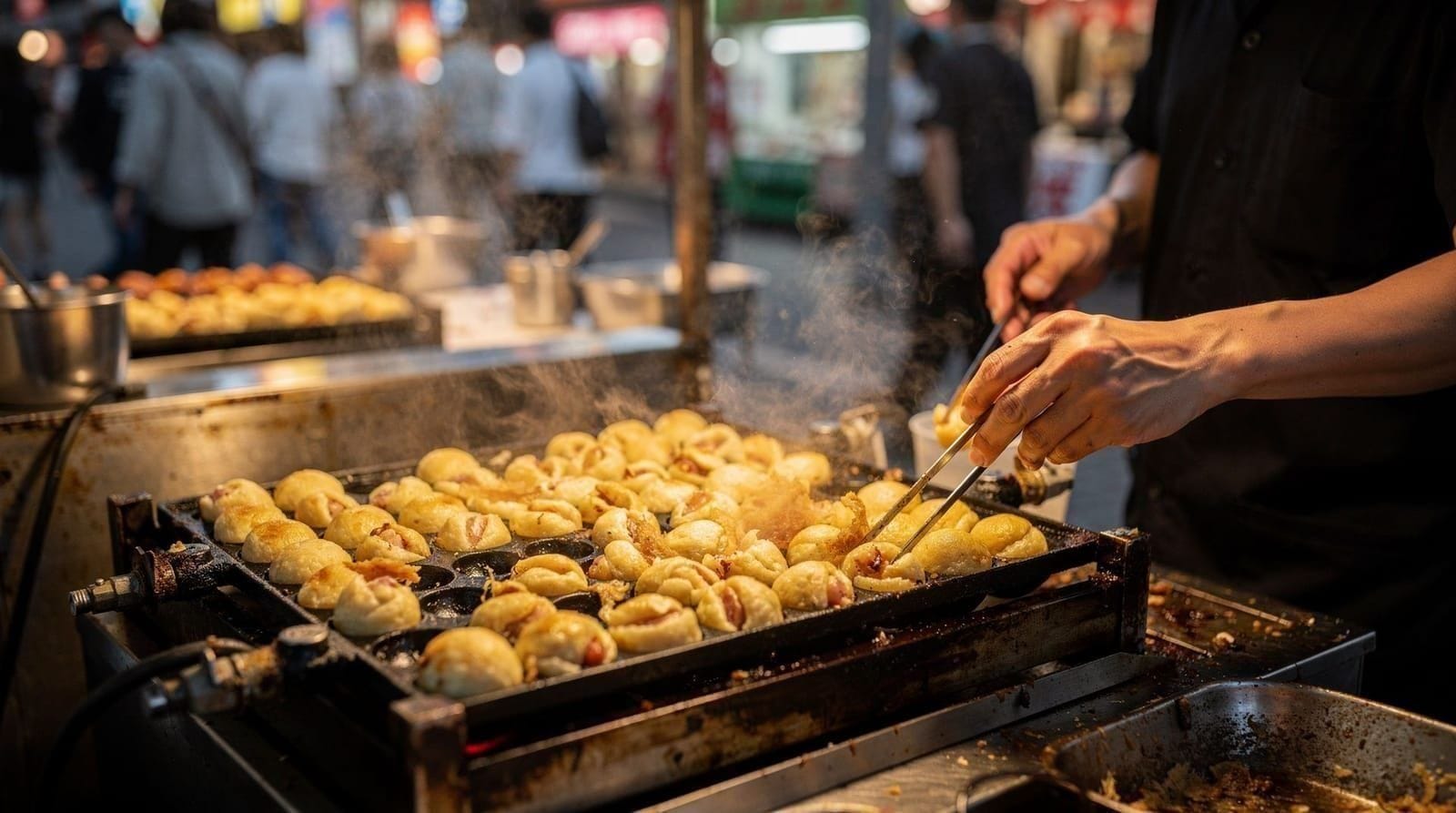
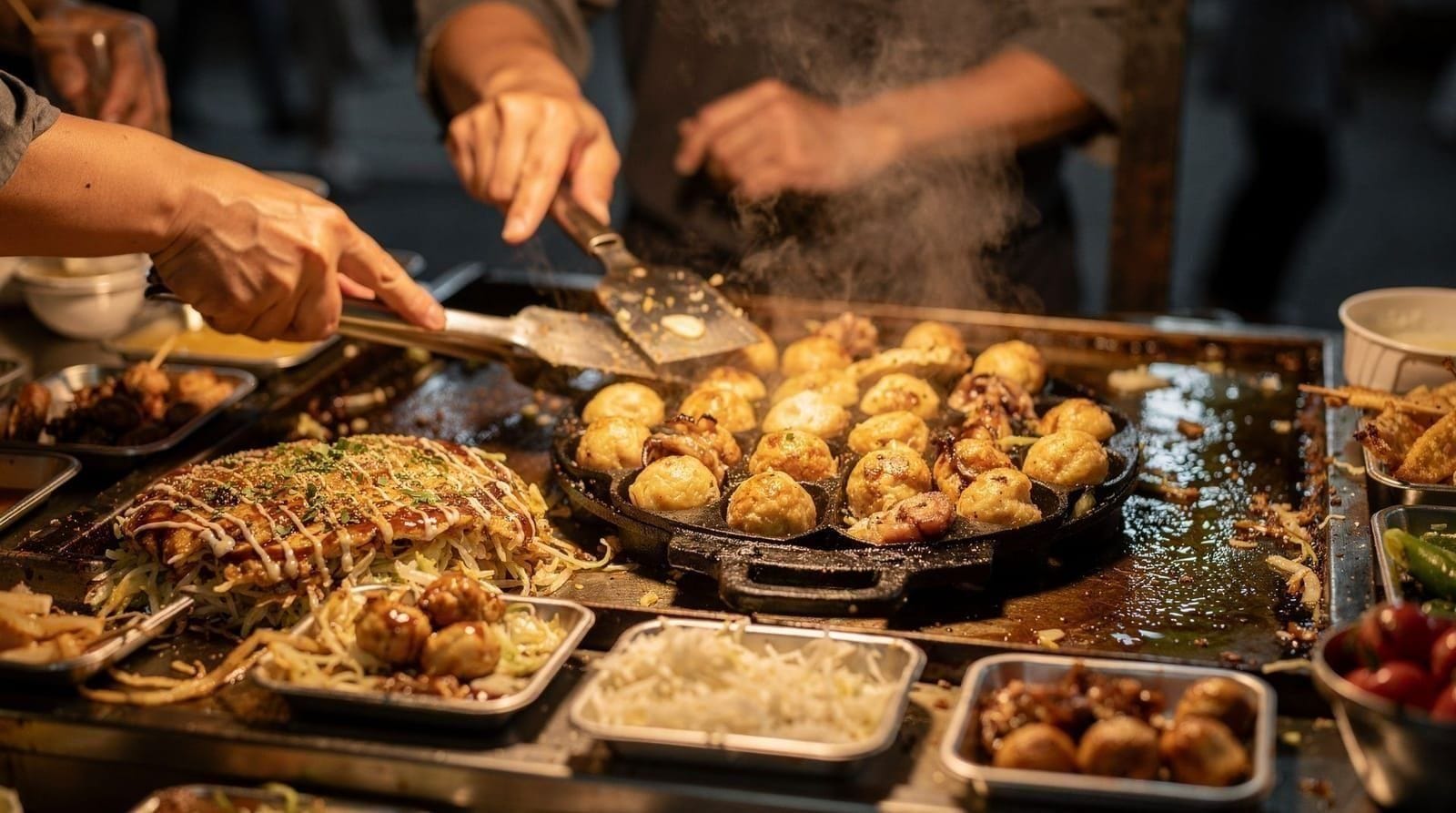
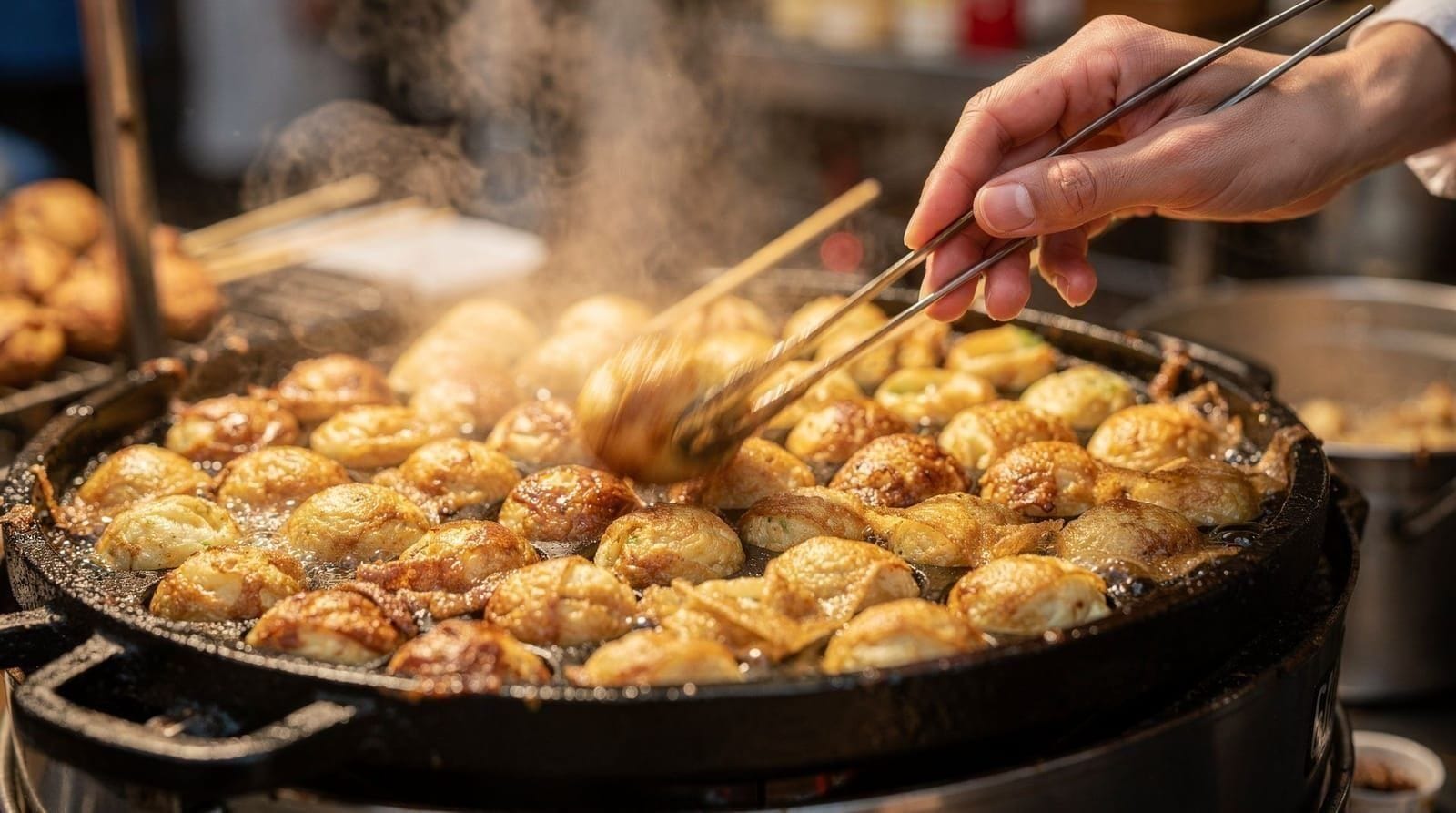
Takoyaki (octopus balls) are the dish most associated with Osaka nationwide, and the city takes real pride in claiming its invention — Aizuya Sohonten, founded in 1933, is widely credited as the original takoyaki shop, though several Osaka stalls make a similar claim. A standard portion of six to eight balls runs ¥500-700 ($4-6), cooked in a molded iron pan, filled with diced octopus, tenkasu (tempura scraps), pickled ginger, and green onion, then topped with a sweet-savory sauce, mayonnaise, bonito flakes, and dried seaweed.
Good takoyaki has a thin, slightly crisp shell and a molten, almost liquid center — if it’s dense and doughy all the way through, it’s been sitting too long. Our full takoyaki guide covers specific stalls in each neighborhood, including which chains are reliable versus which ones exist mostly to catch tourists stepping off tour buses.
Okonomiyaki: the savory pancake
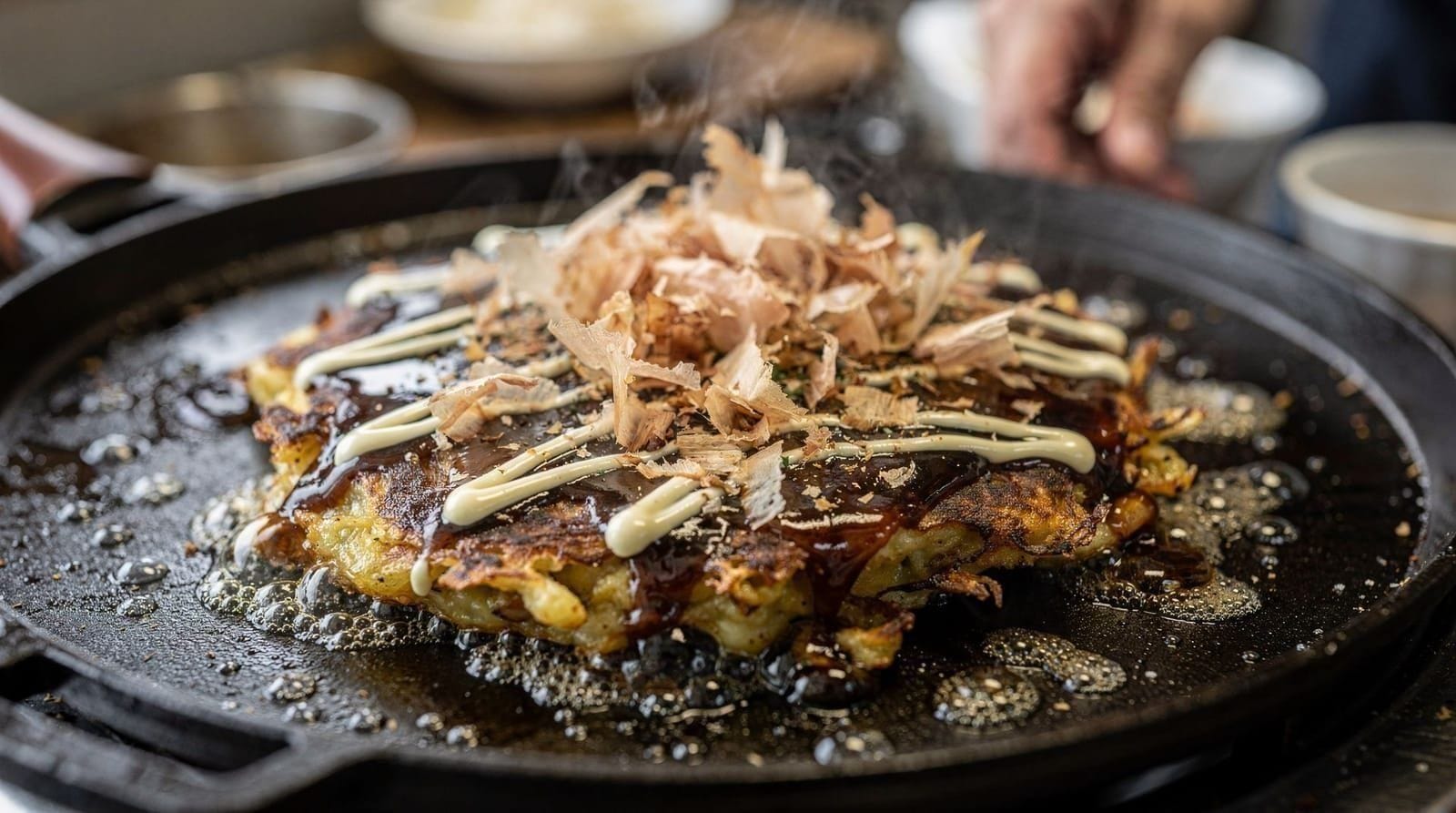
Okonomiyaki translates roughly to “grilled as you like it,” and Osaka-style is a thick batter of flour, grated yamaimo (mountain yam), egg, and shredded cabbage, mixed with a protein — pork belly, squid, shrimp, or a mix — and cooked on a griddle, often at your own table on a built-in teppan. It’s less a street food than a sit-down dish, but it belongs on this list because it’s the other pillar of Osaka’s food identity alongside takoyaki.
A standard plate runs ¥900-1,600 ($8-14) at a casual restaurant. Mizuno, a Dotonbori institution operating since 1953, has held a Michelin Bib Gourmand recommendation in several recent editions of the Osaka guide and routinely has a 30-60 minute wait; Chibo, a larger chain with an English-friendly Dotonbori flagship, is a reasonable backup with shorter lines and slightly higher prices. Full breakdown in our okonomiyaki guide.
Kushikatsu: Shinsekai’s fried skewers
Kushikatsu are skewers of meat, seafood, and vegetables, breaded and deep-fried, served with a shared pot of thin, savory-sweet dipping sauce at the counter. The rule that surprises first-time visitors: no double-dipping. Once a skewer has touched your mouth, you can’t dip it back in the communal sauce — instead, use the free cabbage leaves at the counter to scoop extra sauce onto a skewer you’ve already bitten.
Daruma, founded in 1929, is the chain most associated with the dish and the “no double-dipping” sign hanging over its counters is treated as a genuine house rule, not tourist theater. Individual skewers run ¥120-350 ($1-3) each; a filling meal of eight to ten skewers plus a drink lands around ¥1,800-2,500 ($16-22). Our dedicated kushikatsu guide covers etiquette and specific Shinsekai counters worth the wait.
Kuromon Ichiba Market: the best value-to-quality ratio
Kuromon Ichiba runs about 580 meters through a covered arcade and has operated as a market since the early 1900s, originally supplying nearby restaurants before shifting toward direct-to-visitor sales over the past 15 years. It’s the best place in central Osaka to eat fresh seafood without a restaurant markup: grilled scallops and oysters run ¥400-800 per piece, a small bowl of fresh uni (sea urchin) can run ¥1,000-2,000 depending on the season and grade, and skewers of A5 wagyu — genuinely high-grade beef, not the diluted “wagyu” label used loosely elsewhere — go for ¥800-1,500 each. Prices are printed and mostly non-negotiable, which removes some of the friction present in food markets elsewhere in Asia.
A guided Kuromon Ichiba Market food tour is worth booking on a first visit specifically because it routes you past the stalls set up for tour-group volume and toward the ones that get repeat local customers — the difference in freshness and price is real, and it’s not obvious from the outside.
Dotonbori food beyond the photo ops
Dotonbori’s canal-front restaurants under the giant crab and pufferfish signs are mostly there for the photo, and pricing reflects that — a bowl of ramen that would run ¥800 in Umeda can be ¥1,400 here. That doesn’t mean everything on the strip is bad; it means picking carefully. Kinryu Ramen, with its golden dragon sign and tatami-mat seating just off the main drag, is a reliable, inexpensive option (bowls around ¥800-900) that’s stayed consistent despite its location.
One block back from the canal, Hozenji Yokocho — a narrow, lantern-lit alley around a small moss-covered temple — has quieter, more traditional restaurants at closer to local prices. Our full Dotonbori food guide goes block by block. If you’d rather have someone route you directly to the good spots on a first night, the 3-hour Osaka night food tour covers Dotonbori and the surrounding blocks after dark.
What to skip: Osaka’s street food tourist traps
Any Dotonbori stall with a staff member outside actively waving down foreign tourists, a photo menu in six languages, and prices not clearly posted is a near-guaranteed markup — sometimes double the going rate for an identical portion of takoyaki two streets over. “Premium” or “deluxe” takoyaki sold near the main canal crossing for ¥1,200-1,500 is rarely worth the difference over a ¥500-600 version from a stall with a local queue. Giant crab restaurants under the famous mechanical crab sign are priced for the photo op as much as the food — a full crab dinner easily runs ¥8,000-15,000 per person, while the same quality of crab is often cheaper at Kuromon Market sold by the piece.
Building a street food route for one day
A workable one-day loop: start at Kuromon Ichiba Market around 10am for seafood and wagyu skewers before the crowds peak, walk 10 minutes to Dotonbori for takoyaki and a photo with the Glico sign around midday, continue to Shinsekai in the early evening (about 20 minutes by subway) for kushikatsu and a Tsutenkaku Tower view as the neon comes on, then loop back toward Umeda or Namba for a nightcap.
This mirrors the food-focused day built into our 5-day Kansai food lovers itinerary, which extends the same logic into day trips to Kobe and Kyoto. For a broader introduction that pairs Dotonbori with Shinsekai in a single guided outing, the Dotonbori and Shinsekai foodie tour is a solid option on a short first visit.
Vegetarian and dietary considerations
Osaka’s street food is meat- and seafood-heavy by design — dashi (fish stock) is in nearly everything, including much of the batter used for okonomiyaki and takoyaki, so “vegetable” versions aren’t automatically vegetarian unless a stall confirms it uses a kombu-only stock. A handful of Dotonbori and Umeda restaurants now offer explicitly vegetarian okonomiyaki on request; asking “dashi ni sakana ga haitte imasu ka?” (does the stock contain fish?) before ordering is the most reliable way to check, since English menu translations don’t always flag it.
Seasonal street food to watch for
Street food in Osaka shifts with the calendar more than most visitors expect. Summer (July-August) brings kakigori (shaved ice) stalls to Dotonbori and Shinsekai, often flavored with matcha or Calpis syrup and topped with condensed milk, a welcome break from 30°C-plus humidity. Winter brings oden — a broth of daikon, boiled eggs, fish cakes, and konjac simmered for hours — sold from convenience stores and small stalls alike for ¥100-200 per item, a genuinely local cold-weather habit rather than a tourist dish.
Around New Year, mochi stalls appear briefly at markets including Kuromon Ichiba, selling freshly pounded rice cakes that are worth trying if the timing lines up with a late-December or early-January visit. Cherry blossom season (late March into early April) doesn’t change the food much, but it does triple the crowds at every stall in Dotonbori and Osaka Castle Park, so budget extra queue time.
Street food etiquette worth knowing
Eating while walking is technically discouraged in crowded pedestrian areas like the Dotonbori canal-front, though enforcement is informal — most locals eat standing still near the stall rather than strolling with food in hand, and it’s polite to do the same rather than weaving through the crowd with a skewer.
Trash cans are scarce on Japanese streets generally, including in food districts, so stalls typically expect you to eat near the point of purchase and either return the tray/stick or use a small bin provided by the vendor; carrying a small bag for your own trash is a reasonable backup. Tipping is not expected or practiced at any street food stall, chain restaurant, or sit-down izakaya in Osaka — leaving coins on the counter can cause genuine confusion rather than gratitude.
What to drink alongside Osaka street food
Standing bars near Dotonbori and Shinsekai pour draft beer (Asahi and Kirin dominate the taps, ¥400-600 for a small glass) as the default pairing for kushikatsu and takoyaki, and it’s a genuinely common combination rather than a tourist-facing add-on — locals order a beer before food at most counter-style kushikatsu shops. Highball (whisky and soda) stands have grown fast in Shinsekai and Namba over the past decade, running ¥400-500 a glass and popular precisely because they cut through fried food better than beer for some drinkers.
Non-alcoholic options are easy to find: canned green tea and barley tea (mugicha) from vending machines cost ¥120-160, and Calpis (a diluted yogurt-flavored soft drink) is a distinctly Kansai-associated choice worth trying once. For a more structured evening built around drinking rather than eating, our Osaka bars and izakaya guide and Dotonbori nightlife guide cover where to go after the food stalls close.
Where street food connects to the rest of Kansai
Osaka’s street food culture doesn’t exist in isolation — Kobe’s Nada district built its own food-and-drink identity around sake rather than snacks (see our Nada sake tasting guide), Kyoto’s Nishiki Market runs the same covered-arcade format with a more refined, Kyoto-style selection (our Nishiki Market guide), and Kobe’s beef culture is worth a dedicated day trip covered in our Kobe beef guide.
If you’re deciding how to sequence eating across the whole region, the Osaka destination guide and Kobe destination guide lay out travel times between the food hubs.
Portion sizes and how much to actually order
First-time visitors often over-order, assuming each stall’s portion is a full meal — most street food portions in Osaka are deliberately small, meant to be sampled across several stalls rather than filling you up at one. A single takoyaki tray (six to eight balls) or two or three kushikatsu skewers is closer to a taste than a meal; the grazing approach this guide recommends works precisely because portions are sized for it. Ordering one item at three or four stalls across a few hours, rather than a large order at a single stop, is both cheaper per stall and the way most locals actually eat their way through Dotonbori or Kuromon Market.
Rainy-day and winter street food strategy
Osaka’s street food scene doesn’t shut down in bad weather, but the experience shifts — Dotonbori’s canal-front stalls have overhangs, and Kuromon Ichiba Market and Umeda’s underground malls are covered or indoor entirely, making them a better bet than an open-air stall on a wet day. Winter brings oden stalls and heated indoor seating options that don’t exist in summer, and the covered arcades of Kuromon and Umeda genuinely outperform Dotonbori’s canal-front strip for comfort once temperatures drop. For a broader plan on filling an unexpectedly wet day, see our Osaka rainy day ideas guide, which covers indoor options beyond food.
Frequently asked questions about Osaka street food guide
Is Osaka street food safe to eat?
Yes. Japan's food hygiene standards are strict and enforced, and street stalls are held to the same health codes as sit-down restaurants. The main risk is overpaying, not food safety.How much does a full day of Osaka street food cost?
Budget ¥3,000-5,000 (about $26-44) for a grazing day across three or four stalls — a takoyaki portion, an okonomiyaki, a couple of kushikatsu skewers, and a drink. Doubling that gets you into premium seafood and wagyu skewer territory at Kuromon Market.What is the difference between takoyaki and okonomiyaki?
Takoyaki are round, ball-shaped snacks made from a wheat batter with diced octopus, cooked in a special molded pan. Okonomiyaki is a flat, pan-fried pancake made from a thicker batter mixed with shredded cabbage and a protein of choice, topped with sauce, mayonnaise, and bonito flakes.Where is the best street food in Osaka — Dotonbori or Kuromon Market?
Dotonbori has the highest density of stalls and the most atmosphere (neon, canal views, crowds) but also the most tourist-priced spots. Kuromon Ichiba Market has better quality-to-price ratio on seafood and wagyu skewers, though it also draws large tour groups by mid-morning.Do I need cash for street food stalls in Osaka?
Yes, mostly. Small stalls and market vendors are still cash-heavy, though IC cards (ICOCA, Suica) and contactless payment are increasingly accepted at larger chain locations. Carry ¥3,000-5,000 in small bills for a day of grazing.What time should I visit Kuromon Ichiba Market for street food?
Between 10am and noon on a weekday, before large tour groups arrive and while the seafood is freshest. By early afternoon on weekends, the main aisle can be shoulder-to-shoulder.Is it rude to eat while walking through Dotonbori?
Technically discouraged, though enforcement is informal. Most locals eat standing near the stall rather than strolling with food in hand, and it's polite to do the same rather than weaving through the crowd with a skewer.Can I find vegetarian street food in Osaka?
It takes some asking. Dashi (fish stock) is in most batters, including takoyaki and okonomiyaki, so a "vegetable" version isn't automatically vegetarian unless a stall confirms it uses a kombu-only stock. A handful of Dotonbori and Umeda spots now offer explicitly vegetarian okonomiyaki on request.
Top experiences
Bookable activities with verified prices and instant confirmation on GetYourGuide.