Takoyaki guide — Osaka's octopus ball snack
Osaka: Osaka okonomiyaki takoyaki cooking class
What is takoyaki and where should you eat it in Osaka?
Takoyaki are ball-shaped snacks of wheat batter and diced octopus, cooked in a molded iron pan and topped with sauce, mayonnaise, and bonito flakes. A portion of six to eight runs ¥500-700 ($4-6). Aizuya Sohonten and Wanaka are two long-running Osaka chains worth seeking out over the unnamed stalls directly on the Dotonbori canal-front.
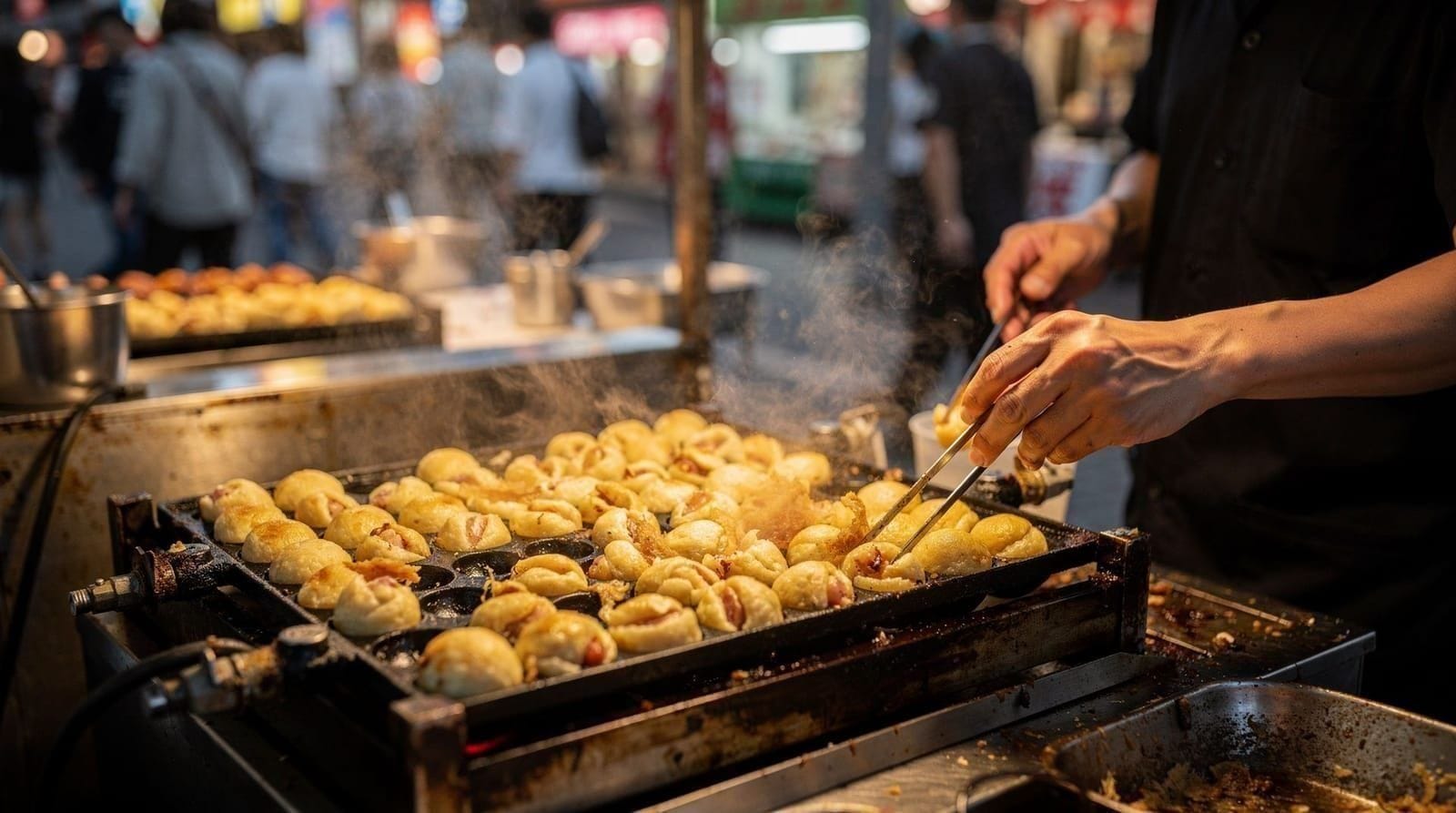
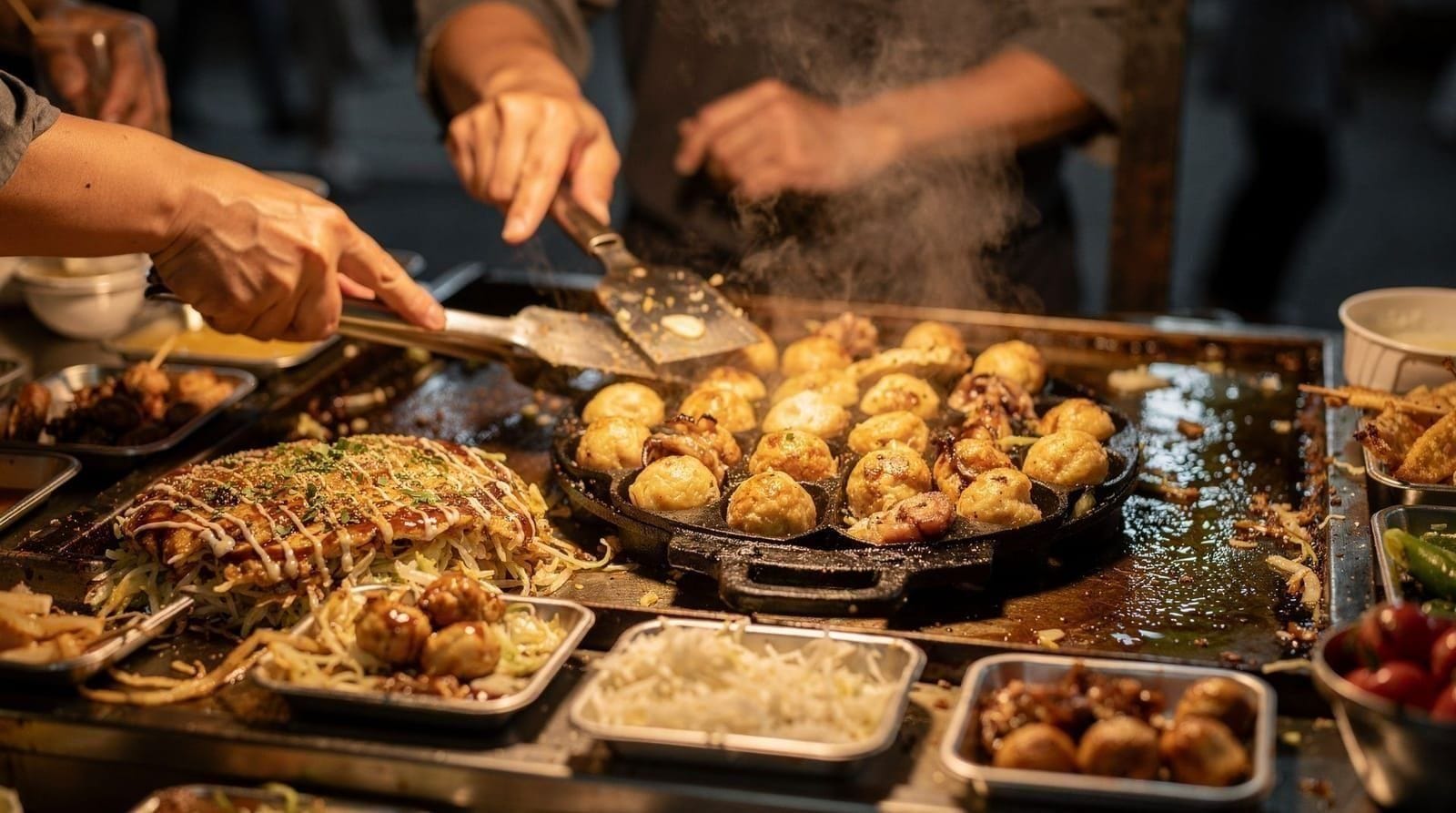
Takoyaki is the dish most people picture when they think of Osaka food — round, golf-ball-sized snacks sizzling in rows on a molded iron griddle, flipped with a metal pick, then doused in a sweet-savory sauce and topped with a flurry of bonito flakes that curl in the rising heat. It’s cheap, it’s everywhere, and the quality gap between a good stall and a mediocre one is bigger than the price gap would suggest.
| Cost | ¥500-700 for 6-8 pieces at a stall |
| Where | Dotonbori, Kuromon Market, Amerikamura, Shinsekai |
| Eat with | Toothpick or small fork, not chopsticks |
| Wait | 60-90 seconds before biting — the center is molten |
| Best value | A block or two off the Dotonbori canal-front |
Where takoyaki came from
The dish traces back to the early 1930s in Osaka, evolving from an earlier snack called akashiyaki (a similar egg-batter ball from nearby Akashi, in Hyogo Prefecture, traditionally dipped in dashi broth rather than sauce) and a beef-and-konjac snack called radioyaki that was popular in the city at the time. Aizuya Sohonten, which opened in 1933 in Osaka’s Nishinari ward, is widely credited as the shop that swapped in octopus and created the takoyaki most people recognize today, and the shop still operates. Several other long-running Osaka stalls make similar claims to the dish’s origin, which is itself very on-brand for a city that treats food history as a point of civic pride.
How takoyaki is made, and what makes it good
The batter is a thin, dashi-enriched wheat flour mixture poured into a pan of hemispherical molds, each filled with a piece of diced octopus, a pinch of tenkasu (crunchy tempura scraps), pickled red ginger (beni shoga), and chopped green onion. The cook rotates each ball with a metal pick as it sets, folding the browning outer layer into the still-liquid center until it forms a sphere with a thin, slightly crisp shell around a soft, almost molten interior.
That contrast — crisp outside, flowing center — is the entire point of good takoyaki, and it’s also the easiest thing for a rushed or high-volume stall to get wrong: pre-cooked balls reheated for tourist volume come out dense and gummy all the way through, with none of the textural payoff.
Standard toppings are takoyaki sauce (a thick, worcestershire-adjacent sauce similar to okonomiyaki sauce), Japanese mayonnaise (Kewpie, noticeably richer than Western mayo due to its egg-yolk-only recipe), a sprinkle of aonori (dried green seaweed flakes), and katsuobushi (bonito flakes) shaved thin enough to visibly move in the residual heat. Some Osaka stalls offer a “negi-shio” (green onion and salt) version without sauce for a lighter, saltier alternative, and a handful of specialty shops do a ponzu-and-daikon version closer to the original akashiyaki style.
Where to eat takoyaki in Osaka
Wanaka, with several locations around Namba and Sennichimae, is a long-running local chain popular with Osakans as well as visitors, known for a slightly thinner batter and a generous octopus piece in every ball; expect ¥500-600 for eight pieces. Aizuya Sohonten, the shop with the strongest claim to inventing the dish, is worth the detour to Nishinari for the history alone, though it’s further from the main tourist circuit than most visitors want to walk. Juhachiban, founded by a former sumo wrestler and recognizable by its sumo-themed branding, has multiple Dotonbori and Namba locations and leans slightly sweeter on the sauce.
Chains with English menus and photos of every combination (a mix of octopus, cheese, or mochi fillings) tend to cluster right on the Dotonbori canal-front — they’re not necessarily bad, but they’re priced ¥100-200 higher per portion than an equivalent stall one block back, and the freshness suffers when a stall is built for constant tourist throughput rather than turnover-driven local traffic.
Kuromon Ichiba Market, a short walk from Dotonbori, has several stalls selling fresh-cooked takoyaki alongside its seafood offerings — a reasonable stop if you’re already there for the market’s grilled scallops and wagyu skewers, covered in our Osaka street food guide. Umeda’s underground malls hide quieter, more local takoyaki counters with almost no English signage, generally ¥50-100 cheaper per portion than the equivalent in Namba.
The octopus itself
Quality takoyaki hinges on the octopus piece being large enough to bite into rather than shredded filler, and on it being genuinely tender rather than rubbery — a sign of either poor-quality octopus or over-tenderizing in a rush to keep up with volume.
Most Osaka stalls source Pacific octopus, some of it imported (Mauritania and Morocco are long-standing suppliers to Japan’s octopus market), which surprises visitors who assume everything is hyper-local; domestic Japanese octopus, when used, is called out explicitly on signage as a selling point and usually commands a small premium. A stall charging noticeably less than ¥500 for a full portion is more likely cutting corners on octopus size than on any other ingredient, since it’s the single most expensive component in the batter.
Amerikamura and other lower-key takoyaki spots
Beyond Dotonbori and Kuromon Market, Amerikamura (Amerika-mura, “American Village”), a compact grid of streets a short walk west of Shinsaibashi known for vintage clothing and youth culture, has several small takoyaki counters that cater to a younger, more local crowd rather than the tour-bus circuit — prices run slightly below Dotonbori for a comparable product, and the people-watching is a genuine draw in its own right. Shinsekai, better known for kushikatsu, also has a handful of takoyaki stalls worth a stop if you’re already there for skewers and Tsutenkaku Tower views, covered in our kushikatsu guide.
How to eat takoyaki without burning your mouth
The single most common mistake first-time takoyaki eaters make is biting straight into a fresh-off-the-griddle ball, which traps steam inside a molten center that’s genuinely hot enough to burn the roof of your mouth. Locals wait 60-90 seconds after the tray is handed over, or take a small first bite and let the steam escape before continuing. Takoyaki is eaten with a toothpick or small fork provided by the stall, not chopsticks, and it’s meant to be eaten standing near the stall rather than carried while walking through crowds — a habit that’s both practical (the sauce drips) and in line with general Japanese street-eating etiquette.
Making takoyaki yourself
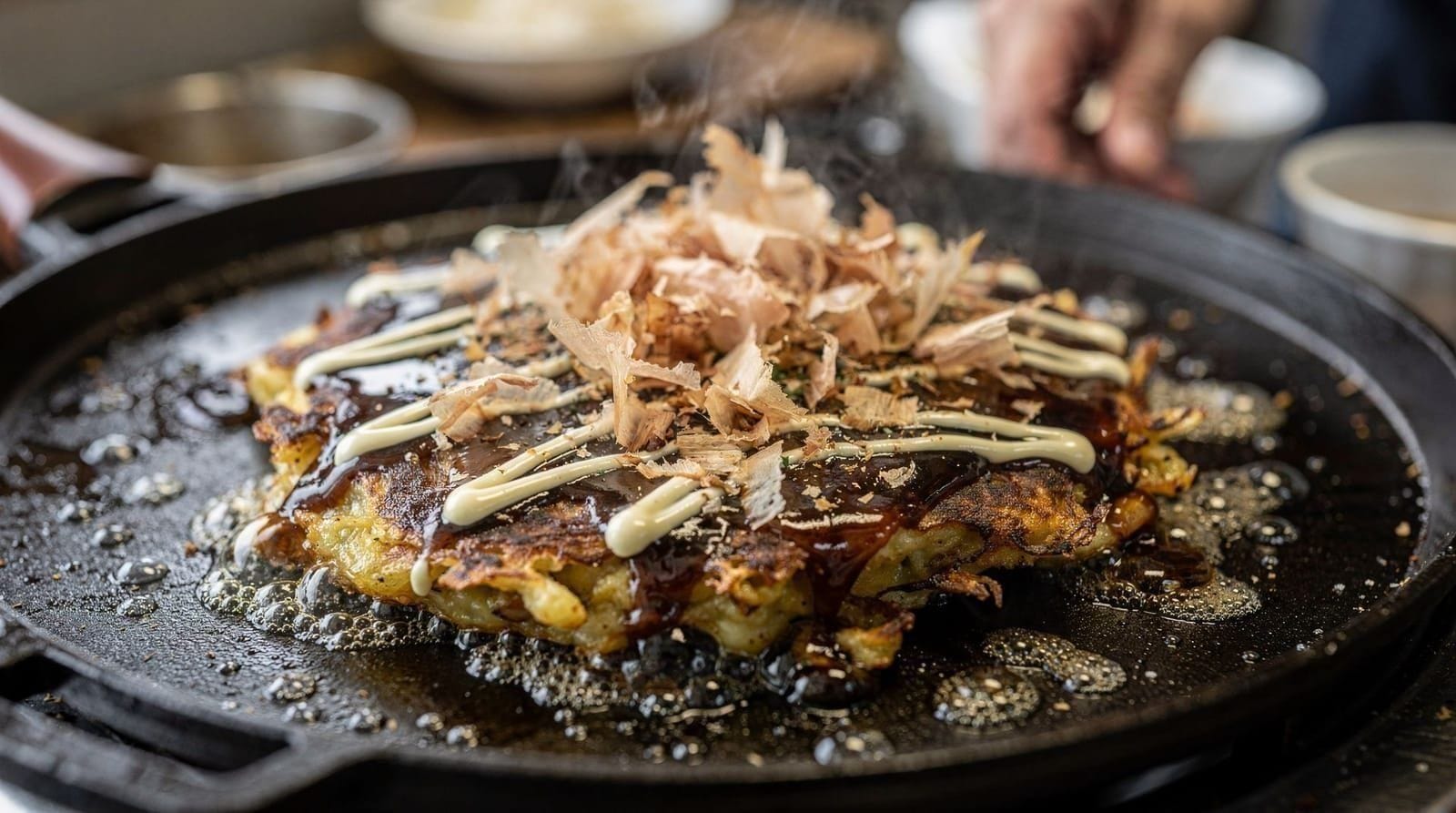
If the dish sticks with you past the trip, a hands-on okonomiyaki and takoyaki cooking class covers both signature dishes in one session, including the pan-flipping technique that looks easy from a stall counter and is considerably harder in practice — most first attempts come out lopsided or split open. It’s a good rainy-day activity or a way to fill an afternoon between a morning at Osaka Castle and an evening in Dotonbori.
Takoyaki versus akashiyaki: the dish’s quieter cousin
Akashiyaki, from the port city of Akashi in Hyogo Prefecture (about 40 minutes from Osaka by train, near Kobe), is takoyaki’s predecessor and uses a lighter, more egg-heavy batter with no sauce — instead, the balls are dipped in warm dashi broth at the table. It’s less photogenic than sauce-topped takoyaki and rarely appears on Osaka menus specifically, but it’s worth trying if a day trip takes you through Akashi or Kobe, if only to understand how the more famous Osaka version diverged from it. Our Kobe destination guide has more on day-tripping in that direction.
Takopa: the home takoyaki party
Beyond the stalls, takoyaki has a strong home-cooking tradition in Osaka that visitors rarely see: takopa (a contraction of takoyaki party), where friends or family gather around an electric takoyaki pan on the dining table and cook a shared batch together, each person adding their own fillings and flipping their own balls.
It’s closer in spirit to a fondue night than to grabbing street food, and it’s common enough that takoyaki pans are a standard wedding-registry and housewarming gift in the Kansai region specifically — a household without one is considered slightly unusual by Osaka standards. If a homestay, ryokan with a shared kitchen, or Airbnb puts a takoyaki pan within reach, it’s worth trying the DIY version at least once for the different, more communal pace of eating it.
Takoyaki across Japan versus takoyaki in Osaka
The dish has spread nationwide and abroad, and convenience store and supermarket versions are sold from Tokyo to Fukuoka, but the balance of ingredients shifts by region — Kanto-area (Tokyo) versions often use a thicker, eggier batter and go heavier on mayonnaise, while Osaka purists tend to favor a thinner batter and a stronger dashi presence, letting the octopus and sauce carry more of the flavor. Festival stalls (yatai) at matsuri across the country sell a version aimed at fast turnover for large crowds, which is usually a step down in quality from a dedicated takoyaki shop regardless of city — a useful thing to know if you’re comparing a bite at Tenjin Matsuri in July to a sit-down portion at Wanaka a week earlier.
What separates a good stall from a mediocre one
A few concrete signs are more reliable than online reviews for judging a takoyaki stall on the spot: a visible line of regulars rather than only visitors with rolling suitcases, a cook working the pan by hand in real time rather than pulling pre-made balls from a warming tray, and a queue that moves in bursts (a fresh batch every few minutes) rather than continuously. Stalls that pre-cook large batches to keep up with tour-group volume inevitably serve some portion of reheated product, which is where the texture problem — dense rather than molten — comes from. None of this requires reading Japanese; it’s observable from outside the stall in under a minute.
Frozen and grocery-store takoyaki
Convenience stores and supermarkets across Osaka sell frozen takoyaki kits and pre-cooked packs, a reasonable way to try a home-style version if a late arrival or early departure means missing the stalls — quality is noticeably lower than fresh-griddled versions, but it’s a real, common way Osakans eat the dish at home rather than a tourist substitute. Takoyaki pans (electric, countertop versions) are sold in Umeda’s department stores and at Don Quijote locations across the city as a souvenir, if bringing the cooking method home appeals more than a t-shirt.
Price by neighborhood, roughly
As a general guide to what a standard eight-piece portion costs depending on where you buy it: Umeda’s underground malls and Amerikamura run ¥450-550; Kuromon Ichiba Market and Shinsekai run ¥500-650; the Dotonbori canal-front itself runs ¥600-800, and “premium” versions with extra cheese, larger octopus pieces, or truffle-oil finishes marketed to visitors can reach ¥900-1,200. None of these price tiers reliably correlate with quality above the ¥550-650 range — past that point you’re mostly paying for location and presentation rather than a meaningfully better product.
Takoyaki as part of a wider food day
Takoyaki rarely stands alone in a day of Osaka eating — it pairs naturally with a kushikatsu stop in Shinsekai (our kushikatsu guide) or an okonomiyaki dinner (our okonomiyaki guide), since all three are cheap, fast, and clustered in the same neighborhoods.
If you’re building a food-focused day or multi-day trip, our Dotonbori food guide covers the wider area block by block, and the 5-day Kansai food lovers itinerary sequences takoyaki alongside Kobe beef, Nishiki Market, and Uji matcha across the wider region. For context on the neighborhood itself, see Dotonbori and Namba and Osaka.
Takoyaki gadgets and souvenirs
Beyond the electric home pans mentioned above, Osaka’s department stores and Don Quijote discount outlets sell a wide range of takoyaki-branded souvenirs — keychains, magnets, and stationery shaped like the Glico running man alongside octopus-ball motifs specifically. A more useful souvenir than the novelty items is a compact takoyaki pick set (the metal skewers used to rotate the balls mid-cook), sold in most kitchenware sections of Umeda’s department stores for a few hundred yen, genuinely usable if you pick up a home pan as well. Loft and Tokyu Hands (kitchen and lifestyle stores with Osaka locations) stock a wider, better-made selection than the tourist-focused souvenir shops directly in Dotonbori.
Takoyaki stalls versus sit-down takoyaki restaurants
Most first-time visitors encounter takoyaki exclusively at street stalls, but a smaller number of sit-down restaurants specialize in the dish with a more curated menu — multiple sauce styles, premium octopus grades, and sometimes a build-your-own element where the batter arrives at the table for guests to cook themselves on a built-in griddle, a format closer to the takopa home tradition covered above but in a restaurant setting. These restaurants run ¥1,200-2,500 per person, a step up from stall pricing, and suit visitors who want to sit down and linger rather than eat standing near a counter.
Pairing takoyaki with a wider Dotonbori food crawl
Takoyaki works best as one stop of several rather than the meal itself, given the small portion size — a reasonable grazing sequence starts with takoyaki, moves to a kushikatsu skewer or two in nearby Shinsekai, and finishes with a lighter okonomiyaki portion or ramen bowl, spreading the calories and flavors across a longer evening rather than filling up at the first stall. The Osaka street food guide sequences a fuller version of this crawl covering several more dishes across a single evening.
How to judge freshness before ordering
Beyond the visible-line and hand-worked-pan signs covered above, a stall’s turnover rate is observable in how the takoyaki looks in the tray: a fresh batch has a glossy, slightly wet-looking shell from the just-applied sauce and mayonnaise, while a batch that’s been sitting develops a duller, slightly dried surface and the bonito flakes stop moving in the residual heat. If a stall keeps large trays of pre-topped takoyaki sitting under a heat lamp rather than topping each order fresh, that’s a reasonable signal to look elsewhere, particularly in the densest tourist stretches of Dotonbori where volume pressure is highest.
A note on regional pride
Ask most Osakans which stall makes the best takoyaki in the city and you’ll get a strong, specific opinion rather than a shrug — it’s one of the few food topics locally that generates genuine, mildly competitive debate, closer to how people elsewhere might argue about barbecue or pizza. That level of civic investment is worth keeping in mind when a recommendation from a local differs from what’s popular with visitors online; both are usually right, just calibrated to different priorities (a quick, reliable neighborhood stall versus a photogenic, review-heavy destination).
Frequently asked questions about Takoyaki guide
What's inside takoyaki?
A wheat-flour batter enriched with dashi, cooked around a piece of diced octopus, tempura scraps (tenkasu), pickled red ginger, and green onion, then topped with sauce, mayonnaise, bonito flakes, and dried seaweed.Is takoyaki vegetarian?
Not by default — the batter is typically made with a dashi (fish-based) stock and contains octopus. Some specialty shops offer a vegetable or cheese version on request, but it's worth confirming the batter itself rather than assuming a non-octopus filling makes it vegetarian.How much does takoyaki cost in Osaka?
Expect ¥500-700 ($4-6) for a standard portion of six to eight pieces at a casual stall, rising to ¥800-1,000 at sit-down restaurants or premium versions with additional toppings like cheese or extra seafood.Is Dotonbori the best place to eat takoyaki?
It's the most convenient and atmospheric, but not necessarily the best value — stalls directly on the canal-front tend to charge a premium for foot traffic. Wanaka and other established chains a block or two back offer similar or better quality for less.Can I find takoyaki outside Osaka?
Yes, it's sold across Japan and increasingly abroad, but Osaka remains the dish's home and the place where quality and variety are highest, given the sheer density of competing stalls.How many takoyaki should one person order?
A single eight-piece portion is a reasonable snack; treat it as one stop on a grazing route rather than a full meal unless you're pairing it with a second order or a side of edamame or fried chicken (karaage) from a neighboring stall. Most visitors are satisfied sampling two or three different stalls' versions across a day rather than filling up at one.
Top experiences
Bookable activities with verified prices and instant confirmation on GetYourGuide.