Okonomiyaki guide — Osaka's savory pancake
Osaka: Osaka okonomiyaki takoyaki cooking class
What is okonomiyaki and how is Osaka-style different?
Okonomiyaki is a savory pancake of flour batter, egg, and shredded cabbage mixed with a protein, grilled and topped with sauce, mayonnaise, and bonito flakes. Osaka-style mixes all the ingredients into one batter before cooking; Hiroshima-style layers them and adds fried noodles. A plate runs ¥900-1,600 ($8-14) in Osaka, with Mizuno in Dotonbori among the most consistently recommended spots.
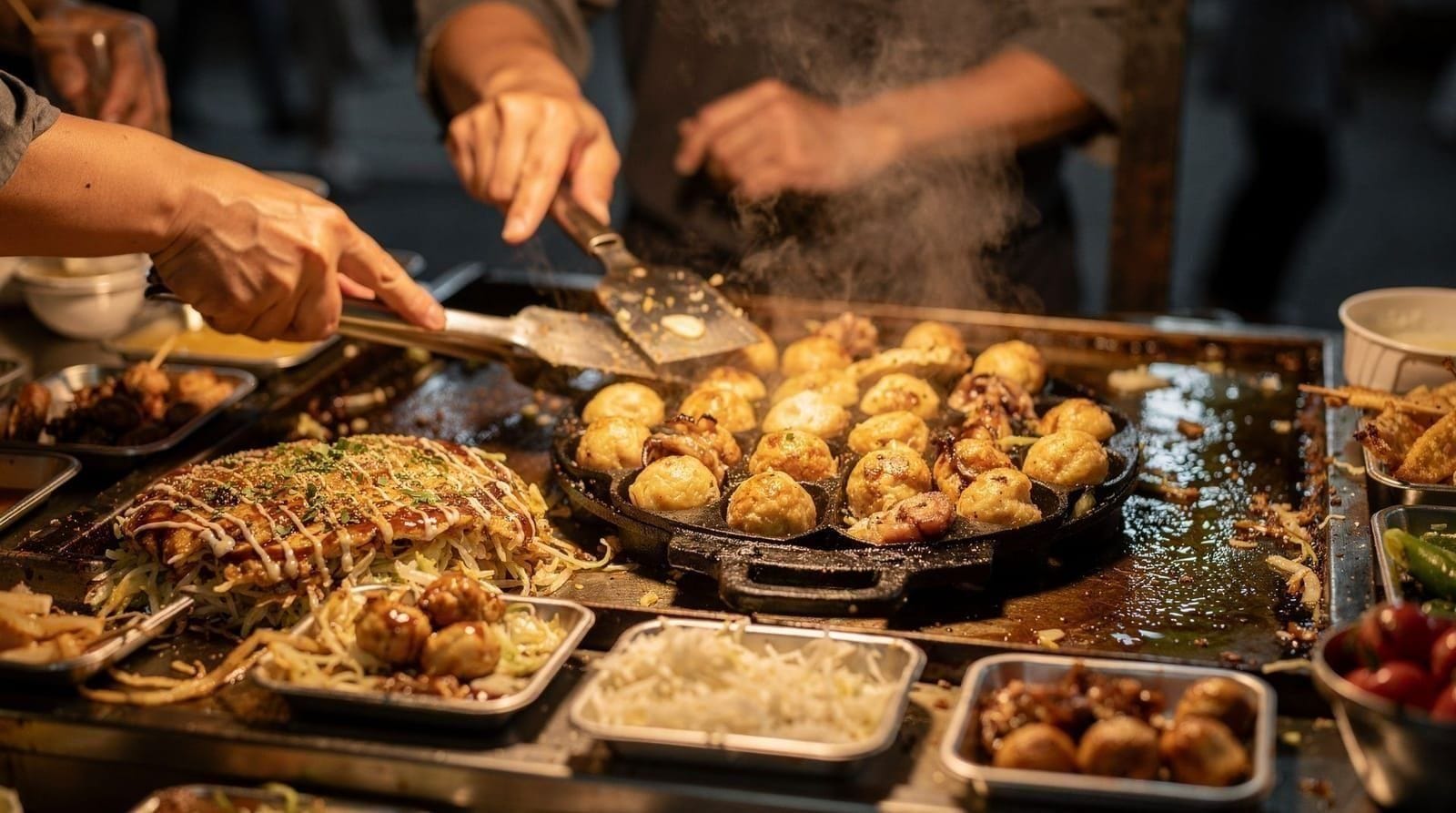
Okonomiyaki is Osaka’s other signature dish alongside takoyaki, and the two are often eaten in the same evening even though they couldn’t be more different in format — one is a handful of bite-size balls, the other a full, knife-and-fork (or, more traditionally, small spatula) meal cooked on a hot griddle, often at your own table. The name translates loosely to “grilled as you like it,” and the “as you like it” part is real: fillings vary by restaurant, region, and personal taste far more than takoyaki’s fairly fixed formula.
| Where | Dotonbori, Umeda, Fukushima |
| Cost | Around ¥900-1,600 a plate |
| Time needed | 45-75 minutes for a sit-down meal |
| Booking | Not usually accepted; expect to queue at peak spots |
| Best time | Right at opening, or 3-4pm off-peak |
What’s actually in okonomiyaki
The base batter is wheat flour, grated yamaimo (mountain yam, which adds a light, slightly gluey texture that helps bind the pancake without making it dense), dashi, and egg, mixed with a generous amount of shredded cabbage — cabbage is closer to the main ingredient than a garnish, giving the finished pancake real bulk and a slight sweetness once cooked through. A protein is folded in before cooking: pork belly is the most common default, but squid, shrimp, a mix of seafood (kaisen), or a cheese-and-mochi combination are all standard menu options.
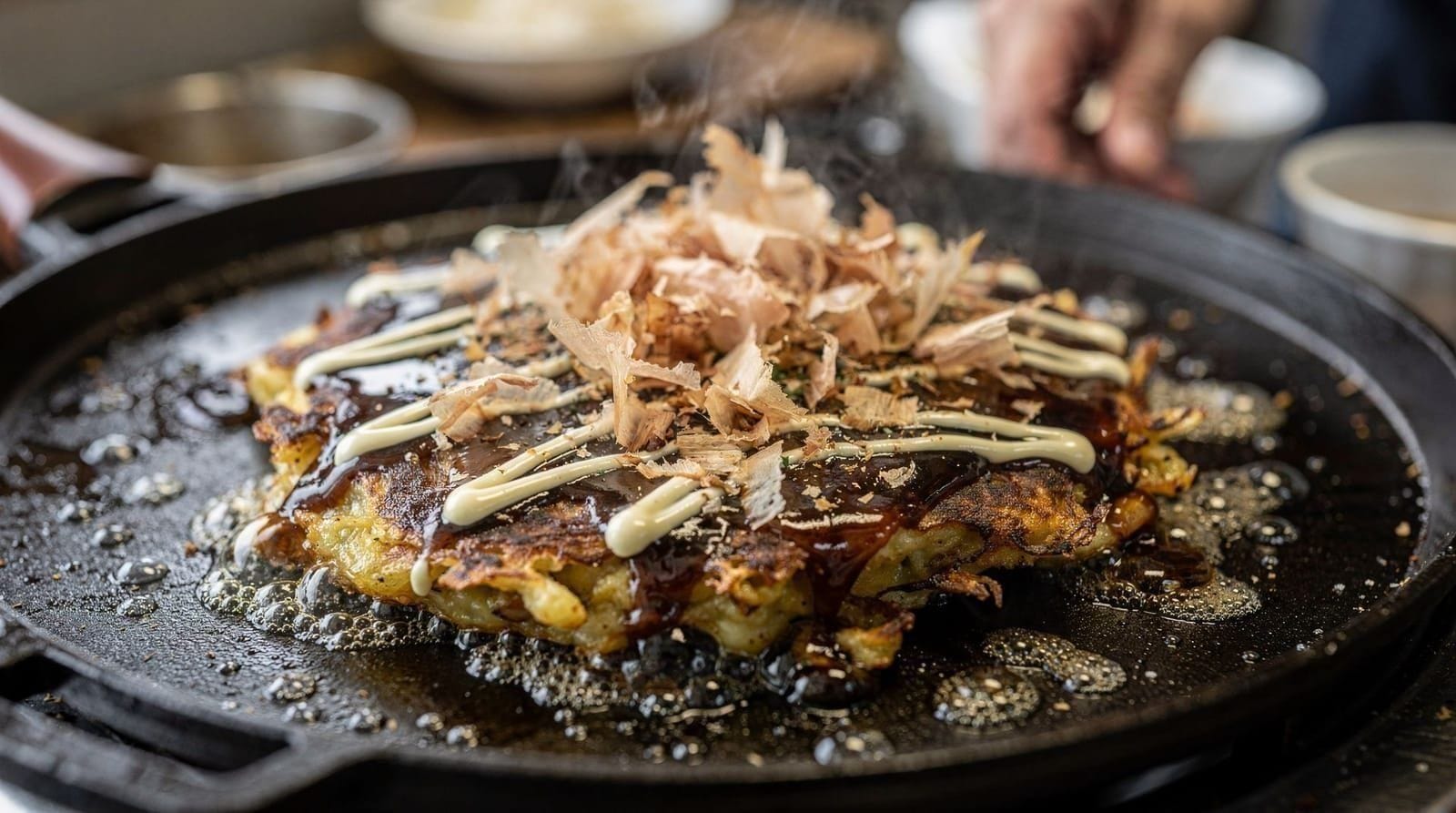
Once cooked on both sides on a hot griddle, it’s topped with okonomiyaki sauce (a thick, slightly sweet sauce related to tonkatsu sauce and Worcestershire sauce), Japanese mayonnaise drizzled in a crosshatch pattern, a dusting of aonori (dried seaweed flakes), and a generous pile of katsuobushi (bonito flakes), which visibly ripple in the heat rising off the pancake — a detail that shows up in nearly every photo of the dish for good reason.
A brief history of the dish
Okonomiyaki’s direct ancestor is funoyaki, a thin, sweetened wheat crepe served with miso that dates back centuries and was associated with tea ceremony culture in Kyoto. The dish shifted toward its modern savory form in the early 20th century, and the postwar version — thicker, cabbage-heavy, built around whatever ingredients were affordable and available — solidified in Osaka during the food-scarce years after 1945, when cheap flour and cabbage made for an filling, stretchable meal. That history is part of why the dish carries genuine working-class pride in Osaka rather than reading as a tourist novelty; it’s comfort food in the literal sense, tied to a specific period of the city’s recovery.
Osaka-style versus Hiroshima-style
The other major regional version, Hiroshima-style okonomiyaki, differs enough that ordering the wrong one expecting Osaka’s version can be a genuine surprise. Osaka-style (sometimes called Kansai-style) mixes every ingredient into a single batter before cooking it as one cohesive pancake. Hiroshima-style builds in distinct layers — a thin crepe-like batter base, then cabbage, then a fried-noodle layer (yakisoba or udon noodles), then a fried egg on top — cooked as a stack rather than mixed together, and it’s noticeably larger and more filling as a result.
Neither is “the real one”; they’re genuinely different regional dishes that happen to share a name, sauce style, and rough concept. If you’re only visiting Osaka on this trip, Osaka-style is what you’ll find on nearly every menu, though a handful of restaurants (particularly ones marketing to a broader tourist crowd) offer both versions side by side for comparison.
Where to eat okonomiyaki in Osaka
Mizuno, operating in Dotonbori since 1953, is the name that comes up most often in serious recommendations — it’s held a Michelin Bib Gourmand recommendation in multiple recent editions of the Osaka guide, uses a distinctive yamaimo-heavy batter that comes out lighter than the neighborhood average, and routinely has a 30-60 minute wait for a table, longer on weekends.
Chibo, a larger chain with a flagship location in Dotonbori and English-friendly service, is a reliable backup with shorter waits and prices only slightly higher than Mizuno. In Umeda, Kiji — tucked into the Kitchinaka-modern underground alley beneath the Umeda Sky Building complex — draws long local queues for a version many Osakans consider among the city’s best, with almost no English signage and a correspondingly local crowd.
Yukari, in the Fukushima area, specializes in negiyaki (a lighter, green-onion-forward relative of okonomiyaki using a thinner batter and no cabbage) and has held Bib Gourmand recognition as well.
A full plate at any of these runs ¥900-1,600 ($8-14) depending on the protein and toppings, with premium versions (extra cheese, additional seafood, wagyu) reaching ¥2,000-2,500. Dotonbori’s most heavily trafficked restaurants, identifiable by the biggest queues and the most aggressive English signage, are not automatically bad — Mizuno and Chibo are both squarely in that category and both genuinely good — but a handful of smaller, less-marketed okonomiyaki counters one or two streets back offer a comparable product for ¥200-300 less per plate.
Cooking it yourself at the table
Many okonomiyaki restaurants build the dish into a teppan (hot iron griddle) set directly into the table, and depending on the restaurant, staff either cook it entirely tableside or hand you the batter to cook yourself with a set of small metal spatulas (kote). If you’re offered the DIY option, the two things that trip up first-timers are flipping too early (before the underside has properly set and browned, which causes the pancake to fall apart) and using the kote to cut and eat directly from the pan rather than transferring a slice to your own plate — both are accepted local practice, not a faux pas, and staff will generally step in to flip for you if it looks like it’s going wrong.
A hands-on okonomiyaki and takoyaki cooking class is a good way to get comfortable with the technique in a lower-pressure setting before trying it at a real restaurant’s table-side griddle, and it pairs both signature dishes into a single afternoon.
Modan-yaki and other regional variations
Modan-yaki (“modern-style”) is an Osaka variant that adds a layer of fried yakisoba noodles into the okonomiyaki batter, splitting the difference between Osaka- and Hiroshima-style without fully committing to either — it’s heartier and starchier, a good option if a standard okonomiyaki plate doesn’t feel like enough of a meal. Negiyaki, mentioned above via Yukari, drops the cabbage and heavy sauce for a lighter, green-onion-forward version closer to a savory crepe. Some restaurants also offer a monjayaki option, a runnier, more spreadable Tokyo-area relative of okonomiyaki that’s eaten directly off the griddle with a small spatula rather than plated — less common in Osaka than in Tokyo, but it shows up on a handful of izakaya menus.
Dietary notes
Okonomiyaki batter contains egg, wheat flour, and typically a dashi stock that includes fish, so it is not vegetarian by default even in a “vegetable-only” protein version, unless a restaurant confirms a kombu-only stock. Pork, squid, and shrimp versions obviously rule out pescatarian or vegetarian diets outright; asking for a plain cabbage-only version with the dashi question addressed directly is the most reliable approach for dietary restrictions, since English menus rarely spell out the stock’s composition.
Pairing okonomiyaki with drinks
Beer is the standard pairing — most okonomiyaki restaurants pour Asahi or Kirin on tap for ¥500-600 a glass — and it cuts through the sauce and mayonnaise better than most non-alcoholic options. Highball (whisky and soda) is a close second in popularity at more casual, izakaya-adjacent okonomiyaki spots. If you’re building an evening around food and drink together rather than treating okonomiyaki as a standalone meal, our Osaka bars and izakaya guide covers where to continue afterward.
How okonomiyaki fits into a day of Osaka food
Okonomiyaki restaurants tend to be sit-down affairs, better suited to a dedicated dinner slot than a grazing stop, which makes it a natural anchor for an evening that starts with takoyaki and Kuromon Market snacking earlier in the day — our Osaka street food guide lays out that kind of route, and the Dotonbori food guide covers the neighborhood in more depth if Dotonbori is where you plan to eat it.
The takoyaki guide and kushikatsu guide round out Osaka’s core trio of signature dishes, and the 5-day Kansai food lovers itinerary shows how to sequence all three alongside Kobe beef and Kyoto’s Nishiki Market. Neighborhood background at Dotonbori and Namba and Umeda and Kita.
Okonomiyaki with kids
Okonomiyaki restaurants are among the more family-friendly sit-down options in Osaka — the tabletop griddle format turns dinner into a bit of an activity, and most restaurants are used to families cooking together and adjusting spice or topping levels for children. Restaurants that cook the pancake fully in the kitchen rather than tableside are a safer choice with younger kids, given the griddle’s surface temperature; ask for “kicchin de yaite kudasai” (please cook it in the kitchen) if a hot table griddle isn’t practical for your group. Portions are large enough that one plate reasonably splits between an adult and a child, which also helps manage cost across a family meal.
Okonomiyaki chains for a quick, reliable meal
Beyond the standalone destination restaurants, chains like Botejyu (which originated in Osaka and has since expanded across Japan and internationally) offer a more standardized, slightly less atmospheric but reliably consistent version of the dish, useful if you want okonomiyaki on a schedule rather than after a 45-minute wait. Botejyu locations are spread across Umeda, Namba, and several shopping mall food courts, with prices in line with the ¥900-1,600 range quoted above and shorter average wait times than the marquee Dotonbori spots. It’s a reasonable fallback on a night when Mizuno’s queue is longer than your patience allows.
Toppings and add-ons worth trying
Beyond the standard sauce-mayo-bonito combination, a few common add-ons are worth flagging for a first-time order: mochi (chewy rice cake) mixed into the batter adds a stretchy texture that pairs well with a cheese filling; a fried egg on top (me-dama, “sunny side up”) is a common upgrade that adds richness; and yaki-soba noodles can usually be added as a side or mixed in for a heartier, modan-yaki-adjacent version even at restaurants that don’t list it by that name. Extra green onion (negi) as a topping, in place of some of the cabbage, gives a sharper, less sweet flavor profile that some diners prefer to the standard version.
What to skip
Okonomiyaki restaurants that photograph the pancake mid-cook for every table and charge a noticeably higher price than the ¥900-1,600 range for a standard pork or seafood version are usually leaning on presentation for tourists rather than technique. A thin, greasy pancake that separates when cut, rather than holding together in a cohesive disc, is a sign of a rushed batter or insufficient cabbage-to-flour ratio — worth sending back or simply not returning to, since it’s a fair proxy for kitchen quality overall.
Takeout and convenience-store versions
Some okonomiyaki restaurants, particularly smaller counter-style shops in Umeda’s underground malls, sell a takeout version wrapped for eating on the move — a reasonable option if a teppan sit-down doesn’t fit your schedule, though the texture suffers somewhat compared to fresh-off-the-griddle. Supermarkets and convenience stores also sell pre-made or kit versions for home cooking, similar to the takoyaki kits mentioned in our takoyaki guide; quality is a clear step down from a restaurant version but a fair way to try the dish on a tight budget or late arrival night.
Reservations and queueing
Popular okonomiyaki restaurants in Dotonbori and Umeda generally don’t take reservations for small groups, which means queueing is part of the experience at Mizuno, Chibo, and Kiji during peak dinner hours (7-9pm) and on weekends. Arriving right at opening (usually 11am for lunch or 5pm for dinner) or eating slightly off-peak, around 3-4pm or after 9pm, cuts the wait significantly. Groups of five or more should expect longer waits proportionally, since teppan tables are sized for two to four diners at most casual okonomiyaki spots, and larger groups may be split across separate griddles.
Regional okonomiyaki chains beyond Osaka
While Osaka-style dominates the city, a handful of nationwide chains offer a useful reference point for comparing regional styles side by side. Some larger okonomiyaki restaurants in Dotonbori and Umeda now list both Osaka- and Hiroshima-style versions on the same menu specifically for visitors curious to compare, a convenient shortcut if a trip to Hiroshima itself isn’t on the itinerary. Pricing for the Hiroshima-style option at these restaurants generally runs slightly higher than the standard Osaka-style plate, reflecting the extra noodles and additional cooking steps involved.
Pairing okonomiyaki with a wider food day
Okonomiyaki works well anchoring an evening that also includes takoyaki earlier in the day and a stop at Nishiki Market if the trip extends into Kyoto — treating Osaka’s and Kyoto’s signature street foods as a matched pair rather than choosing one city’s food scene over the other gives a fuller sense of Kansai’s culinary range in a single multi-day visit. The 5-day Kansai food lovers itinerary sequences all of this alongside Kobe beef and sake tasting for a food-focused trip.
Frequently asked questions about okonomiyaki
Is okonomiyaki a pancake or a pizza?
Neither, exactly, though it’s often described as both in English-language menus for lack of a better analogy — it’s closer to a thick savory pancake bound with egg and yamaiimo, cooked entirely on a griddle rather than baked, with no crust or dough base like pizza.
Can I get okonomiyaki without pork?
Yes — squid, shrimp, mixed seafood, and cheese-mochi versions are standard menu options at nearly every okonomiyaki restaurant, and a plain cabbage version can usually be requested even if it’s not listed, though confirming the dashi stock is separate from confirming there’s no meat filling.
How long does it take to cook okonomiyaki?
At a restaurant, expect roughly 10-15 minutes from order to a fully cooked pancake, whether it’s prepared by staff or at your own table griddle. It cooks slower than it looks in videos, and flipping too early is the most common way to end up with an undercooked or broken pancake.
Is Osaka-style or Hiroshima-style better?
Neither is objectively better — they’re different dishes with a shared name and sauce style. Osaka-style is lighter and more cohesive; Hiroshima-style is heartier and more layered, thanks to the added noodles. Trying both on separate trips, if your itinerary allows a Hiroshima stop, is the only real way to form a preference.
Do I need a reservation for Mizuno in Dotonbori?
No, and reservations generally aren’t accepted for small groups — expect a 30-60 minute wait during peak dinner hours. Arriving at opening or eating slightly off-peak reduces the wait considerably.
Top experiences
Bookable activities with verified prices and instant confirmation on GetYourGuide.