Umeda and Kita
Umeda is Osaka's business and shopping core, with the Sky Building's rooftop observatory, Grand Front, and calmer dining than Dotonbori.
Osaka: Osaka Umeda Sky building observatory ticket
Quick facts
- Best time to visit
- Clear evenings for sunset from the Umeda Sky Building; otherwise year-round
- Days needed
- Half a day
- Getting there
- Osaka Station is the JR hub; 10 minutes by subway from Namba
- Nearest station
- Osaka Station (JR) / Umeda Station (Hankyu, Hanshin, Midosuji)
- Good for
- Shopping, skyline views, business-district dining
Umeda, the core of Osaka’s northern Kita district, is built around Osaka Station and functions as the city’s business and shopping center rather than its tourist showcase. That makes it a useful counterpoint to Dotonbori: fewer crowds after 8pm, better department stores, and one of the best skyline views in the city from the Umeda Sky Building.
| Where | Kita (north) district, around Osaka Station |
| Days needed | Half a day |
| Getting there | Osaka Station (JR); 10 min by subway from Namba |
| Cost | Sky Building deck around ¥1,500; malls free to browse |
| Best time | Late afternoon into sunset for the Sky Building |
The station that swallowed a neighborhood
Osaka Station and the surrounding Umeda Station complex (served separately by Hankyu, Hanshin, and the Midosuji subway line) form one of the largest, most layered train hubs in Japan, connected via underground passages that link directly into department stores, restaurants, and shopping malls without needing to surface. First-time visitors reliably get turned around down here — Google Maps struggles with the underground layout, and it’s worth budgeting extra time on a first pass through, or just following station signage toward your specific department store rather than trying to shortcut.
Umeda Sky Building: the view worth the ticket
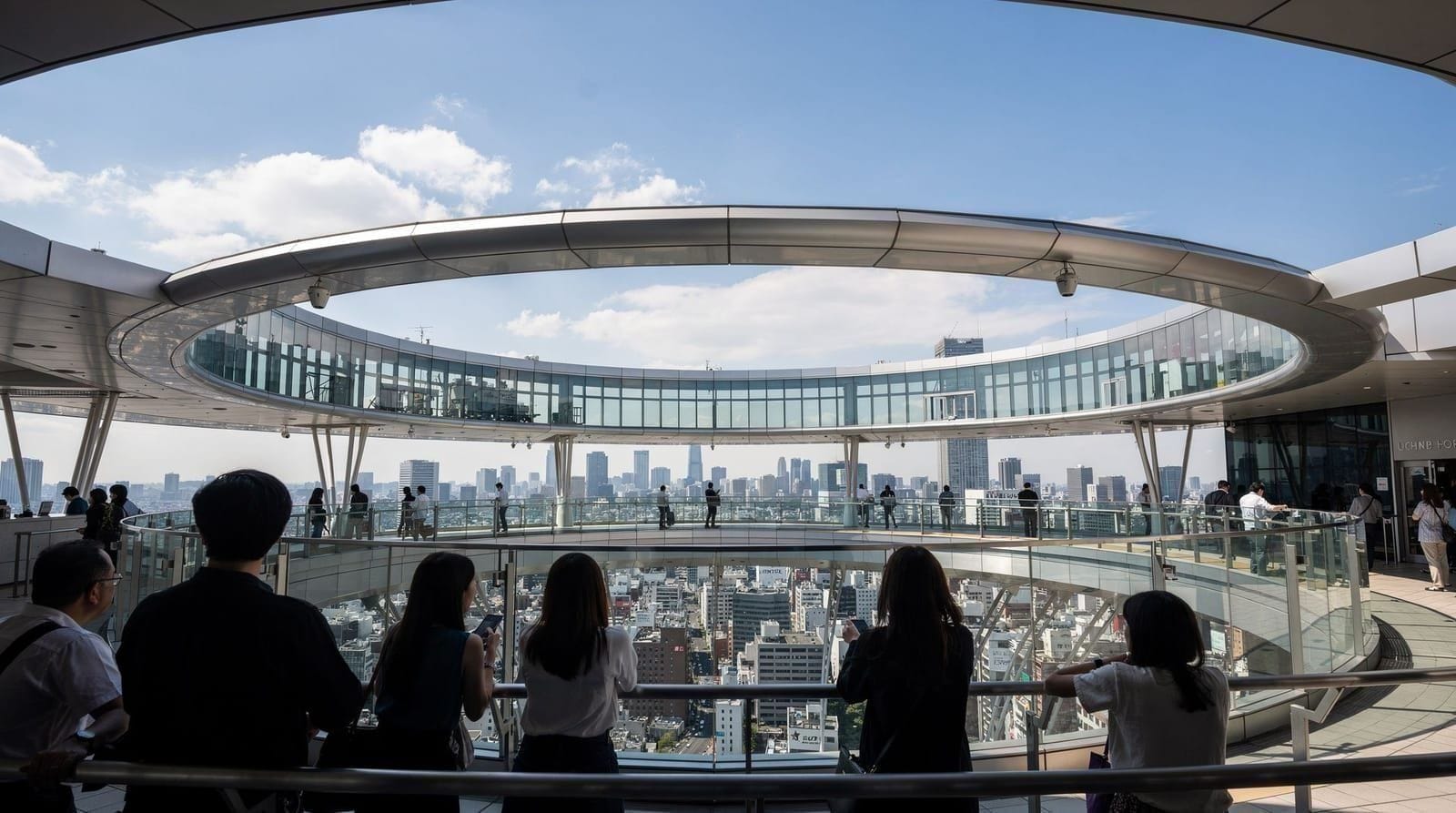
The Umeda Sky Building’s Floating Garden Observatory connects two 40-story towers via an open-air rooftop walkway 173 meters up, giving a 360-degree view over the city that’s genuinely one of the better skyline vantage points in Osaka — arguably better than Abeno Harukas for photography, since it includes the Yodo River and the more distant mountains ringing the Osaka basin. Sunset is the reliable time to go, since the building faces open sky in most directions and isn’t boxed in by taller neighbors. A Umeda Sky Building observatory ticket bought in advance avoids the queue at the base, which can run long on weekend evenings.
Shopping: Grand Front, Hankyu, and the underground malls
Grand Front Osaka, directly north of the station, is a large modern complex covering fashion, homeware, and dining across multiple towers, with a well-regarded food hall in the basement. The Hankyu department store, one of Japan’s oldest and most established retailers, anchors the older shopping core to the south, and the warren of underground malls (Whity Umeda, Diamor Osaka) connects most of this without needing to go outside — useful on a rainy day.
The HEP FIVE building’s red ferris wheel, visible from blocks away, is a minor landmark rather than a destination in itself, but a ride gives a decent elevated view over the shopping district for a modest ticket price; details on the HEP FIVE ferris wheel ticket.
Nakanoshima: the island district between rivers
South of Umeda, Nakanoshima is a narrow island formed between the Dojima and Tosabori Rivers, and it functions as Osaka’s cultural and civic core rather than its shopping one — the Osaka City Central Public Hall, a red-brick Renaissance-style building from 1918, anchors one end, and the Nakanoshima Museum of Art, a newer addition with a strong contemporary and modern collection, sits nearby. It’s a 15-20 minute walk from Osaka Station or a short subway ride, and a reasonable stop for visitors who want a break from retail density — riverside paths here are considerably quieter than the station complex itself, especially at lunchtime when office workers from Nakanoshima’s business towers spill out into the small parks along the water.
Depachika: the department store basements worth a detour
Both Hankyu and the Grand Front towers have depachika — basement food halls that are a genuine Japanese institution rather than an ordinary supermarket, packed with counters selling everything from wagashi (traditional sweets) and bento boxes to imported cheese and high-end fruit gift boxes. They’re worth browsing even without buying anything: many counters offer small tasting samples, and the presentation (individually wrapped, gift-boxed items priced accordingly) says as much about Japanese food culture as any restaurant meal. It’s also a practical stop for picking up a reasonably priced, high-quality bento for a train journey or a hotel-room dinner, typically ¥800-1,500 ($7-13) per box.
Nakazakicho: the retro pocket next door
A short walk northeast of Osaka Station, Nakazakicho is a small district of narrow lanes lined with vintage clothing shops, independent cafes, and converted old wooden houses — a deliberate contrast to Umeda’s glass towers, and one of the few parts of central Osaka that feels unhurried. It’s easy to miss on a map since it’s not signposted as a destination the way Dotonbori is, but it’s worth 30-45 minutes if you want a break from shopping-mall density.
Shin-Umeda Shokudogai: cheap eats under the tracks
Tucked beneath the elevated train tracks near Osaka Station, Shin-Umeda Shokudogai is a narrow, low-ceilinged alley of small eateries that predates most of the glass-tower development around it — a genuine contrast to Grand Front’s polish, serving inexpensive yakitori, okonomiyaki, and set lunches to office workers rather than tourists. It’s easy to walk past without noticing, since the entrances are unmarked from the main road, but it’s one of the more atmospheric, unpretentious places to eat in the area, with most dishes running ¥500-1,200 ($4-10).
Eating and drinking after dark
Umeda’s dining skews toward business-district standards: reliable ramen and izakaya chains catering to office workers, plus higher-end options in the Grand Front and Hankyu towers. It’s quieter and less performative than Dotonbori after 9pm, with fewer tourist-facing gimmicks and correspondingly steadier pricing. A guided night walk through Umeda’s food and pubs is useful if you want a local’s read on which of the countless near-identical izakaya doorways are actually worth entering — the area has very little English signage compared to Namba, so a guide or a translation app helps more here than elsewhere in the city.
Paying your way around Umeda
Osaka Station’s shopping towers and chain restaurants take contactless cards and IC card taps without issue, but the standing bars and small counters in Shin-Umeda Shokudogai skew more toward cash, in keeping with the rest of the city. An ICOCA card covers the subway and JR trains through the station complex and most vending machines and convenience stores inside it. Our ICOCA card guide covers where IC cards work and where cash is still expected.
Day-tripping from Umeda
Umeda’s proximity to Shin-Osaka — one JR stop, about 4 minutes — makes it a genuinely practical base for day trips beyond the city, since the shinkansen to Kyoto, Kobe, and Himeji departs from there rather than from Namba or Tennoji. If your Kansai plans stretch to multiple day trips in the same week, the JR Kansai Area Pass is worth comparing against individual fares before you commit to a base. For a change of pace within the city itself, Shinsekai and Tennoji sit at the opposite end of Osaka’s spectrum — retro, inexpensive, and considerably less polished than Umeda’s towers.
How Umeda became Osaka’s second center
For most of Osaka’s modern history, Namba and Minami held the city’s commercial center of gravity, with Umeda serving mainly as a rail junction. That balance shifted through the late 20th and early 21st centuries as JR West, Hankyu, and Hanshin all invested heavily in redeveloping their station buildings — the most visible recent step being the 2011-2013 Osaka Station City project, which rebuilt JR Osaka Station into a connected complex including the Lucua and Lucua 1100 shopping towers and a rooftop garden (Time’s Place) open to the public for free. The practical result for visitors is a station that keeps expanding outward and upward, with new retail and dining space opening in most years, and no clear final edge to the complex.
Getting here and connecting onward
Osaka Station connects directly to Shin-Osaka (one JR stop, about 4 minutes), the departure point for shinkansen to Kyoto, Kobe, Himeji, and beyond, which makes Umeda a practical base if day trips are a priority. It’s a 10-minute Midosuji subway ride to Namba for Dotonbori, and about 20 minutes to Tennoji for Shinsekai, making Umeda a reasonably central pivot point regardless of which part of the city you’re headed to next. Full city overview at our Osaka destination guide, and see where to stay in Osaka for a comparison against Namba and Tennoji as a base.
Tourist traps and honest warnings
Umeda has far fewer of the scams associated with Dotonbori — it’s a business district first, and street touts are rare. The main practical hazard is simply getting lost in the underground station complex, which can eat 15-20 minutes if you’re unfamiliar with it; following signage toward a specific exit number (rather than a landmark name) is the more reliable method. As with the rest of central Osaka, street crime is low.
Frequently asked questions about Umeda and Kita
Is Umeda worth visiting if I’m already going to Dotonbori?
Yes, for a different pace — Umeda offers shopping, a quieter dining scene, and one of Osaka’s best skyline views from the Sky Building, none of which Dotonbori really covers. Half a day is enough to see the highlights.
Umeda Sky Building or Abeno Harukas — which view is better?
Both are worthwhile; the Sky Building’s open rooftop walkway gives a more atmospheric, less enclosed view and includes the river and distant mountains, while Abeno Harukas, as Japan’s tallest building, gives more height and a wider single-direction panorama. If choosing one, the Sky Building is generally considered the more photogenic option, especially at sunset.
How do I avoid getting lost in Osaka Station?
Follow exit numbers on station signage rather than trying to navigate by landmark name — the underground complex links Hankyu, Hanshin, JR, and the subway through a maze of passages that don’t always match what a map app shows. Staff at station information points are used to helping visitors and generally speak enough English for directions.
Is Umeda a good base for a first trip to Osaka?
Yes, particularly if day trips to Kyoto, Kobe, or Himeji are a priority, since Shin-Osaka’s shinkansen station is one stop away. It’s quieter at night than Namba, which some visitors prefer and others find less lively.
What time should I visit the Umeda Sky Building?
Late afternoon into sunset gives the best light and views in most directions; arriving 30-45 minutes before sunset lets you see the city in daylight and again after dark without a second ticket.
Is Nakanoshima worth visiting alongside Umeda?
Yes, if you want a quieter, more cultural stop — it’s a 15-20 minute walk or short subway ride south of Osaka Station, with a historic public hall, an art museum, and riverside paths that contrast sharply with the station complex’s retail density.
Does Umeda have anything for a rainy day?
Yes — the underground mall network (Whity Umeda, Diamor Osaka) connects Osaka Station, Umeda Station, Grand Front, and the Hankyu and Hanshin department stores without needing to step outside, making Umeda one of the more rain-proof parts of central Osaka to spend a half-day in.
Where can I find cheap, non-touristy food in Umeda?
Shin-Umeda Shokudogai, a narrow alley of small eateries tucked beneath the elevated train tracks near Osaka Station, serves inexpensive yakitori, okonomiyaki, and set lunches to office workers rather than visitors, with most dishes running ¥500-1,200. The depachika food halls in Hankyu and Grand Front are also a reliable, if slightly pricier, source of good bento boxes and prepared food.
Is Umeda a good base for day trips to Kyoto, Kobe, or Himeji?
Yes — Shin-Osaka, one JR stop from Osaka Station, is the shinkansen departure point for all three, making Umeda one of the more practical bases in the city for a day-trip-heavy itinerary.
Can I pay by card everywhere in Umeda?
Mostly — chain restaurants, department stores, and convenience stores in and around Osaka Station take contactless cards and IC card taps, but smaller standing bars and counters, especially in Shin-Umeda Shokudogai, are more likely to be cash-only.
Top experiences
Bookable activities with verified prices and instant confirmation on GetYourGuide.