Osaka Castle walking route
Osaka: Osaka castle history walking tour tower
How long does the Osaka Castle walking route take?
The full loop covering the park's moats, the Higo-ishi stone, the museum tower, Nishinomaru Garden, and Toyokuni Shrine covers about 3-4km and takes 2.5-3 hours at a comfortable pace. Weekday mornings, outside cherry blossom season, are noticeably calmer than weekend afternoons.
Osaka Castle Park covers roughly 100 hectares, and most visitors walk it inefficiently — beelining straight to the keep and missing the stone walls, quieter garden areas, and smaller shrines that make the full loop worthwhile. This route lays out a specific order that covers the park’s highlights without backtracking, starting and ending near the two main train stations.
| Distance | 3-4km, mostly flat |
| Time needed | 2.5-3 hours including the museum tower |
| Cost | Grounds free; museum tower ~¥600 |
| Getting there | JR Osakajokoen Station |
| Best time | Weekday mornings, outside cherry blossom season |
Why walk the full loop instead of just visiting the keep
Most visitors to Osaka Castle default to the shortest possible path: arrive, walk straight to the keep, tour the museum, leave. That approach misses what many longtime visitors consider the more genuinely impressive part of the site — the scale of the stone fortifications and moats, which took a different kind of engineering effort than the keep’s museum interior and reward a slower, fuller walk around the grounds rather than a direct beeline. This route is built specifically to correct that default, sequencing the park so the stonework gets proper attention before the museum, rather than treating the walls as scenery to walk past on the way to the “real” attraction.
Starting point: Osakajokoen Station
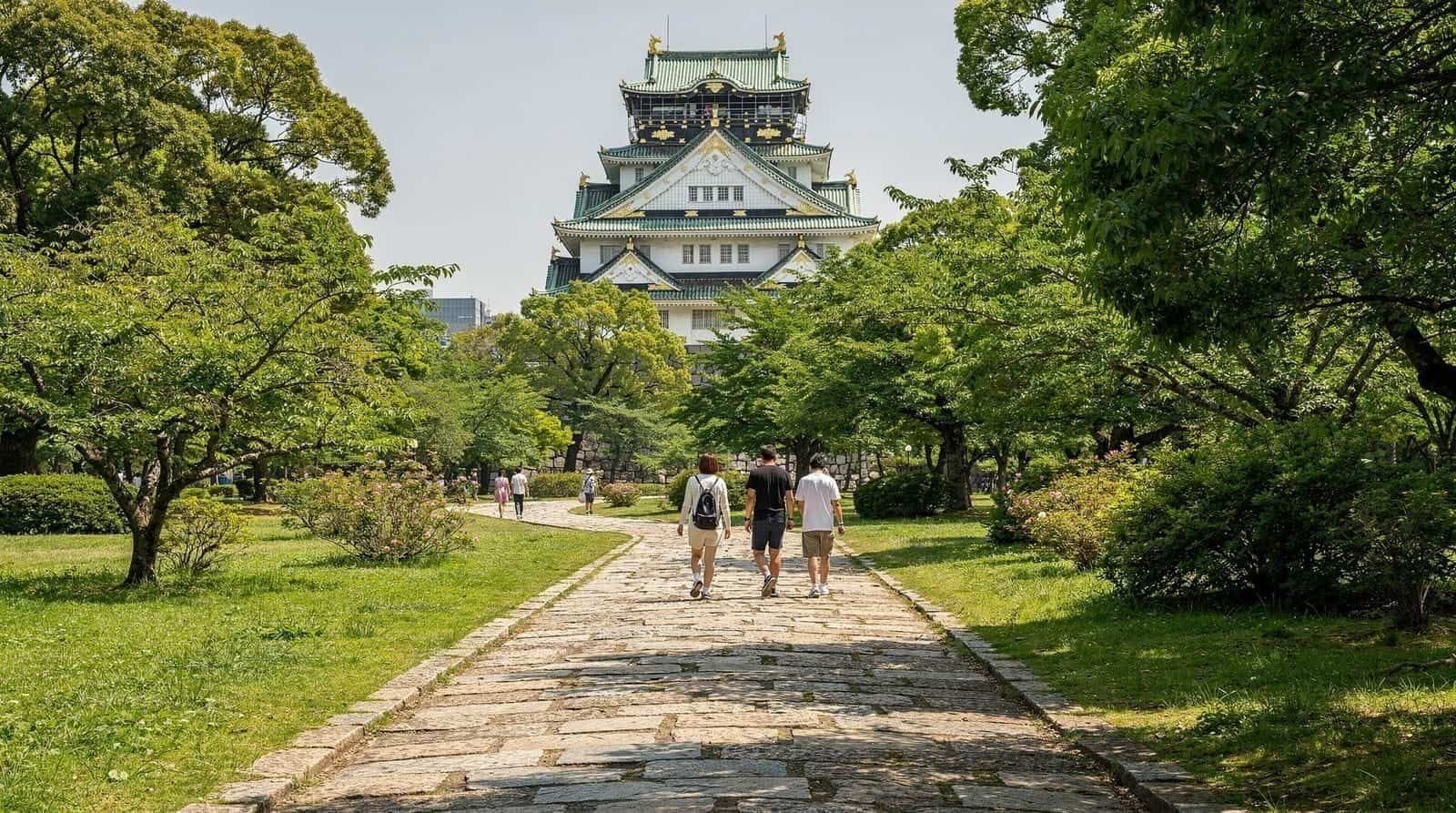
Begin at JR Osakajokoen Station on the Loop Line, which sits right at the park’s northeast edge — the most direct arrival point from either Umeda or Namba (10-15 minutes either way). From the station, the castle keep is visible across the outer moat, giving an immediate sense of scale before you’ve walked more than a few minutes.
What to bring for this walk
Comfortable, flat walking shoes are sufficient for this entire route — unlike the stepped terrain of Kyoto’s Higashiyama, covered in our Higashiyama walking route, nothing here requires specialized footwear. A hat and sunscreen are worth bringing given how exposed much of the moat-front walk is, with limited shade along the outer wall sections. A small amount of cash is useful for the museum tower entrance fee and any vending machine stops, though card payment is increasingly accepted at the ticket counter itself.
Leg one: the outer moat and the Higo-ishi stone (20 minutes)
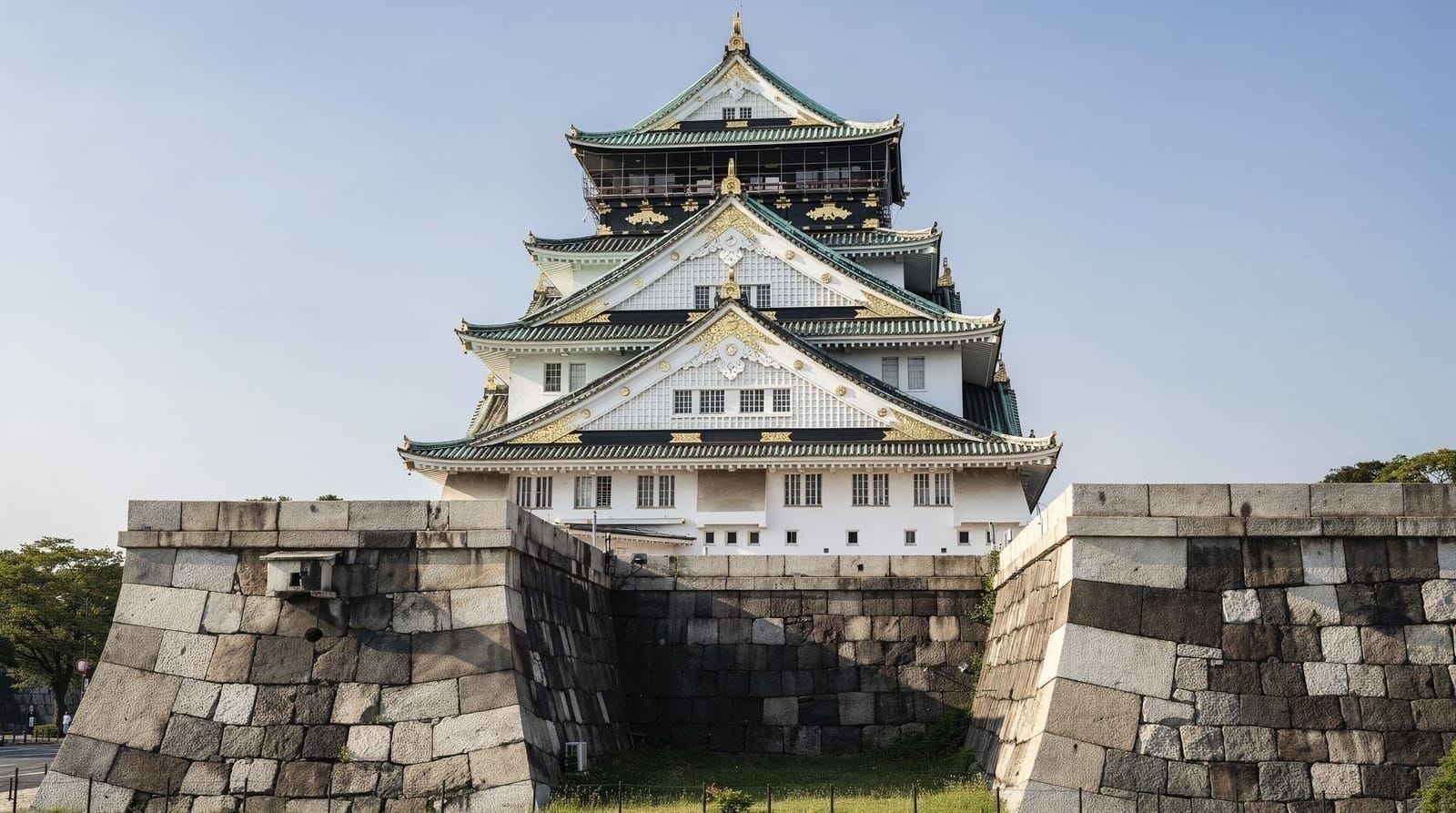
Walk along the outer moat’s edge toward the Otemon Gate, the park’s main historical entrance, passing some of the largest stone fortifications in Japan along the way. Just past the gate, look for Higo-ishi, the single largest stone in the castle’s walls, estimated at around 130 tons and quarried from islands in the Seto Inland Sea, transported here using period techniques — barges, log rollers, and enormous manual labor — that remain a subject of engineering fascination today. It’s easy to walk past without registering the scale, so this is worth a deliberate stop rather than a passing glance.
Leg two: crossing to the inner grounds (15 minutes)
Continue through Otemon Gate into the inner grounds, where the path narrows between higher stone walls before opening onto the approach to the keep itself. This stretch gives the clearest sense of the castle’s original defensive design — the narrowing and turning of the approach path was a deliberate feature meant to slow an attacking force, not an accident of terrain.
Leg three: the museum tower (60-90 minutes)
The keep standing today is a 1931 concrete reconstruction, rebuilt again after WWII damage and renovated in 1997 with modern museum fittings — worth knowing before entering, since visitors expecting an intact centuries-old structure are sometimes disappointed, while visitors expecting a well-run museum in a dramatic setting generally aren’t. The museum floors cover Osaka’s feudal history, Toyotomi Hideyoshi’s rise, and the castle’s construction and destruction, with English signage throughout and an observation floor at the top offering a wide view over the park.
Osaka Castle museum tower ticket booked ahead saves time at the entrance during peak cherry blossom season, when queues can stretch 20-30 minutes.
Leg four: Nishinomaru Garden (20-30 minutes, seasonal priority)
From the keep, backtrack slightly west to Nishinomaru Garden, a fenced lawn area with a small separate admission fee — the best cherry blossom viewing spot in the immediate park, with around 300 trees and the castle tower visible behind them during the last week of March into early April. Outside blossom season, it’s a quiet lawn with noticeably fewer visitors than the main approach, worth including in the loop regardless of season for the contrast with the busier eastern side of the park.
Leg five: Toyokuni Shrine (10 minutes)
A short walk from the keep, Toyokuni Shrine is dedicated to Toyotomi Hideyoshi himself, the castle’s original builder — a smaller, quieter stop than the main keep and easy to fold into the loop without a significant detour. Worth five minutes if the history of the Toyotomi clan’s rise and fall interests you, since the shrine’s dedication ties directly to the castle’s founding story covered in the museum tower.
Castle, temple, and shrine walking tour covers this fuller loop — the keep, Toyokuni Shrine, and nearby religious sites — with a guide explaining the connections between them, useful if the museum’s wall panels alone don’t give enough context on how the shrine, the keep, and the wider park fit together historically.
What the moats and walls looked like at their military peak
It’s worth pausing on the outer moat’s original defensive purpose before continuing to the keep, since the scale involved is easy to underestimate walking past quickly. At the castle’s height under Toyotomi Hideyoshi, the fortifications extended well beyond what survives in the park today, with an outer moat and wall system (largely filled in or built over during the Edo period and modern city development) that made the complex one of the largest fortified structures in the world at the time of its construction.
The stones visible today, including Higo-ishi, represent only the surviving core of a considerably larger defensive system, worth keeping in mind as a reminder that the current park, impressive as it is, shows a reduced footprint of the original castle’s true scale.
Optional extension: Osaka Museum of History
If time allows, exit the park toward Tanimachi 4-chome Station to reach the Osaka Museum of History, which covers the same feudal period in more depth and includes an excavated section of the ancient Naniwa Palace beneath the building — a reasonable add-on (30-45 minutes) if the castle museum leaves you wanting more context, though it adds a meaningful detour to the route and is better treated as a separate stop on a different day if time is tight.
Total distance and realistic timing
The full loop — outer moat, Higo-ishi, inner grounds, museum tower, Nishinomaru Garden, and Toyokuni Shrine — covers roughly 3-4km of mostly flat, well-paved walking, making this one of the more accessible historical walking routes covered on this site, workable with a stroller or for visitors with mobility concerns who’d struggle with Higashiyama’s stepped slopes. Budget 2.5-3 hours at a comfortable pace, including the museum tower visit; skipping the museum interior and focusing purely on the grounds and stone walls can be done in under an hour.
A slower alternative pace for photographers and history buffs
For visitors specifically interested in photography or the site’s military history, rather than treating this as a single efficient loop, extending the pace to a half-day rather than 2.5-3 hours allows time to properly examine the stonework’s construction techniques, read the museum’s exhibits in full rather than skimming, and wait for favorable light at the best photo points along the moat. This slower version works particularly well paired with an early arrival, since the extra time is most rewarding before the park fills with midday crowds.
When to walk this route
Weekday mornings, outside cherry blossom season, are genuinely calm — the park’s wide paths handle crowds better than Dotonbori or Higashiyama’s narrow slopes, but the museum tower queue and Nishinomaru Garden still get crowded on weekends and throughout the last week of March into early April. Osakajo Hall, a large arena within the park, occasionally hosts concerts and events that affect crowd levels and train congestion around Osakajokoen Station on event nights — worth checking before planning an evening visit if a quiet experience matters.
A broader route combining the castle with other Osaka highlights
For visitors who want to see more of central Osaka in a single day beyond just the castle park, Osaka five highlights walking tour with ramen lunch covers the castle alongside other central sights with a guided lunch stop built in, a reasonable option if the castle is one part of a fuller day rather than the sole focus. Ultimate walking tour covering the castle and Dotonbori links this route directly to an evening in Dotonbori, a sensible pairing given the two are roughly 15-20 minutes apart by train.
Traveling this route with kids
This route is genuinely one of the more family-friendly walks covered on this site, given its flat terrain and the sheer visual scale of the moats and stone walls, which tends to land well with children even without much interest in the historical detail. Nishinomaru Garden’s open lawn is a reasonable spot to let kids run during a rest break, and the museum tower’s observation floor gives an easy, elevator-accessible payoff view without requiring a long climb. Budgeting extra time for kids to simply look at the water and the stones, rather than moving through at an adult sightseeing pace, makes for a noticeably smoother family visit.
Getting from the castle to Dotonbori or Shinsekai
From Osakajokoen Station, it’s a short ride back toward central Osaka for Dotonbori, or a slightly longer connection to Shinsekai and Tennoji. Full city context is in our Osaka destination guide, and the Osaka Castle guide covers ticket options, seasonal illumination events, and crowd patterns in more depth than this route-focused page.
Combining the castle route with a Dotonbori evening
A workable full day: walk the full castle loop in the morning while the park is calmest, then take the short train ride into Dotonbori for the afternoon and evening, timing arrival for after 5pm when the neon signage lights up. This sequencing takes advantage of the castle park’s morning calm and Dotonbori’s evening atmosphere, rather than visiting either at its least favorable time of day.
Comparing this walk to Himeji Castle’s grounds
Visitors who plan to also see Himeji Castle, Japan’s best-preserved original castle keep, sometimes wonder how the two walking experiences compare. Himeji’s grounds are more compact but considerably steeper, with the approach to the keep itself involving a genuine uphill climb through the castle’s original defensive maze of gates and walls — an intact defensive design rather than Osaka’s more open, park-like modern layout.
Osaka Castle’s walking route, by contrast, is flatter and more leisurely, trading some of Himeji’s authentic defensive atmosphere for easier accessibility and a more relaxed pace. Neither replaces the other; they show genuinely different sides of Japanese castle architecture and are worth visiting as a complementary pair rather than a substitute for one another.
Practical notes
Coin lockers are available near Osakajokoen Station and inside the museum tower building, useful if you’re carrying luggage before checking into accommodation. The park has reasonably good public toilet coverage along the main paths, concentrated near the keep and the station. Vending machines are common throughout, a practical consideration given Kansai’s summer heat (28-35°C, June-August) if walking the full 3-4km loop at that time of year.
Why this route works well as a first-morning orientation
Beyond the castle itself, this route functions as a genuinely useful orientation to how Osaka’s public spaces and transit connect, given how central the park sits relative to the rest of the city. Walking the full loop gives a sense of scale for Osaka’s flatter, more grid-like layout compared to Kyoto’s hillside districts, and the direct Loop Line connection to Osakajokoen Station means this route can bookend a day that also includes stops elsewhere on the same train line without backtracking. For visitors on their first morning in the city, this route is a reasonable way to get oriented before diving into denser, more crowded districts like Dotonbori later the same day.
Photography spots along the route
The clearest photo of the keep with the moat in the foreground comes from the bridge crossing near Otemon Gate, particularly in the morning when the sky is less hazy. Nishinomaru Garden, during cherry blossom season, offers the classic shot of the tower framed by blossoming trees, best captured from the garden’s northern section looking south toward the keep. The observation floor at the top of the museum tower gives a wide panoramic view over the park and the city skyline, worth timing for a clear day if photography is a priority, since Osaka’s summer humidity haze can meaningfully reduce visibility from the tower on hot afternoons.
Water and rest points along the route
Vending machines are common throughout the park, particularly near the station, the museum tower entrance, and Nishinomaru Garden’s entrance gate, making this one of the easier routes on this site to manage hydration during Kansai’s hot summer months (June-August, 28-35°C). Benches and shaded rest areas are scattered along the main paths, though less common directly along the moat-front walk, worth factoring in in if walking the full loop with young children or anyone needing frequent rest stops.
Accessibility notes for this specific route
As mentioned earlier, this route is one of the more accessible on this site given its mostly flat, well-paved paths, making it workable for strollers and most wheelchair users along the outer moat, inner grounds, and Nishinomaru Garden sections. The museum tower itself has elevator access to most floors, though the very top observation level typically requires a final short flight of stairs — worth checking current accessibility information directly with the museum if this is a hard requirement, since it can change with renovations.
Building this route into a wider first day in Kansai
For visitors combining this walk with a broader look at the region’s castles, pairing it later in the trip with the Himeji Castle tickets guide gives a useful before-and-after contrast between Osaka’s reconstructed, museum-focused keep and Himeji’s original, UNESCO-listed structure. Visitors with only a half-day for the castle specifically can shorten this route by skipping the museum tower interior and focusing purely on the outer moat, Higo-ishi, and Nishinomaru Garden, still covering the route’s most photogenic and historically significant stops in under an hour.
Frequently asked questions about the Osaka Castle walking route
How long is the full Osaka Castle walking route?
Roughly 3-4km, taking 2.5-3 hours at a comfortable pace including the museum tower. A shorter version focused only on the grounds and stone walls can be done in under an hour.
Is the route accessible for strollers or wheelchairs?
Yes, more so than most historical routes on this site — the paths are mostly flat and well-paved, though the museum tower’s final approach to the observation level typically involves stairs.
What’s the best time to walk this route?
Weekday mornings, outside cherry blossom season (late March-early April), for the calmest experience. The museum tower queue and Nishinomaru Garden get busy on weekends and throughout peak bloom.
Do I need to buy tickets in advance?
Not strictly required outside peak season, but booking the museum tower ticket ahead saves time at the entrance during cherry blossom season, when queues can run 20-30 minutes.
Can I combine this route with Dotonbori in the same day?
Yes — the castle park and Dotonbori are roughly 15-20 minutes apart by train, making a morning-castle, evening-Dotonbori sequence a practical full day.
Top experiences
Bookable activities with verified prices and instant confirmation on GetYourGuide.