Namba nightlife guide
Osaka: Osaka bar hopping hidden bars Namba
Duration: 2 hours
What is Namba like for nightlife?
Namba is Osaka's densest nightlife hub, built around the Dotonbori canal's neon and food stalls, with a wider layer of standing bars, izakaya, and hidden small bars in the surrounding blocks. It's walkable, well connected by the last-train network, and covers everything from cheap standing bars (¥400-600 a beer) to hidden speakeasy-style venues that need local knowledge or a guide to find.
| Where | Around Namba Station — Dotonbori, Shinsaibashi, Sonezaki, Den Den Town |
| Cost | Around ¥400-600 for standing bar drinks; ¥3,000-8,000 for a seated evening |
| Time needed | A full evening, roughly 6pm-midnight |
| Getting there | Namba Station (Midosuji, Nankai, JR) |
| Best time | Weeknights for calmer bars; Friday/Saturday for full atmosphere |
Namba is the umbrella district that contains Dotonbori’s canal-front strip, the Shinsaibashi shopping arcades, and a much larger web of streets that most first-time visitors never explore beyond the main tourist path. Understanding Namba’s nightlife means understanding that it isn’t one scene — it’s several distinct ones layered close together, each with a different crowd, price point, and reason to visit.
Why “Namba” and “Dotonbori” get used interchangeably
Part of what makes Namba’s nightlife confusing to first-time visitors is that the district doesn’t have a single, obvious boundary the way a neighborhood with a clear historical center often does. Namba Station itself sits at the southern edge of what most visitors think of as “Dotonbori,” and the area’s various sub-districts — Dotonbori’s canal-front, Shinsaibashi’s shopping arcades, Sonezaki’s bar streets, Den Den Town’s electronics district — blend into each other without hard boundaries, which is why locals and guidebooks alike use “Namba” and “Dotonbori” somewhat interchangeably despite technically referring to different things.
For practical purposes, treating the whole area as one continuous nightlife zone, organized loosely around Namba Station, is the more useful mental model than trying to draw precise borders between sub-districts.
Dotonbori: the visible core
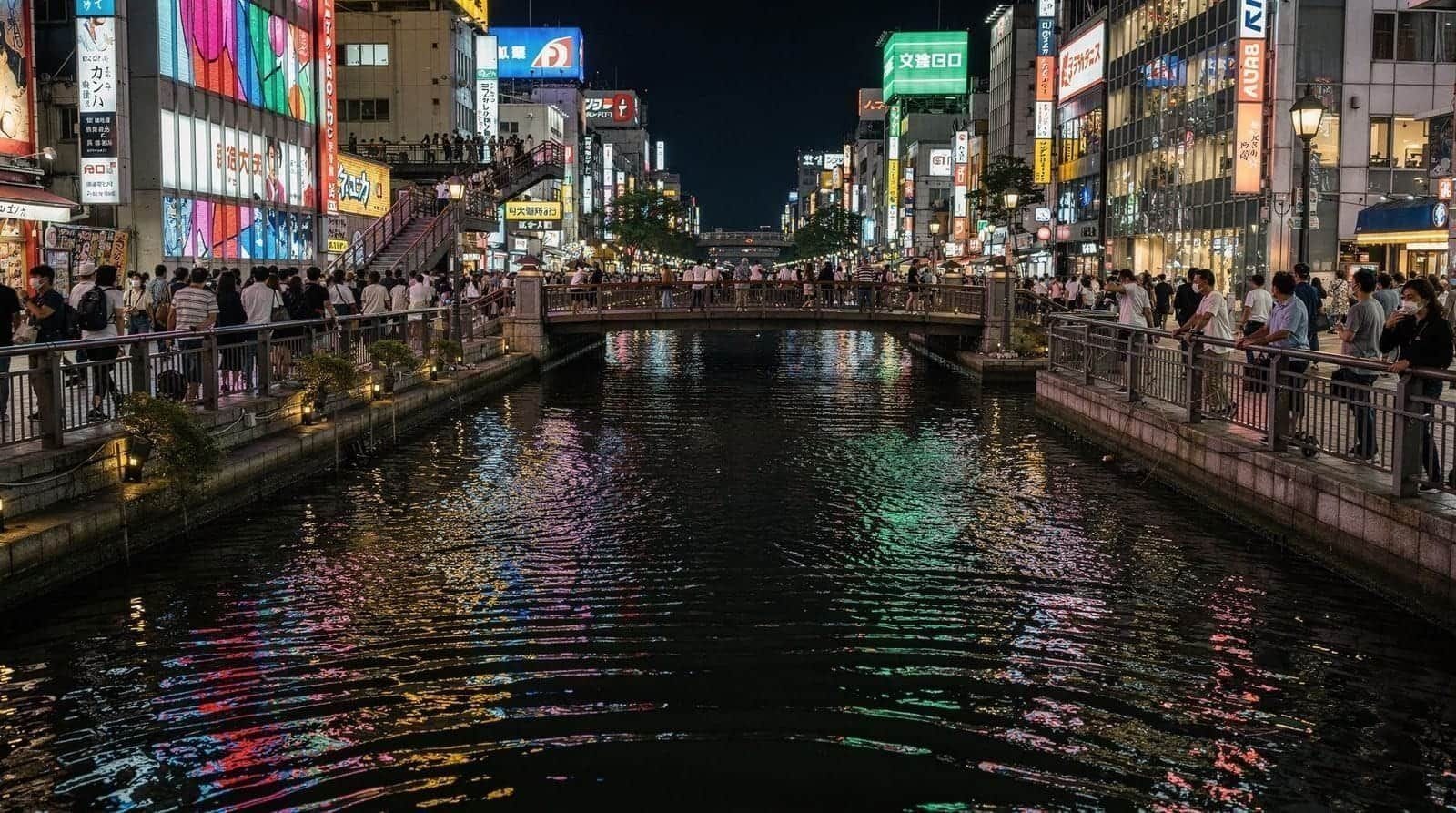
The canal-front strip under the Glico sign is Namba’s most visited stretch after dark, staying lively well past midnight on weekends with illuminated signage, street food stalls, and a steady flow of visitors. It’s worth an evening but not the whole night — the food and photo-op value here is real, but the drinking scene one or two blocks back tends to be both cheaper and more interesting. Our Dotonbori nightlife guide covers this specific stretch, including the tout-related scams worth knowing about before wandering the canal-front after dark.
Shinsaibashi and the streets just off the arcade
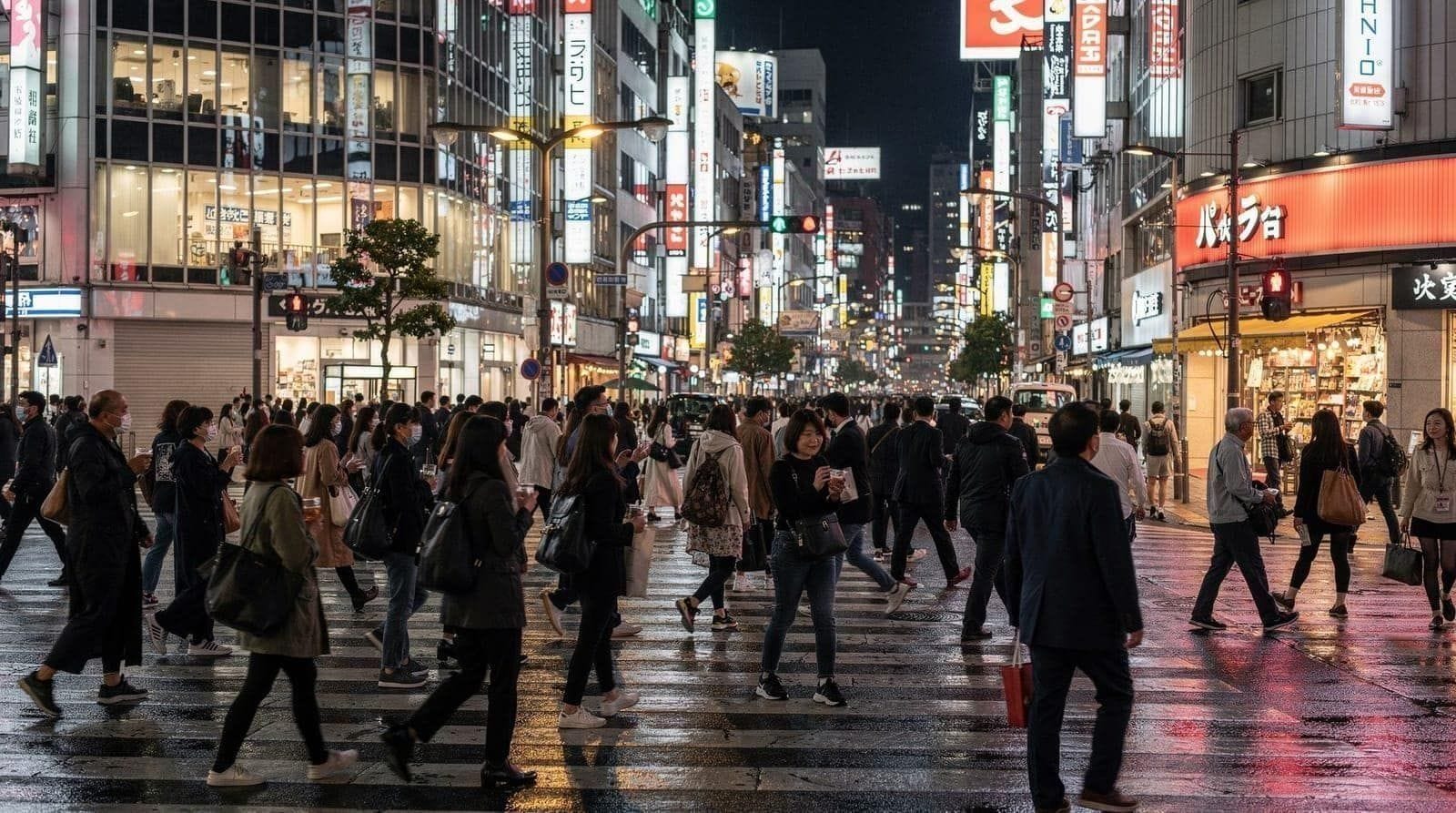
Shinsaibashi-suji, the roofed shopping arcade running north from Dotonbori, closes down commercially by evening but the streets branching off it — particularly toward Sonezaki further north — pick up a dense concentration of small bars and izakaya once the shops shutter. This is a genuinely mixed scene: casual standing bars alongside more polished cocktail bars, with less of the tourist-facing pricing that affects the canal-front directly.
Den Den Town after dark: quieter than you’d expect
South of Namba Station, around Nippombashi, Den Den Town — Osaka’s electronics, retro gaming, and anime and manga district, covered in more detail in our manga and anime in Osaka guide — has a considerably quieter nightlife scene than Dotonbori, since most of its specialty shops close by early evening. A handful of gaming bars and retro-arcade-themed bars have opened in the area in recent years, catering specifically to the same crowd interested in the district’s daytime offerings, worth a stop if that specific niche interests you rather than expecting a broad nightlife district.
Hidden bars: Namba’s defining nightlife feature
What separates Namba from most nightlife districts covered on this site is the sheer density of small, deliberately unmarked bars tucked into upper floors of nondescript buildings throughout the area — identifiable only by a buzzer, a small sign, or a name on a building directory, built for regulars and word-of-mouth rather than passing foot traffic.
Bar-hopping tour of hidden Namba bars is the most efficient way into this specific scene, since a guide with existing relationships at each venue removes the trial-and-error a solo visitor would otherwise face trying to identify which unmarked doors lead somewhere worthwhile.
Doyama-cho: Osaka’s LGBTQ nightlife district
Doyama-cho, technically part of neighboring Umeda rather than Namba proper, is close enough by train (10 minutes on the Midosuji Line) that it’s worth including for anyone planning a Namba-based night out — a compact area with a dense concentration of small bars, many extremely intimate in size, catering to a range of communities within the broader LGBTQ scene. Namba itself has a smaller scattering of welcoming bars in its own backstreets, generally clustered near the same hidden-bar concentration mentioned above.
Language and ordering across Namba’s venues
English signage and menus are more common in Namba than in most other Osaka nightlife districts, given the sheer volume of foreign visitors passing through, though this varies considerably by venue type — larger, chain izakaya and tourist-facing bars near the canal generally have English or picture menus, while Ura-Namba’s small independent spots and Namba’s hidden bars often don’t. A handful of simple phrases (nama biru, “draft beer”; osusume, “recommendation,” useful for asking staff what to order) go a long way in these less English-friendly venues, and pointing at another table’s order remains a reliable fallback anywhere in the district.
Seeing the canal after dark
For a lower-key, lower-cost evening option, a short 20-minute Dotonbori canal cruise after dark shows the illuminated signage from the water with a live commentary guide — a reasonable way to open or close an evening, and a good option if part of your group is less interested in bar-hopping than in simply seeing the lights.
Late-night eating: Namba doesn’t stop at dinner
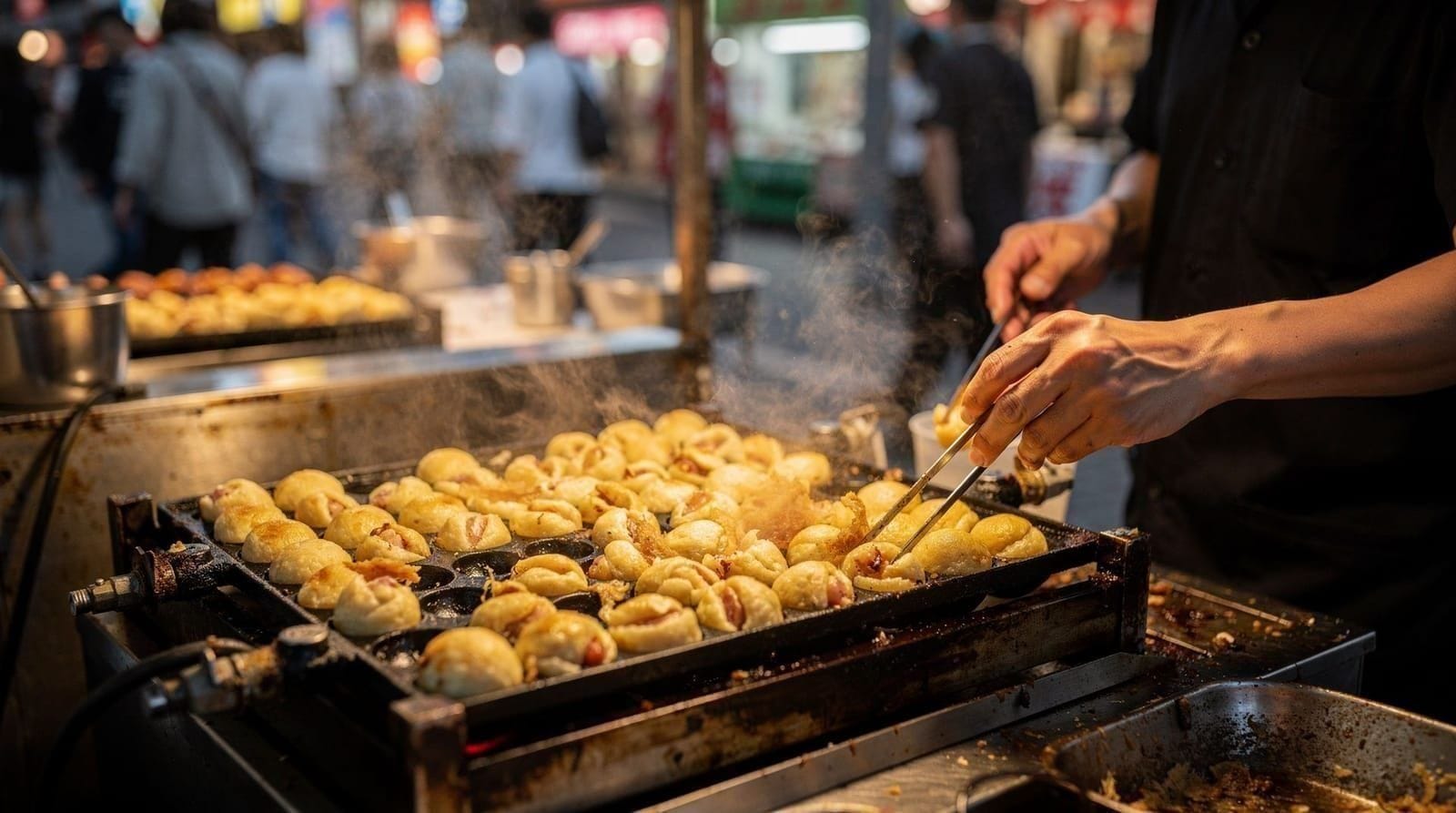
Beyond the daytime food stalls, several restaurants around Namba and Dotonbori stay open into the early morning hours specifically to catch the post-bar crowd, serving ramen, yakitori, and other late-night comfort food.
3-hour Osaka night food tour is built around this later evening window, covering Dotonbori and the surrounding blocks after dark with stops timed for when the food and the crowds are both at their peak.
Budgeting a multi-night Namba nightlife stretch
If Namba’s nightlife is a recurring part of a longer Osaka stay rather than a single evening, budgeting across several nights is worth planning deliberately rather than spending at the same rate every night. A reasonable pattern: one bigger night involving a guided bar-hopping tour or a proper seated izakaya dinner (¥5,000-8,000 per person), balanced against one or two lighter nights built around standing bars and casual snacking (¥2,000-3,000 per person), rather than treating every evening as a full bar-hopping circuit. This mirrors how many locals actually structure a week of going out — a mix of bigger and smaller nights — rather than a uniform spend every evening.
A rougher, cheaper contrast: Shinsekai
A short subway ride from Namba, Shinsekai offers a noticeably different, more worn-in nightlife character — cheap kushikatsu counters, standing bars, and a retro atmosphere under Tsutenkaku Tower.
Dark side night walking tour of Shinsekai leans into the neighborhood’s historically rougher reputation, a genuinely different angle from Namba’s more polished, visitor-oriented streets — worth a second night out if that contrast interests you.
Accessibility considerations in Namba’s nightlife venues
Namba Station and the main streets around Dotonbori and Shinsaibashi are generally well equipped with elevators and step-free access, a contrast to some of Kansai’s older, less accessible historic districts. Individual bars and restaurants vary considerably, however — many of the smallest, most atmospheric hidden bars and standing bars occupy older buildings with narrow stairs and no elevator access, particularly upper-floor venues in the older blocks north of Dotonbori. If mobility is a specific concern, sticking to ground-floor izakaya and the larger, newer venues around Namba Parks and Shinsaibashi’s main arcade is the more reliably accessible approach than attempting the upper-floor hidden-bar scene.
Prices across Namba’s nightlife scene
Standing bars run ¥400-600 for a beer and ¥300-800 per small dish; a full seated izakaya evening runs ¥3,000-5,000 per person. Hidden bars and cocktail-focused venues run somewhat higher, typically ¥1,000-2,000 per drink given the more curated setting and often better-trained bartenders. Guided bar-hopping experiences bundle two to three stops and several drinks into a fixed price, generally comparable to or slightly above independent pricing, with the main value being access and routing rather than a discount.
Safety and the specific risks worth knowing
Namba is very low-risk by international standards for violent crime, and the primary concerns are practical rather than dangerous: touts (often fluent English speakers) steering visitors toward bars with undisclosed cover or table charges, and pickpocketing risk in the densest crowds on weekend nights, both covered in more detail in our Dotonbori nightlife guide. Declining street solicitation outright and keeping bags zipped and visible in the busiest stretches covers most of the practical risk.
Weather and seasonal considerations in Namba
Much of Namba’s nightlife infrastructure is well suited to Kansai’s variable weather — the Shinsaibashi and adjoining arcades are covered, providing a dry route between venues during the June-July rainy season, and Namba Parks’ and Takashimaya’s connected indoor spaces offer air-conditioned relief during the peak summer heat (28-35°C, July-August) if an evening starts before the worst of the heat has broken. Winter, while considerably milder in Osaka than in northern Japan, still makes the standing-bar format less appealing for lingering outdoors between stops, and a seated izakaya evening tends to be the more comfortable choice for a colder-weather night out in Namba.
Namba during Japanese holidays and festivals
Namba’s crowd density spikes noticeably during major Japanese holiday periods — Golden Week (late April into early May), Obon (mid-August), and the New Year period all bring a mix of domestic travelers and returning locals to the district’s shops and restaurants, and nightlife venues correspondingly get busier and, in some cases, adjust hours around specific holiday dates. Tenjin Matsuri, one of Osaka’s largest annual festivals held in late July, doesn’t take place in Namba directly but draws crowds that spill over into the district’s nightlife scene in the days surrounding the main event, worth factoring into planning if a trip overlaps with the festival’s dates.
Getting home from a Namba night out
Namba Station is one of Osaka’s best-connected transit hubs — Midosuji subway, Nankai Line (with a direct connection to Kansai Airport), and JR services all converge here, which is part of why the surrounding blocks stay busy at all hours. Last trains generally run until around midnight to 1am depending on the line, and taxis are readily available around Namba Station at any hour if you miss the last train, though at a considerably higher cost than the equivalent train fare.
Groups, solo travelers, and couples: matching the venue to the occasion
Namba’s range of venue types makes it easy to match a night out to a specific occasion or group size. Larger groups (six or more) generally do best at a seated izakaya booked ahead, or a guided bar-hopping tour where group logistics are handled by the guide rather than negotiating seating at multiple small venues independently. Couples looking for a quieter, more intimate evening are better served by one of the district’s hidden bars, seated with fewer strangers around than a standing bar or busy izakaya. Solo travelers, as covered above, are comfortably accommodated at nearly every venue type in the district, with counter-style standing bars being the single easiest format to walk into alone without any awkwardness.
How Namba compares to Umeda for a night out
Umeda, Osaka’s northern hub, has a more local, office-worker-driven nightlife scene concentrated in its underground malls and side streets, generally with less English signage and a less visitor-adjusted atmosphere than Namba. Our Osaka bars and izakaya guide covers both areas and the specific venue types — tachinomi, izakaya, whisky bars — in more depth than this district-focused guide.
Building a full evening in Namba
A workable sequence: dinner around Dotonbori or Shinsaibashi by 7pm, a stop at a standing bar or two working toward Sonezaki, then either a guided hidden-bar crawl or independent bar-hopping through the small streets north of the main arcade, closing with a late-night ramen stop before the last train. This mirrors the structure most of the guided tours above are built around, useful as a template even if you’re putting the evening together independently.
Amerikamura: youth culture next door
A few minutes’ walk northwest of Dotonbori, Amerikamura (“American Village”) is Osaka’s youth fashion and street-culture district, built up from the 1970s onward around imported American clothing and music — today it’s a dense grid of vintage clothing shops, streetwear boutiques, record stores, and a scattering of casual bars and small live-music venues that draw a younger, more subculture-oriented crowd than the main Dotonbori strip.
Triangle Park, the district’s small central plaza, is a common informal gathering spot in the evening, particularly among younger locals, and the surrounding blocks have a noticeably different, more countercultural energy than Namba’s food-and-neon core just a few minutes away. Worth a stop for visitors interested in Osaka’s youth and street-fashion scene specifically, distinct from the district’s more famous canal-front identity.
Namba’s shopping-to-nightlife transition
One practical thing worth understanding about Namba’s rhythm: the district functions as a major daytime shopping hub (Takashimaya department store, Namba Parks, and the Shinsaibashi arcades) that transitions fairly seamlessly into its nightlife identity as shops close in the early evening and restaurants and bars take over the same streets. This means arriving in Namba in the late afternoon and simply staying through the transition — shopping, then an early dinner, then bars — is a natural, low-effort way to structure a full day and evening without needing to relocate between districts.
What a first-timer should actually do on night one
For a first evening in Namba with no other plans yet made, a workable, low-research default: walk the Dotonbori canal-front around sunset for the classic photo and atmosphere, eat dinner at either a canal-front restaurant or a short walk into Ura-Namba for better value, then pick one additional activity based on energy level — a guided hidden-bar crawl for a structured, social evening, a solo standing-bar stop or two for something quieter, or karaoke if the group wants an activity rather than just drinking.
This sequence covers the district’s core identity without requiring extensive advance planning, and every element of it is covered in more depth elsewhere in this guide and in our Dotonbori nightlife guide.
Karaoke as a Namba nightlife staple
Karaoke boxes are a genuine, widely used part of Namba’s nightlife rather than a novelty tourist activity, with several multi-story chains clustered around Dotonbori and Shinsaibashi offering private rooms by the hour, typically ¥300-800 per person per hour depending on time of day and whether a drink package is included.
Late-night and early-morning rates are often noticeably cheaper than peak evening hours, and many venues offer all-you-can-drink packages that make a group session considerably better value than ordering drinks individually throughout the night. It’s a reasonable option for a group wanting an activity beyond straightforward drinking, or as a way to extend an evening past last-train hours until the trains start running again in the early morning.
Craft beer and a shifting drinking culture
Alongside Namba’s traditional standing bars and izakaya, a newer wave of craft beer bars and taprooms has opened across Shinsaibashi and the streets north of Dotonbori over the past decade, reflecting a broader craft beer movement that’s grown steadily across Japan’s major cities. These venues typically charge more per glass than a standard draft Asahi or Kirin (¥800-1,400 versus ¥400-600) but offer a considerably wider range of styles, including Japanese microbrewery output alongside imported options — worth seeking out specifically if craft beer, rather than the standard highball-and-lager rotation, is a specific interest during your trip.
Namba’s sub-scenes at a glance
| Sub-district | Vibe | Price level | Best for |
|---|---|---|---|
| Dotonbori canal-front | Neon, food stalls, crowds | Moderate to tourist-priced | Photos, first-timers, a quick look |
| Shinsaibashi/Sonezaki backstreets | Dense small bars and izakaya | Reasonable, local-friendly | Bar-hopping without tourist markup |
| Den Den Town | Quiet, niche gaming bars | Reasonable | Otaku-adjacent nightlife |
| Doyama-cho (Umeda) | Intimate LGBTQ bar scene | Moderate | LGBTQ nightlife |
| Amerikamura | Youth, streetwear, subculture | Reasonable | Younger, alternative crowd |
| Shinsekai (short subway ride) | Rough-edged, retro | Cheap | A grittier contrast to Namba |
Booking a guided night out versus going independently
None of Namba’s core nightlife requires a guide, and a first night walking Dotonbori and picking a standing bar or two works fine without any advance arrangement. Where a guide earns its cost is the hidden-bar scene specifically — unmarked doors, buzzer entry, and venues built for regulars are genuinely hard to access confidently as a first-time solo visitor, and a guide with existing relationships at each stop removes most of the guesswork. For a simpler evening built around dinner, a canal cruise, and a standing bar or two, going independently costs nothing extra and works perfectly well.
Frequently asked questions about Namba nightlife
What’s the difference between Namba and Dotonbori nightlife?
Dotonbori refers specifically to the canal-front strip with the illuminated signage and food stalls; Namba is the broader district around Namba Station that includes Dotonbori along with Shinsaibashi, Sonezaki’s bar concentration, and Den Den Town. Most visitors treat them as one continuous area.
Are Namba’s hidden bars safe to visit?
Yes, generally — they cater to regulars and are typically legitimate, small-scale bars rather than anything predatory. The touts operating separately near the canal-front, inviting people into undisclosed-charge venues, are the actual risk to watch for, not the hidden bars themselves.
What time should I start a night out in Namba?
Dinner around 6-7pm, moving into bars by 8-9pm, gives a full evening before the last-train cutoff around midnight to 1am. Weekday nights are noticeably calmer than Friday and Saturday.
Is there an LGBTQ nightlife area near Namba?
Doyama-cho in neighboring Umeda, about 10 minutes away on the Midosuji Line, is Osaka’s main LGBTQ nightlife district. Namba itself has a smaller scattering of welcoming bars in its own backstreets.
How do I get back to my hotel if I miss the last train?
Taxis are readily available around Namba Station at any hour, though considerably more expensive than the equivalent train fare, especially for longer distances outside central Osaka.
Do I need to book a guided bar-hopping tour in advance?
It’s worth booking ahead, especially on weekends, since a guide’s small-bar relationships mean limited group sizes and set schedules. For an independent evening at standing bars or the canal-front, no booking is needed at all.
Is Namba nightlife suitable for a solo traveler?
Yes — counter-style standing bars in particular are an easy, low-awkwardness format to walk into alone, and the district’s density means there’s rarely a need to travel far between options.
Top experiences
Bookable activities with verified prices and instant confirmation on GetYourGuide.