Nara Park
Nara Park guide — deer etiquette and safety, Todai-ji's Great Buddha Hall, and how the park connects to Kasuga Taisha, with prices and real advice.
Nara: Nara deer park UNESCO day trip hotel pickup
Quick facts
- Park entry
- Free, open 24 hours
- Deer crackers
- ¥200 (~$1.85)
- Deer population
- ~1,200, wild
- Todai-ji entry
- ¥800 (~$7.40)
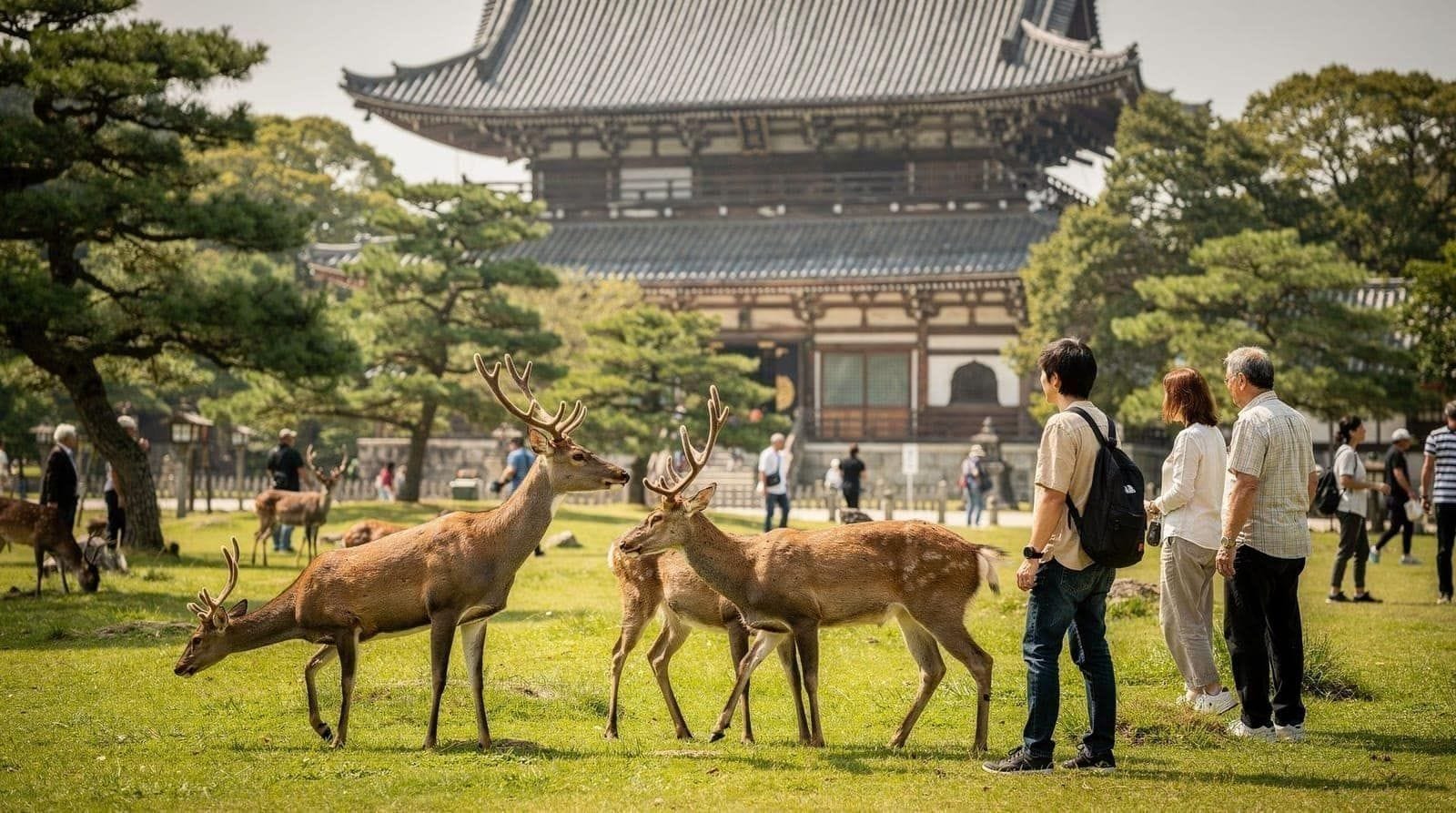
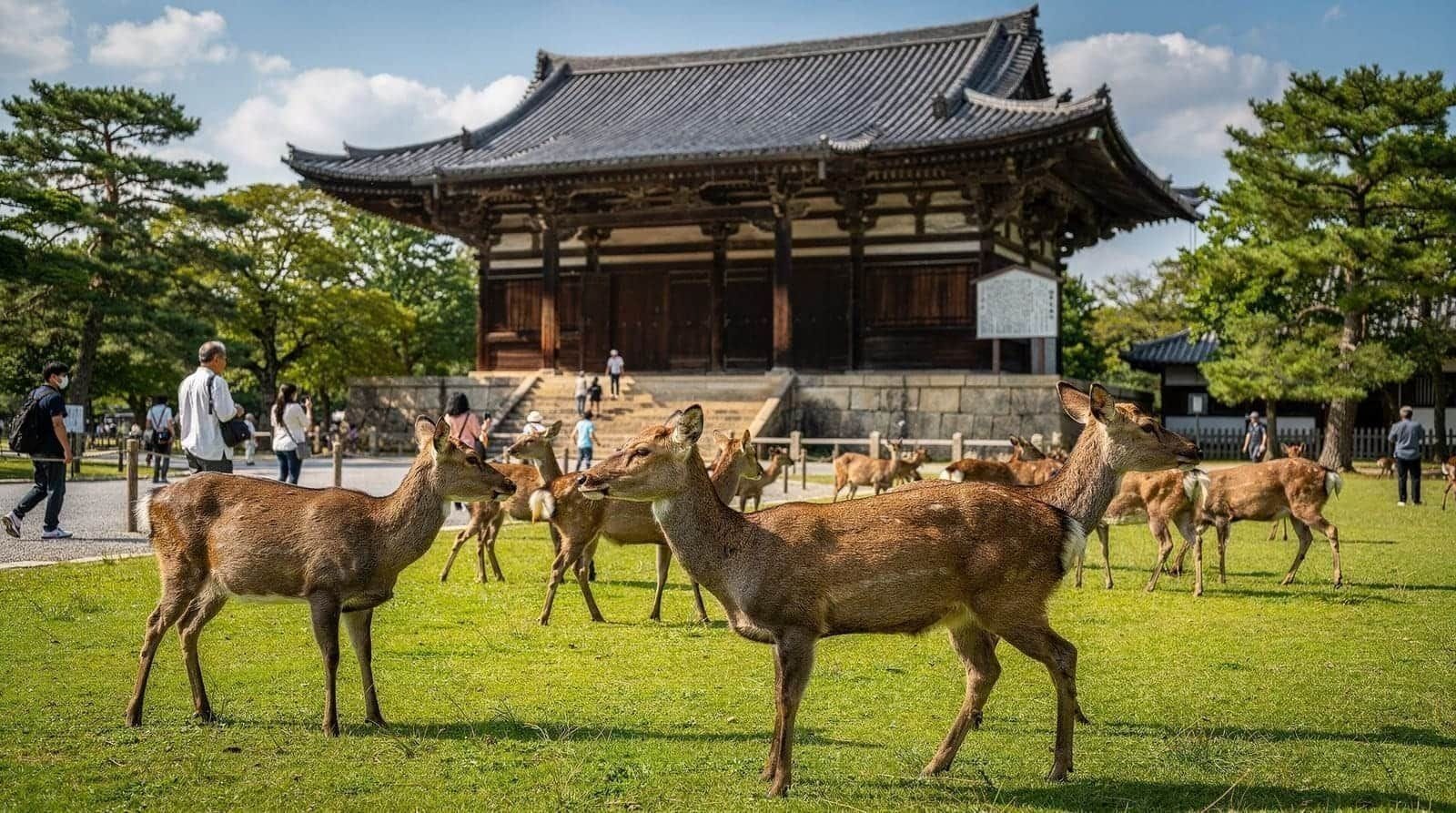
Nara Park is a 660-hectare open space that blends without fences or clear boundaries into the grounds of Todai-ji, Kasuga Taisha, and Kofuku-ji, and it’s the single most-visited part of Nara for one reason above the temples: roughly 1,200 wild sika deer roam freely across the lawns, paths, and temple approaches, protected since 1957 as a natural monument and, in local Shinto tradition, regarded as messengers of the gods. This page focuses specifically on the park and the deer themselves — for the temples that share the same grounds, see the main Nara destination page.
| Entry | Free, open 24 hours |
| Deer crackers | ¥200 (~$1.85) a stack |
| Deer population | ~1,200, wild |
| Getting there | 5 min walk from Kintetsu-Nara, or 15-20 min from JR Nara |
| Time needed | Half a day |
| Best time | Before 9am for calmer deer and light |
Getting to Nara Park
Nara Park sits a five-minute walk from Kintetsu-Nara Station (the faster arrival point from Osaka, via the Kintetsu Nara Line’s limited express from Namba, about 35 minutes) or a 15-20 minute walk (or short bus ride) from JR Nara Station, served by the JR Yamatoji Line’s rapid service from Osaka Station in about 45 minutes. There’s no admission gate or fee to enter the park itself — it’s an open public space that flows directly into the temple grounds around it.
The deer, in detail
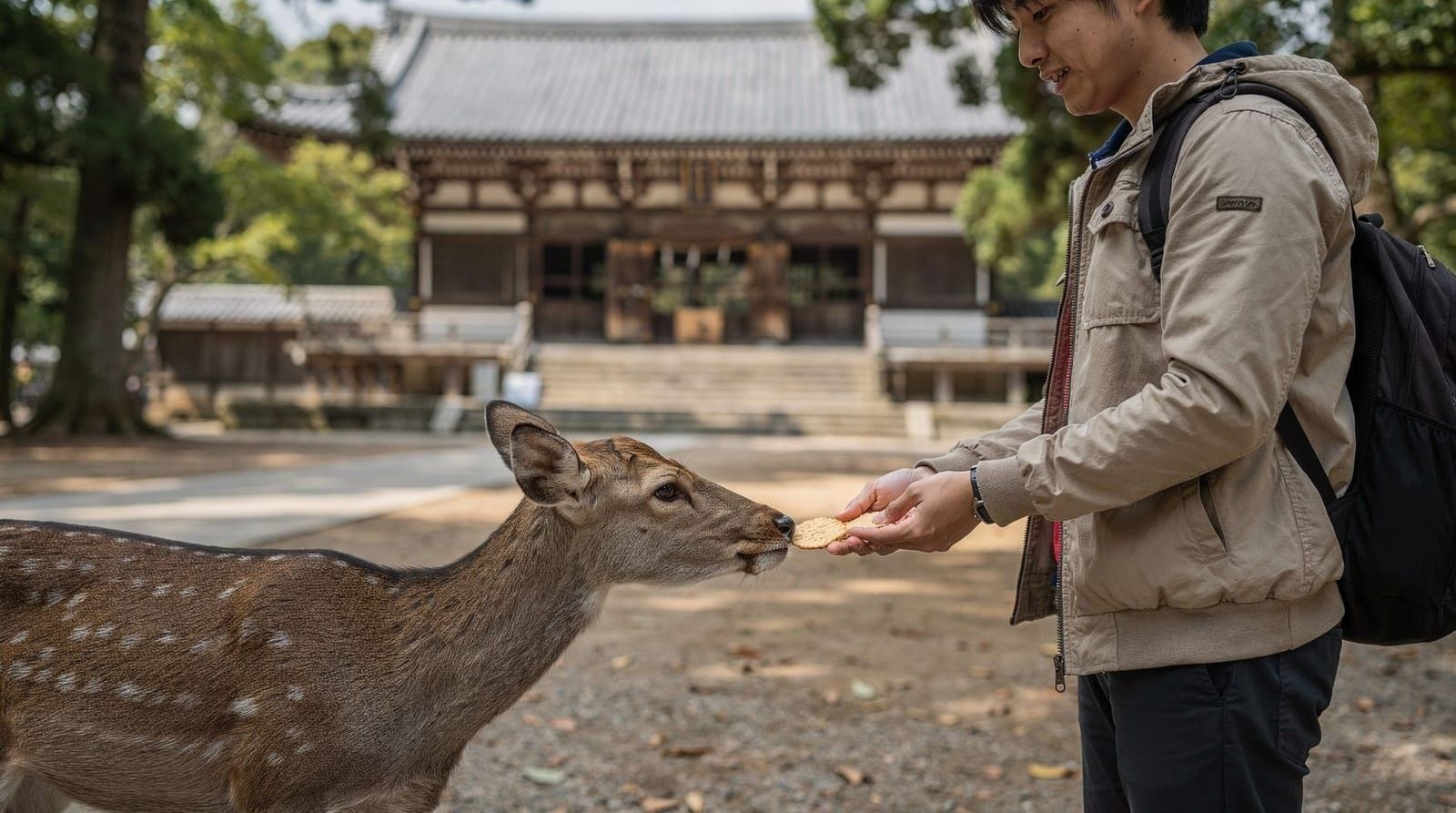
The deer that give the park its reputation are genuinely wild, not a managed captive population, though centuries of contact with pilgrims and tourists have made them comfortable approaching people, especially anyone visibly holding shika senbei (deer crackers), sold by vendors around the park for about ¥200 (~$1.85) a stack. Some deer have learned to bow their heads before receiving a cracker, a learned behavior rather than an innate one, and it’s become one of the park’s signature photo moments.
The honest safety notes, worth reading before arriving with small children or a bag full of food: these are wild animals with genuine strength in their necks and, for males for part of the year, antlers (most bucks are dehorned in a ceremony each October to reduce injury risk, but not all, and not year-round).
Deer will nip at clothing, butt gently or firmly, or crowd a visitor who’s holding out food without releasing it — the most common cause of minor injuries is a deer headbutting someone who teased it with a cracker rather than handing it over. Extra caution is worth taking around does with fawns in late spring (May-June), which are noticeably more defensive, and during the autumn rutting season (September-November), when bucks can be more aggressive generally.
Posted multilingual signs around the park flag specific individual deer known to be more assertive. None of this makes the park dangerous in any serious sense — millions of visitors feed and pet these deer every year without incident — but treating them as wild animals rather than tame pets is the right frame of mind.
Guided deer, temples, and hidden lanes walking tour is a practical way to get comfortable with deer etiquette on a first visit, with a guide on hand to explain behavior in real time rather than relying on a posted sign.
Why the deer are considered sacred
The deer’s protected status traces back to Kasuga Taisha’s founding myth: according to shrine tradition, the god Takemikazuchi arrived at the newly built shrine in 768 riding a white deer, and the animals have been regarded as divine messengers in the local Shinto tradition ever since.
For centuries during the feudal era, killing a deer in Nara was a capital offense, and while that legal protection no longer applies today, the deer retain their status as a Natural Monument under Japanese law, protected by a dedicated local foundation (the Nara Deer Preservation Foundation) that manages their health and population. This history is part of why the deer roam so freely through temple grounds without fencing — they’re treated as part of the sacred landscape rather than wildlife to be managed at a distance.
Sarusawa Pond and Ukimido
Near the Kintetsu-Nara Station entrance, Sarusawa Pond sits just south of Kofuku-ji’s five-story pagoda and offers one of Nara’s most reliable reflection photos — the pagoda mirrored in the still water, particularly striking at dawn before wind picks up on the surface. A small red pavilion, Ukimido, sits on stilts over the water nearby, illuminated at night and a pleasant, quiet counterpoint to the deer-and-crowds energy of the main park just a few minutes’ walk away. The pond has its own minor legend, tied to a court lady who is said to have drowned herself here in the 8th century after being spurned by an emperor — a somber footnote easy to miss walking past on the way into the park.
What else is in the park
Beyond the deer, the park’s grounds hold Todai-ji’s Great Buddha Hall (entry ¥800, ~$7.40), Kasuga Taisha’s lantern-lined approach and inner sanctuary (¥500, ~$4.65), and Kofuku-ji’s five-story pagoda and National Treasure Museum (¥700, ~$6.50) — all detailed on the main Nara destination page.
Nara National Museum, dedicated to Buddhist art, sits within the park as well and hosts an annual exhibition each autumn (typically late October to mid-November) of the Shoso-in Repository’s imperial treasures, a genuinely rare display of 8th-century objects normally kept in storage and rotated out year to year, so the specific pieces on show differ each autumn. Regular entry to the museum’s standing Buddhist sculpture collection runs around ¥700 (~$6.50), separate from the special autumn exhibition, which typically charges a higher combined fee given its limited-run nature and heavier demand.
Family visits
Nara Park is one of the more genuinely kid-friendly stops in the Kansai region — flat, open, free to wander, and centered on an activity (feeding deer) that engages children in a way most temple visits don’t. That said, supervision matters more here than at a typical playground: young children holding food are exactly the visitors deer approach most insistently, and a toddler unable to quickly release a cracker is more likely to end up startled by a nudging deer than an adult would be. Handing the cracker over immediately, rather than letting a child wave it around, avoids most of the minor incidents that happen here.
Nara Park private family bike tour with lunch is built around a family pace, covering the park by bike with a lunch stop included — a good option if walking the whole area feels like a lot with young kids in tow.
When the park is busiest
Nara Park draws heavy crowds from mid-morning through mid-afternoon, particularly on weekends, during cherry blossom season (late March-early April) and the Nara Deer Antler Cutting Ceremony (early October, a genuine spectacle where handlers ceremonially remove antlers from wild bucks in a centuries-old tradition, drawing large crowds specifically to watch it).
Arriving before 9am gets noticeably calmer deer encounters and quieter paths for photography, and the deer themselves are more active and visible in the cooler morning hours than during the heat of a summer afternoon, when many retreat to shade under the park’s trees. Weekday visits, particularly outside Japanese school holiday periods (spring break in late March, summer break through August, and around New Year), see noticeably fewer domestic school groups, which make up a large share of the park’s weekday crowds outside the main tourist season.
Nara deer park and UNESCO sites day trip with hotel pickup is a convenient option if you’d rather not manage the train connection from Osaka yourself, especially for an early-morning start. For a broader look at combining the park with Todai-ji and Kasuga Taisha in a single guided visit, Nara half-day private tour of four must-see spots covers the park alongside the main temples.
Photography in the park
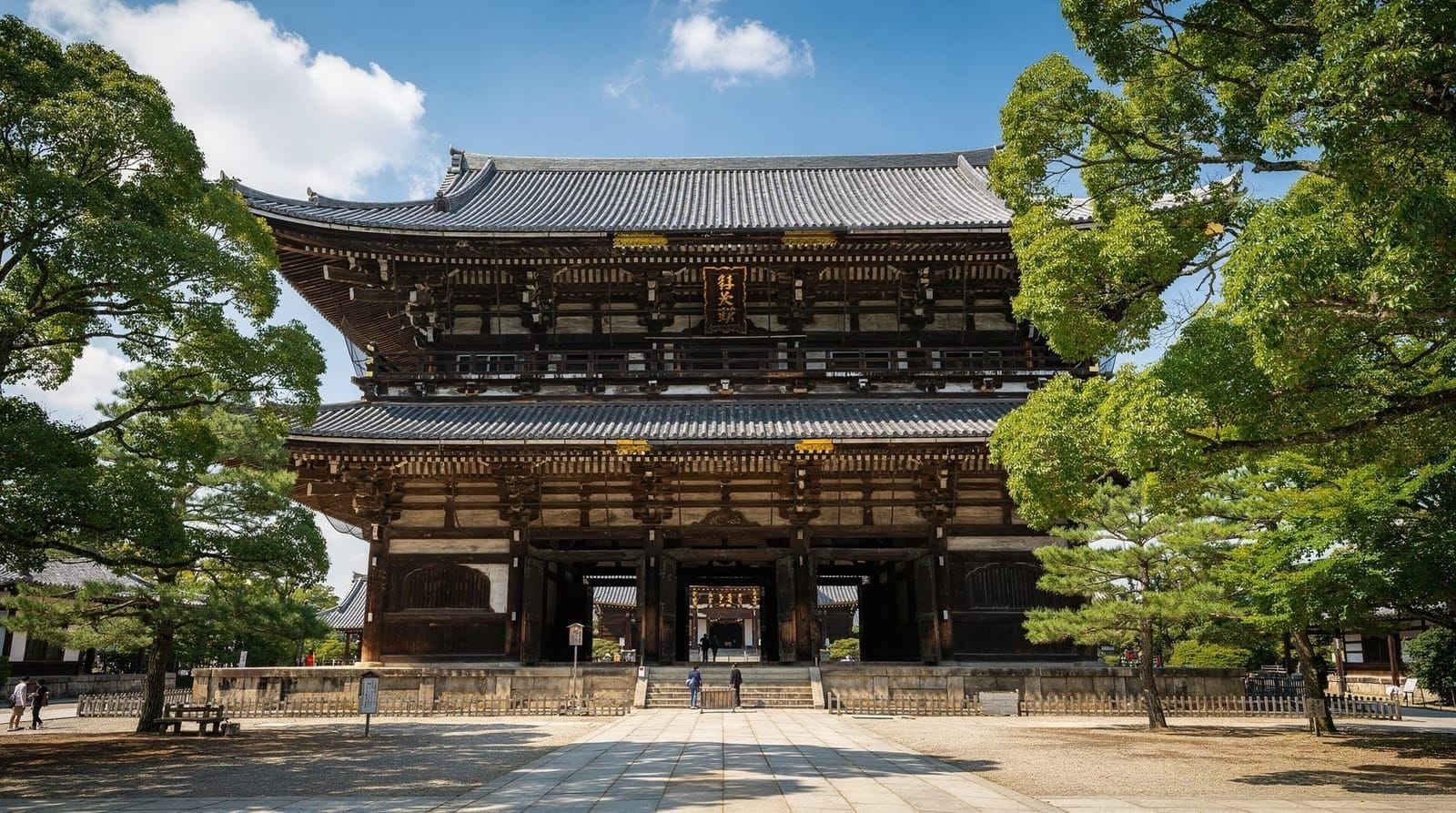
Early morning (before 9am) offers the best combination of soft light, calmer deer, and thinner crowds for photography, particularly around Sarusawa Pond and the approach to Todai-ji’s Nandaimon gate, both of which get busy with tour groups by mid-morning. A longer lens helps for candid deer shots without needing to approach closely with food, and shooting into the low morning or late afternoon sun through the park’s cedar and maple canopy is a reliable way to get the atmospheric, dappled-light shots that show up often in Nara photography. Autumn (November) adds red and gold foliage color against the deer and temple buildings, a combination that draws a specific subset of visitors purely for photography during that window.
Practical notes
Coin lockers are available at both Kintetsu-Nara and JR Nara stations, useful if you’re carrying luggage on a day trip. Benches and rest areas are scattered throughout the park, though shade is limited in the more open lawn sections — worth knowing in summer. Deer cracker vendors operate throughout the park and near both station approaches; buying from an official stand (rather than any unofficial seller) is the safer, more standard way to feed the deer.
Public restrooms are available near the Todai-ji approach, Kasuga Taisha, and the Nara National Museum, though they can be busy during peak hours — worth using one before setting off on the longer walk between Todai-ji and Kasuga Taisha rather than assuming another will appear along the wooded path.
A deeper look at deer etiquette
Beyond the basics of handing over a cracker quickly, a few less obvious points of etiquette help both visitor and animal: avoid running or sudden arm movements around deer, since the reflex to flee or defend is quicker than it looks in a calm-seeming animal; don’t feed deer anything besides the official shika senbei, since human food (including regular crackers, bread, or fruit) can cause digestive problems; and if a deer starts nudging insistently, showing empty hands calmly rather than turning your back and walking away tends to end the encounter faster.
Our companion Nara deer etiquette guide covers this in more depth, including specific situations that trip up first-time visitors, like a deer nosing into an open bag it’s smelled food in previously.
Kasuga Taisha’s connection to the park
Kasuga Taisha, a short walk east through the park’s wooded paths, is inseparable from the deer’s origin story — shrine tradition holds that the god Takemikazuchi arrived here in 768 riding a white deer, which is precisely why the animals have been protected and revered in this specific location for well over a millennium rather than simply tolerated as wildlife. The Kasuga Taisha guide covers the shrine’s 3,000 stone lanterns and its 20-year rebuilding tradition (shikinen sengu) in more depth, useful context for understanding why this particular shrine, rather than any other in Nara, is so tightly bound up with the park’s deer population.
Todai-ji, a few minutes from the deer
Todai-ji’s Great Buddha Hall sits at the park’s western edge, close enough to the busiest deer-feeding areas that most visitors naturally combine both in a single stop. The Todai-ji guide covers the hall’s history, ticket details, and the wooden pillar with the Buddha-nostril-sized hole in more depth than fits on this deer-focused page, and it’s worth reading before arriving if the temple itself, not just the deer, is part of the plan.
Building Nara Park into a family day
For families weighing how much of Nara to attempt in a single visit, Nara Park’s flat, free, engaging format tends to anchor the day, with the surrounding temples as add-ons rather than the other way around for younger children. The Nara deer park family guide, Kansai family attractions guide, and Osaka with kids guide all cover how a deer-centered morning or afternoon fits into a broader Kansai family itinerary, including realistic timing for young children who tire faster than the temple-hopping pace many adult itineraries assume.
Combining with Nishiki Market-style food stops
Nara’s own food scene doesn’t match Kyoto’s Nishiki Market in scale, but the same grazing approach — small stalls, quick bites, no sit-down commitment — works well in Naramachi just south of the park after a deer-and-temple morning. The Nishiki Market guide, written primarily for Kyoto, is a useful reference for the format if you’re building a food-stop mentality into a Nara day rather than a formal sit-down lunch.
Frequently asked questions about Nara Park
Is Nara Park free to enter?
Yes, the park itself has no entrance fee or gate — it’s an open public space. The temples within it (Todai-ji, Kasuga Taisha’s inner sanctuary, Kofuku-ji’s museum) charge separate admission.
Is it safe to feed the deer?
Generally yes, and it’s the park’s main draw, but the deer are wild animals — hand crackers over quickly rather than teasing them, and take extra care around does with fawns in late spring or during the autumn rutting season, when deer can be more defensive or assertive.
How many deer live in Nara Park?
Roughly 1,200 wild sika deer, protected as a natural monument since 1957 and regarded in local Shinto tradition as messengers of the gods.
What time of day is best to visit Nara Park?
Before 9am for calmer deer encounters, softer light for photography, and thinner crowds. The deer are also more active in cooler morning hours than during a hot summer afternoon, when many retreat to shade.
Is Nara Park good for young children?
Generally yes — it’s flat, open, and centered on an engaging activity, but supervision matters since young children holding food are the visitors deer approach most insistently. Handing crackers over quickly rather than letting kids wave them around avoids most minor incidents.
How do I get to Nara Park from Osaka?
The Kintetsu Nara Line’s limited express from Namba to Kintetsu-Nara Station takes about 35 minutes and lands a five-minute walk from the park. The JR Yamatoji Line’s rapid service from Osaka Station to JR Nara Station takes about 45 minutes, with a 15-20 minute walk or short bus ride to the park from there.
Top experiences
Bookable activities with verified prices and instant confirmation on GetYourGuide.